A waveguide is a structure that confines and directs electromagnetic waves along a specific path, typically using boundaries or refractive index differences. In photonics, waveguides are essential for routing light through chips, enabling on-chip optical communication, sensing, and computing. They are the optical equivalent of wires in electronic circuits, but instead of electrons, they guide photons.
History
The concept of waveguides dates back to the early 20th century, with theoretical work by Lord Rayleigh and practical developments in microwave technology during World War II. Optical waveguides became prominent in the 1970s with the advent of fiber optics.
How it works
Waveguides work by total internal reflection or by using photonic bandgaps to confine light within a core region. The geometry and material properties determine which wavelengths can propagate and how they bend. In integrated photonics, waveguides are fabricated as tiny ridges or channels on a silicon or diamond substrate, guiding light with minimal loss over millimeter-scale distances.
An ordinary flashlight shines in all directions, and after just a couple of dozen meters its beam fades so much it barely lights a wall. The atmosphere scatters light, and wind and heat currents distort it even more. But if you lay an invisible pipe for light right in the air, the beam will travel through it like water through a hose.
The orchestra plays, but the conductor hears only a general hum. Each instrument plays its own part, but you can't tell where the flute is and where the double bass is. You need a spectrum analyzer — a device that breaks down sound by frequency.
At the heart of the system is a rail with clip-on antennas moving along it, each emitting a radio signal. The smartphone receives these and, knowing the speed of light, calculates the distance to each antenna from the time delay.
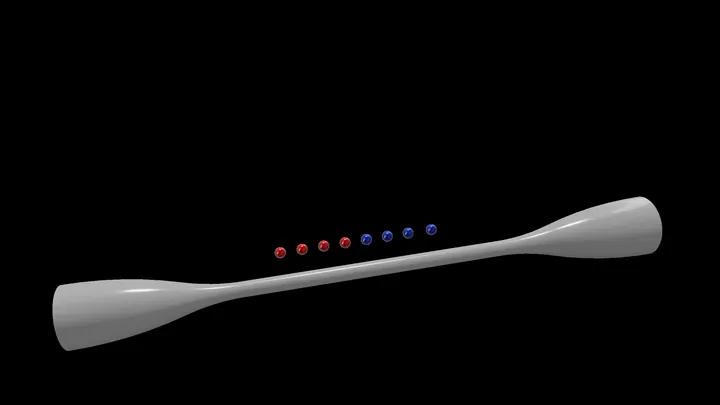
An orchestra without a conductor, where musicians hear each other through a shared wall. That's roughly how the new type of laser works: a few atoms (emitters) sit along a waveguide — a thin track for light on a chip. Light from each atom runs along this track and affects its neighbors.
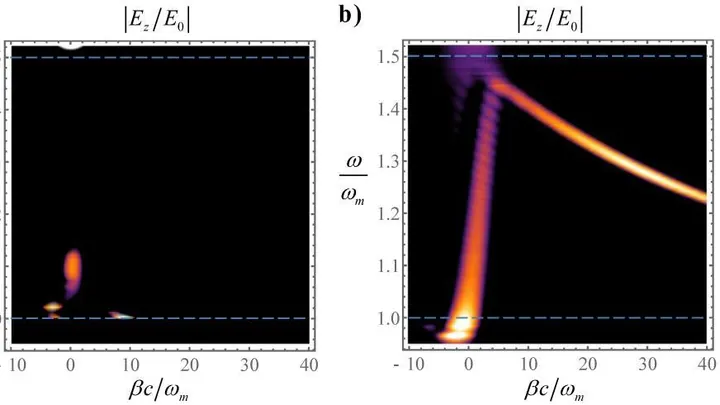
An ordinary microwave cavity resembles a music box: it responds only to strictly defined frequencies: its own notes. But what if you could make it sound different? Scientists changed the rules of the game by making the walls "one-way." Inside such a cavity, a wave can only run forward, never reflecting back.
Light is a stream of photons. In a special waveguide, resembling a narrow corridor, a 'gatekeeper' atom usually lets them through one at a time. This phenomenon is the domain of single-particle spectroscopy.
An ordinary envelope has a rectangular shape, and the letter inside does not change the envelope's properties. With photons, particles of light, the situation is different: their 'shape' in time can vary, and this shape itself carries information.
When light passes through a turbid medium, like a glass of milk or frosted glass, it scatters in all directions. But sometimes, instead of spreading out, it gets trapped in tiny 'pockets' inside the material. Physicists call these pockets localized modes: light falls into them as if into a trap and cannot escape.
A river flows in one direction, but a wave on its surface travels in the opposite direction. The same splitting happens in hyperbolic materials: the energy of a light wave and its fronts diverge, preventing a sharp lens from being created.
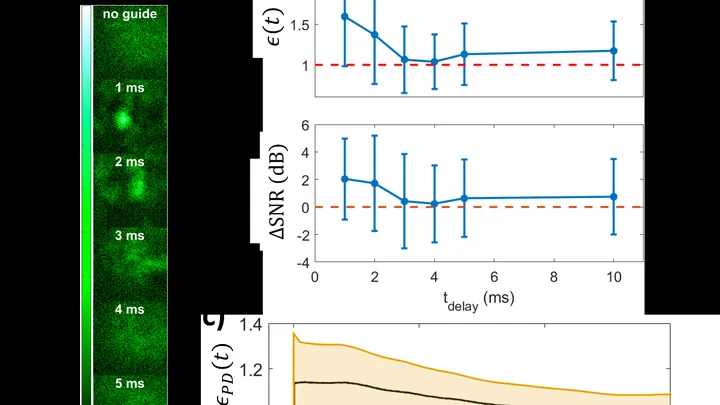
A green flashlight beam dives into a pool and reaches the bottom with barely any loss. Water is transparent to green light, which is why it's used for underwater communication. But to send video or sensor data, the light needs to be switched on and off very quickly — billions of times per second. Ordinary lasers are too slow and unstable for this.
The receiver doesn't catch radio waves but submillimeter light — the radiation emitted by cold clouds of gas and dust in distant galaxies. Inside, there's an array of tiny resonators, each tuned to its own frequency, like the strings of a grand piano tuned to notes.
A swarm of fireflies in a night forest flashes randomly: each beetle blinks on its own, and the light scatters equally in all directions. Now imagine the fireflies agreeing to blink so that their combined light goes only north — even though they stay put and none of them turns. That's roughly what physicists did with atoms inside a thin glass tube.
Light passing through a thin crystal can change color and the direction of its oscillations. In a molybdenum disulfide flake just hundreds of atoms thick, an infrared beam turns green, and its polarization, the way the light wave oscillates, obeys the crystal's geometry.
Hydrogen is the lightest fuel, and its conversion into electricity on a metal surface resembles a game of ping-pong: hydrogen atoms alternately attach to and detach from the electrode. But the score in this game depends on solution acidity in ways that were unexpected. Classical formulas predict a smooth change, while experiments show jumps and kinks.
A diamond speck smaller than a hundredth of a millimeter glows red. Inside it is a crystal defect: two neighboring carbon atoms, where one is missing and a nitrogen atom sits nearby. Such a pair captures light and re-emits it, like a tiny beacon that doesn't fade at room temperature.
This speck was brought near a pathway on the chip's surface.
Sound in a thin plate behaves like ripples on water: it travels, reflects off edges, and changes shape. But sound has a peculiar trait: it can pass through places where waves are forbidden to exist. It's as if ripples on a pond suddenly vanished before a stone barrier and reappeared on the other side, without going around it.