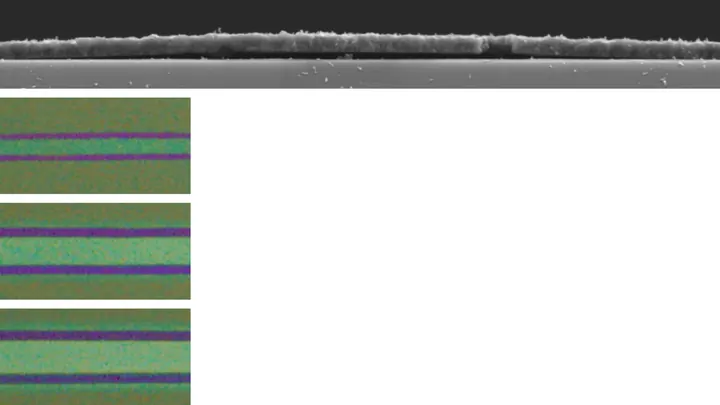
Etching is a process of selectively removing material from a surface to create patterns, clean the surface, or shape structures. It is a fundamental technique in microfabrication, used to create the intricate circuits and features on semiconductor chips, as well as in art and printing. In the context of the given titles, etching is likely used to pattern thin films or create precise structures in materials like aluminum nitride.
History
Etching has been used for centuries in art and decoration, but its application to electronics began in the 1950s with the development of photolithography and the need to pattern silicon wafers for transistors.
How it works
Etching can be done through wet chemical methods, where the material is dissolved in a liquid etchant, or dry methods like plasma etching, where reactive ions bombard the surface to remove material. The process is controlled by using a mask—a protective layer that resists the etchant—so that only exposed areas are removed. This allows for the creation of very fine patterns with high precision, down to nanometer scales in modern semiconductor manufacturing.
In practice
Etching is used in the production of integrated circuits, microfluidic devices, and optical components, as well as in creating surface textures for improved adhesion or light management.
Fun fact
The ancient technique of etching metal plates for printing, developed in the 15th century, uses the same fundamental principle of selective material removal as modern semiconductor fabrication.
You're looking for fireflies in a dark forest. Instead of photographing the whole forest every second and then poring over the images, you carry a small device that spots the flashes on its own and cuts out only a circle around each one. The rest, the blackness, isn't saved. That's exactly how the new sensor for scientific cameras works.
A superconducting quantum interferometer is a device that senses magnetic fields billions of times weaker than the needle of an ordinary compass. Inside it, there is a narrow bridge where superconductivity briefly breaks.
The heart sometimes loses its rhythm, like an orchestra where the violins suddenly start playing each on their own. Cardiologists in such cases look for the "out-of-tune" areas by reading the heart's electrical signals and precisely ablating them with a thin probe — a catheter.
Quantum bits (qubits) are like delicate music in a noisy factory. Ambient magnetic fields constantly 'drown out' their quantum state, turning a coherent signal into cacophony. Usually, this destructive process is slowed by retuning the qubits themselves to different frequencies, but that doesn't always work.
A bridge of aluminum just a few atoms thick is the heart of many quantum devices. Current flows through such a bridge without resistance, and it can be controlled with a magnetic field. These bridges are called Josephson junctions, after the British physicist who described their behavior.
Think of a stack of paper: when the sheets lie perfectly aligned, light passes through them uniformly. But turn one sheet by a few degrees, and the picture changes. Something similar happens with layers in certain materials: rotate them relative to each other, and their properties change — sometimes dramatically.
Spectroscopy isn't the key here, or rather, it's not the method used.
An ordinary sheet of paper looks white because it scatters all light rays chaotically. But a butterfly's wing shimmers blue and green without a drop of paint: its surface is covered with microscopic grooves that dampen some light waves and amplify others. Engineers have long dreamed of replicating this trick: creating a material that colors itself simply by trapping light in the right places.
Diamond is the hardest natural material, and working with it usually feels like a sculptor using a jackhammer: rough, with cracks and chips. But electronics demands jeweler-like precision, because diamond conducts heat superbly, withstands high temperatures, and can work in quantum devices.
A laser beam strikes a gold-and-silver film for just a few nanoseconds — in that time, light travels less than a meter. At the point of impact, the metal boils, splatters, and freezes into a random pattern of tiny particles. Each pattern is as unique as cracks in ice or tree branches.
A chef tastes the soup after every pinch of salt and instantly decides what to add next. That's roughly how the new setup for growing thin crystalline films works — except instead of taste, it uses an image from an electron microscope, and instead of a chef, a computer program.
A laser beam passes through glass and touches a thin diamond film. At the point of contact, the film turns into a narrow strip that lifts slightly. We place a second strip next to it, and between them remains an empty corridor. That's the channel: its width can be fifty times its height, like a sheet of paper lying on a table.
A printer that prints not with ink but with metal and ceramic is now a reality. Scientists took an ordinary drop of water containing dissolved metal salts and made it deposit copper, zinc oxide, or nickel hydroxide onto a surface — all with precision down to millionths of a meter.
The secret lies in electricity.
A steel plate with an 8×8 grid of cells dampens elastic waves in two frequency corridors at once. This is not a lucky accident but the outcome of a calculation using a new scheme: first a coarse template for the low frequency, then fine-tuning within free pixels for the high frequency.