Light enters strictly from above express
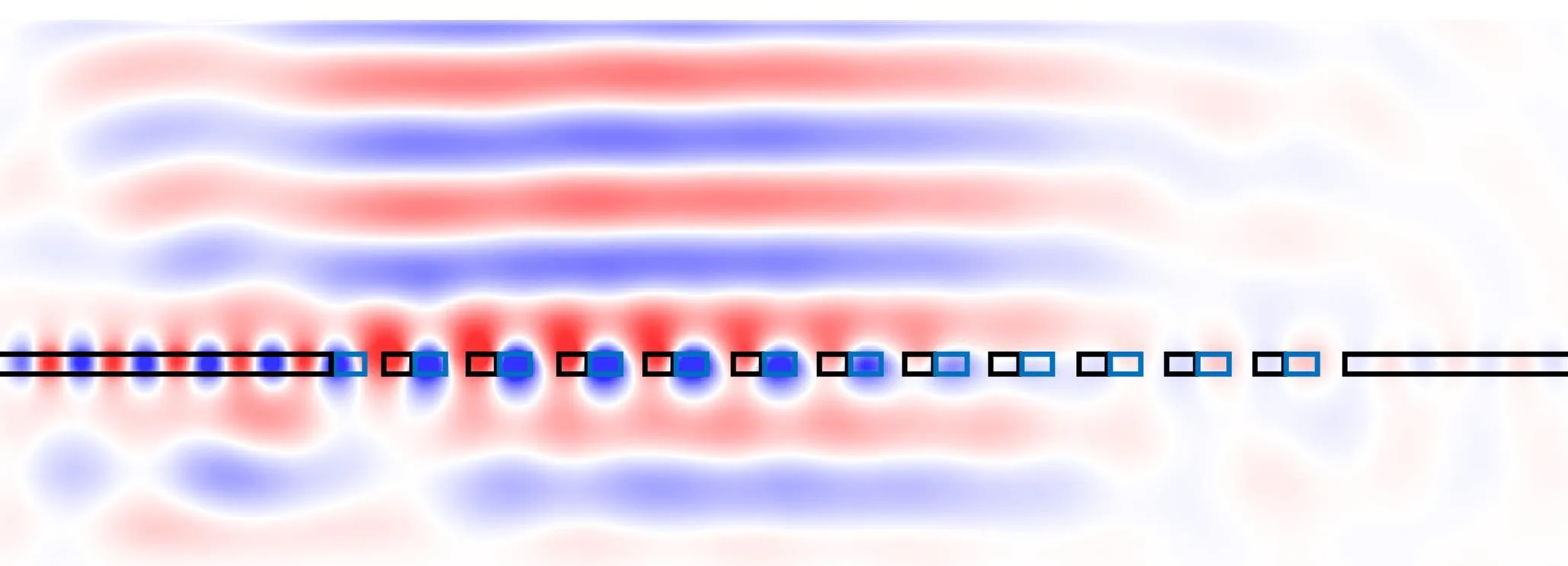
A laser beam hits the chip vertically, like an arrow striking a target. Ordinary gratings in this position lose half the light: it scatters in both directions, like a crowd rushing through open doors. The new design forces light to go only to the left, into the desired waveguide.
The secret is that the grating stripes are asymmetric — one wall of each stripe is slightly longer than the other. It's like blinds tilted at an angle: from outside they let your gaze through, but from inside they barely do. So does light: it enters freely from above but cannot escape backward or sideways.
Fabricating such a grating is simple: a silicon wafer is etched once, without additional layers. In simulation, the coupling efficiency from a standard optical fiber reached 41% at vertical incidence, and the difference between the desired and undesired directions exceeded 10 dB. The experiment confirmed: unidirectionality 12.8 dB, losses 8.35 dB at a wavelength of 1528 nm.
Such a grating is a ready-made building block for hybrid circuits where a laser sits directly above the chip. This will speed up the assembly of optical transmitters, lidars, and sensors. Light enters strictly from above, and stays in the chip.
The wavelength of 1550 nm is in the near-infrared range, invisible to the eye but ideal for optical fibers: in glass, light attenuates the least at this wavelength.