Tuning a Neural Network by Radio express
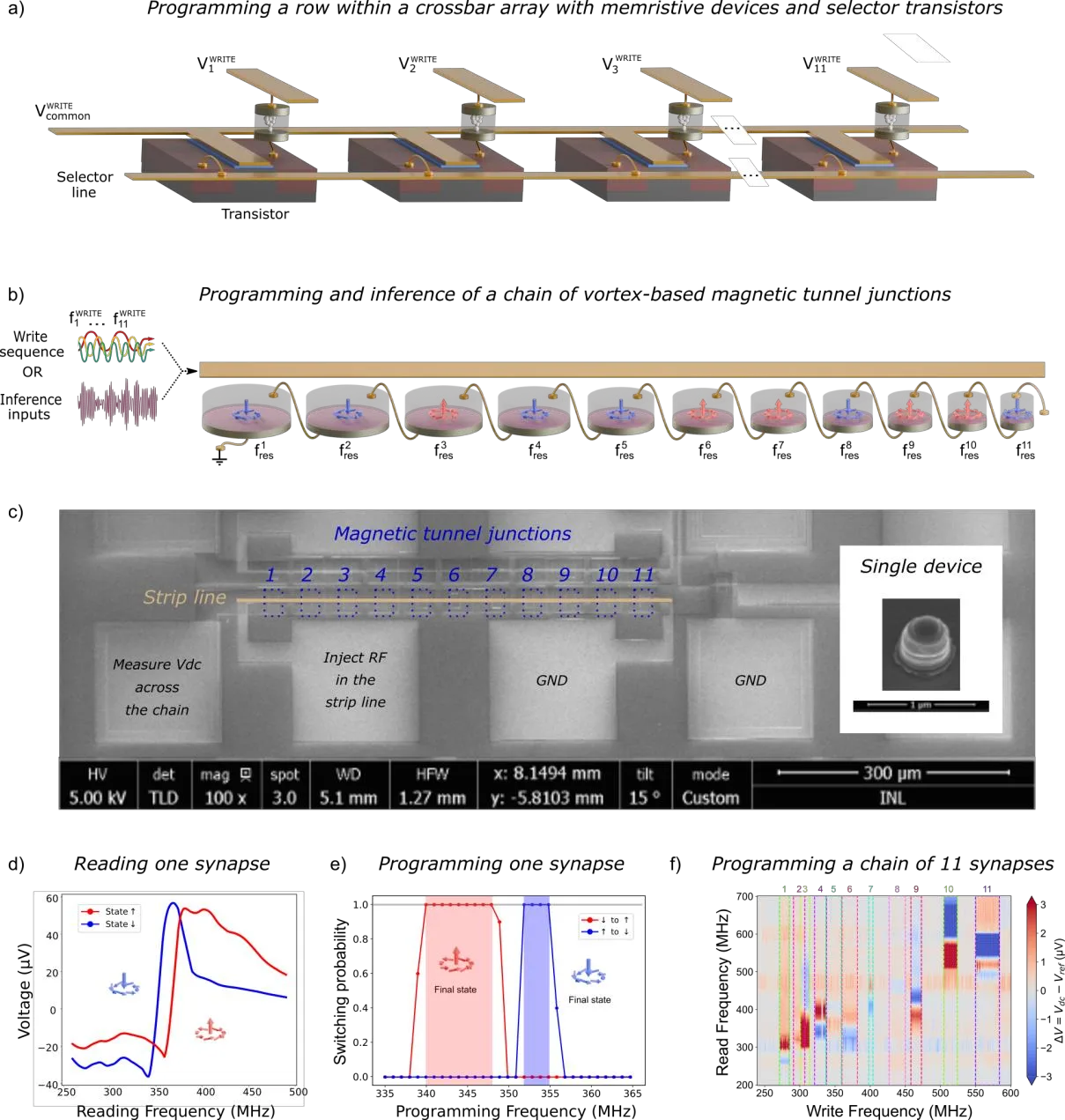
A radio receiver picks up only one station because its resonant circuit is tuned to that station's frequency. Magnetic vortices in a new type of computing element work in much the same way. Each vortex is a tiny magnetic "top" inside a tunnel junction (a device that changes resistance depending on magnetization). The vortex can spin one way or the other, and that direction is its memory — an analog of a one or a zero.
In conventional electronics, changing the state of each element requires a separate wire. Here, a frequency trick is used. A chain of 11 vortices is exposed to a radio signal through a shared strip antenna. But only the vortex whose natural frequency matches the signal frequency flips. This is similar to how an opera singer can shatter a glass by hitting its resonant frequency without disturbing other dishes. In this way, synaptic weights (the strength of connections in an artificial neural network) can be programmed without individual access lines.
The authors built a network of 22 such synapses — two chains of 11—and showed that the same hardware can be quickly switched between completely different tasks. After tuning for handwritten digit recognition, accuracy reached nearly 95%. Then, simply by changing the vortex configuration with the same radio signal, the same network learned to distinguish drone radio emissions with accuracy above 97%. Meanwhile, the first configuration on the drone task gave only 13% correct answers, and the second on digits gave about 48%. This is not a universal brain, but it is a striking demonstration of reconfiguration without rewiring. Such an approach promises compact and energy-efficient neuromorphic chips for portable electronics where rapid mode switching is important. And the radio receiver from the start of our discussion is now not just a metaphor but a working principle: the frequency carries the command, and the vortex responds like a receiver to a familiar wave.
A magnetic vortex in a tunnel junction has a diameter of about 100 nanometers, a thousand times thinner than a human hair.
The technology resembles the "smart dust" from Stanislaw Lem's stories, where swarms of microscopic devices coordinate via radio signals to perform computations.