Radio signals are electromagnetic waves with wavelengths from about a millimeter to hundreds of meters, corresponding to frequencies from roughly 300 GHz down to a few kHz. They are generated by accelerating charges, typically in antennas, and are used for communication, radar, and astronomy. In astrophysics, radio signals reveal processes invisible in other bands: synchrotron radiation from cosmic rays, emission from cold hydrogen gas, and fast radio bursts from exotic sources.
History
Heinrich Hertz first generated and detected radio waves in 1887, confirming Maxwell's equations. Karl Jansky discovered cosmic radio emission in 1932, founding radio astronomy.
How it works
Radio waves are produced when electric charges oscillate or are accelerated. In a transmitting antenna, an alternating current drives electrons back and forth, radiating waves that propagate through space. In astrophysical contexts, relativistic electrons spiraling in magnetic fields emit synchrotron radiation, and neutral hydrogen emits at the characteristic 21-cm line. Radio signals can be focused by parabolic antennas and detected by receivers that amplify the tiny voltages induced by the waves.
In practice
Radio signals are used in wireless communication, radar, GPS, and radio astronomy to study pulsars, galaxies, and the cosmic microwave background.
Fun fact
The human head acts as a resonant antenna for radio waves around 1 GHz, which is why mobile phone signals can be affected by the position of the head.
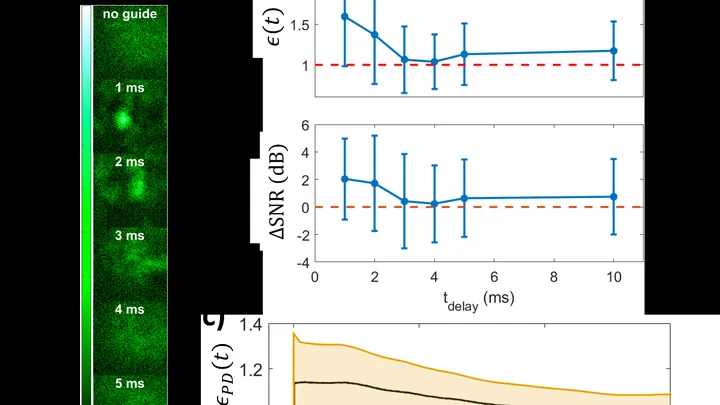
An ordinary flashlight shines in all directions, and after just a couple of dozen meters its beam fades so much it barely lights a wall. The atmosphere scatters light, and wind and heat currents distort it even more. But if you lay an invisible pipe for light right in the air, the beam will travel through it like water through a hose.
Radio astronomy began with the mysterious noise caught by the antenna of Karl Jansky and the rhythmic pulses that Jocelyn Bell Burnell playfully called 'little green men'.
Throw a stone into water: right at the point of impact, the waves are chaotic — that's the near field. Farther out, they spread in smooth circles — the far field. This same principle governs antennas for terahertz communications — the future of super-fast internet.
A fundamental string plucked at the moment of the Big Bang doesn't just hum a single note — waves run along it, and occasionally tiny loops peel off. These loops, like tuning forks, begin to ring at their own frequency, producing a very high-pitched sound.
A spinning top whirls at great speed and, instead of a steady hum, emits a quiet buzz — because it is slightly dented. Neutron stars work much the same way: city-sized spheres compressed to such density that a teaspoon of their material weighs as much as a mountain.
Searching for extraterrestrial signals is like trying to hear a whisper at a roaring stadium. The Green Bank Telescope listened to 70,000 stars, but 100 million bursts turned out to be earthly noise — from phones, satellites, microwave ovens.
Cosmic rays are particles from deep space, accelerated to colossal energies. Smashing into the atmosphere, they trigger particle showers with radio waves. These waves are fingerprints, revealing the energy and direction of the intruder.
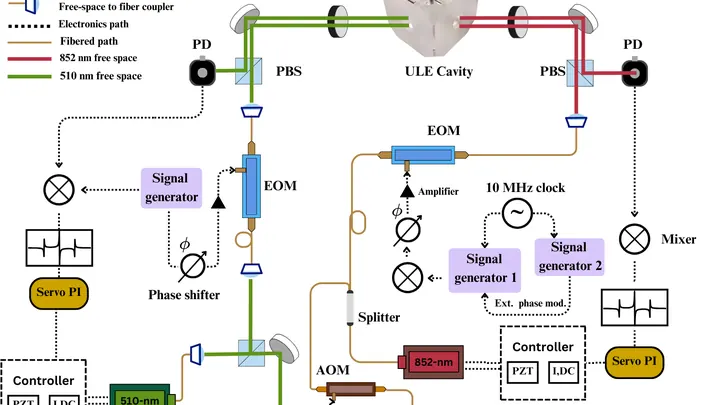
An ordinary laser emits narrow lines, like a string that sounds only one note. For spectroscopy, this is inconvenient: if a substance absorbs light between the lines, you might miss it.
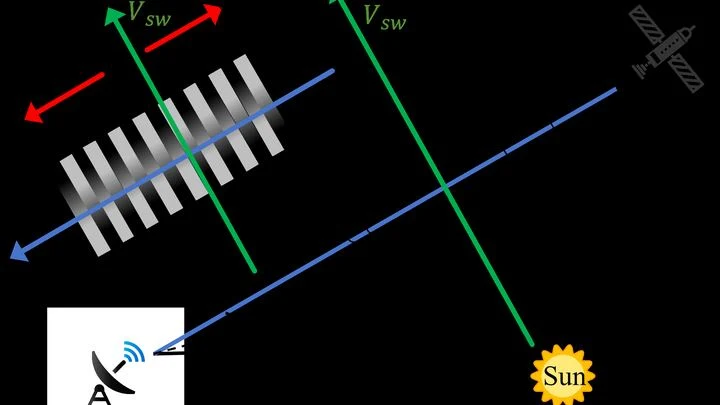
A radio signal travels from Mars to Earth, but on the way it has to push through the invisible "wind" of charged particles blowing from the Sun. This wind, like ripples on water, slightly distorts radio waves.
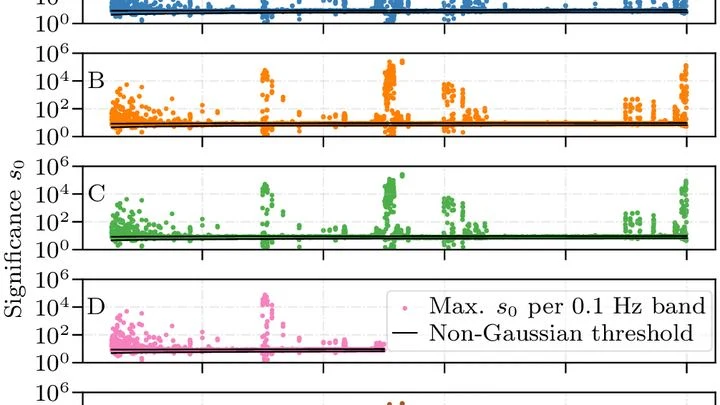
The Fermi telescope spent 17 years recording gamma rays from the active nuclei of galaxies with giant black holes at their centers. The glow of their jets resembles a chaotic cacophony: it constantly changes.
Light in an optical fiber is a stream of photons, and quantum communication requires single photons that can be sent one at a time. But making them emerge quickly while remaining indistinguishable from one another is a tough challenge.
Radio waves that oscillate less than once per second pass through the earth and water with almost no loss. Such signals are used to communicate with submarines and to search for minerals. But a conventional antenna for them would need to be hundreds of meters long, and its sensitivity leaves much to be desired.
Gravitational waves are ripples in spacetime curvature that imperceptibly stretch and squeeze everything around. But the Moon, like a bell, catches these waves: as a gravitational wave passes through it, it makes our satellite vibrate.
The night of March 4, 2024. The MeerKAT radio telescope in South Africa catches a millisecond pulse: a fast radio burst coming from a depth of 17.4 gigaparsecs. This is light that traveled 10.5 billion years to reach Earth.
The RATAN-600 radio telescope is a ring of hundreds of aluminum panels on a mountainside in Karachay-Cherkessia. In the spring of 2018, its mirror caught radio waves from sixteen red dwarfs — small, dim, but very long-lived stars.