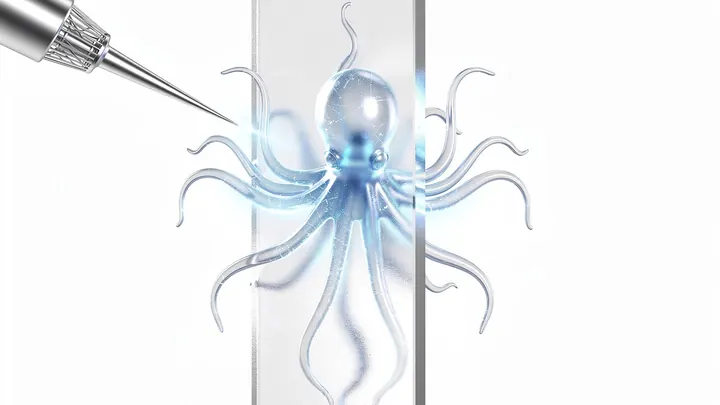
A tunnel junction is a sandwich structure consisting of two conducting layers separated by an extremely thin insulating barrier, typically only a few nanometers thick. In classical physics, an electron approaching this barrier would simply bounce back, as it lacks the energy to overcome the potential barrier. However, quantum mechanics allows the electron to 'tunnel' through the barrier as a wave, with a probability that decays exponentially with barrier thickness. This phenomenon is not just a curiosity — it is the fundamental operating principle behind many modern electronic and superconducting devices.
History
The concept of quantum tunneling was developed in the late 1920s by Friedrich Hund, George Gamow, and others to explain alpha decay. The first solid-state tunnel junction was demonstrated by Leo Esaki in 1957, who showed that heavily doped germanium p-n junctions exhibited negative resistance due to tunneling. Esaki shared the 1973 Nobel Prize in Physics with Ivar Giaever and Brian Josephson for their work on tunneling in semiconductors and superconductors.
How it works
The key is the wave nature of particles. An electron incident on the barrier is described by a wavefunction that does not abruptly drop to zero inside the insulator; instead, it decays exponentially. If the barrier is thin enough, a small but non-zero amplitude survives on the other side, meaning there is a finite probability the electron emerges. In superconducting junctions, the tunneling of Cooper pairs (bound electron pairs) gives rise to the Josephson effect, where a supercurrent flows without any voltage applied. The tunneling rate is highly sensitive to the barrier thickness and the density of available quantum states on both sides, making tunnel junctions precise probes of electronic structure.
In practice
Tunnel junctions are used in superconducting qubits for quantum computing, where Josephson junctions act as nonlinear elements. They are also essential in magnetic tunnel junctions for read heads in hard disk drives and in flash memory devices.
Fun fact
The thickness of a tunnel junction barrier is typically only a few atoms wide, meaning that a single atomic layer of impurity can change the tunneling current by orders of magnitude.
You don't build a road by demolishing neighboring houses: first you lay the asphalt, then you grind away the excess, leaving a smooth surface. That's roughly what physicists in Heidelberg did when they took on the production of Josephson junctions, tiny sandwiches of superconductor and insulator through which current flows without resistance.
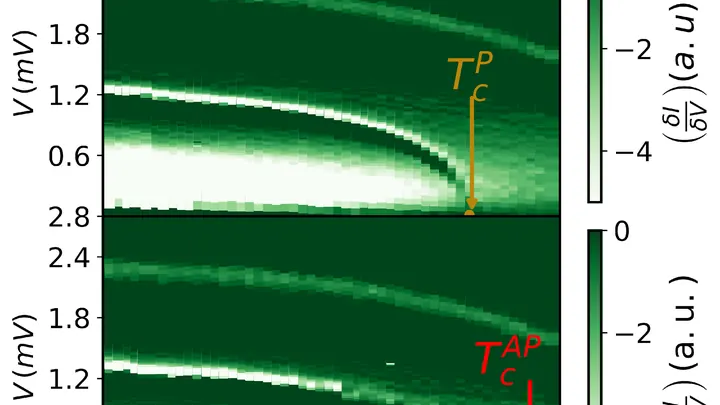
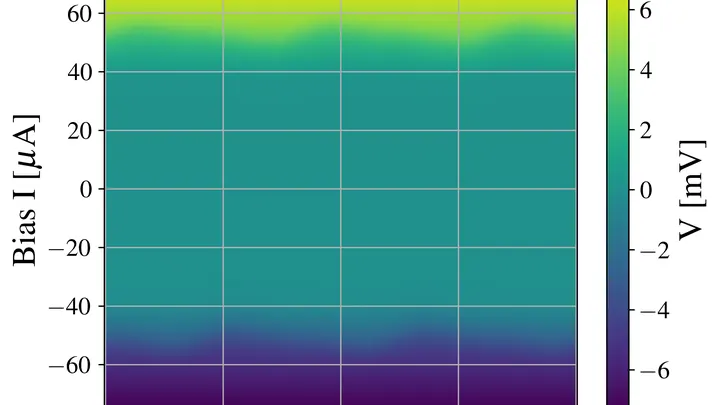
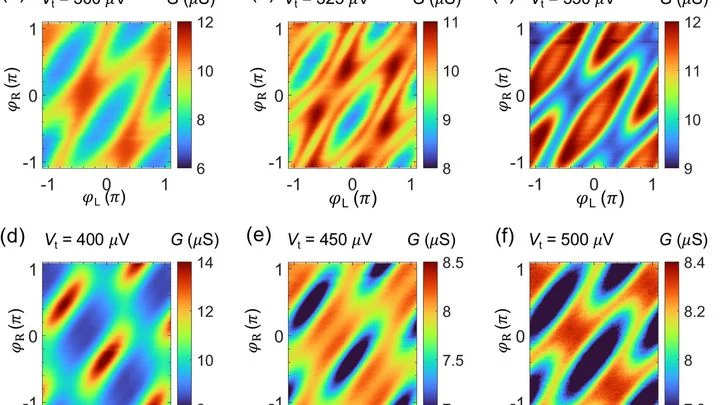
The Josephson junction is a bridge made of superconductor, separated by an ultra-thin insulating layer. Current flows through it even without voltage. But when the current becomes too large, the bridge starts to oscillate, and even steps, Shapiro steps, appear on the voltage graph. Between these steps hide invisible gaps where the system behaves strangely.
Drop by drop from a faucet, or a steady stream without a single splash. That's roughly what the two regimes of current in a superconducting contact look like. Only here, the role of water is played by Cooper pairs — bound electrons that move without resistance.
The 21-kilometer ring near Protvino was once planned to accelerate protons. Today, the same tunnel could host a very different machine — a muon collider. The muon is a heavy cousin of the electron, and that's its strength. On a curve, an electron radiates like a searchlight, losing precious energy. A muon radiates a billion times less.
The book is open to the middle. Current runs along the spine, while the pages remain cool. That's roughly how a two-dimensional topological insulator works — a material where electricity flows only along the edges, while the interior stays still.
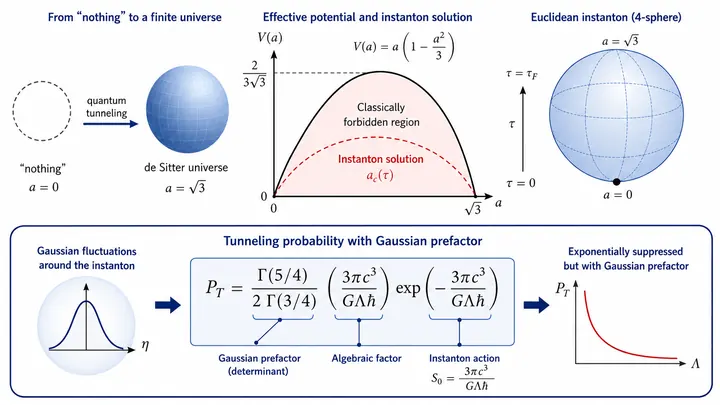
It all starts with a tiny scar — a thin tunnel connecting two universes. In quantum cosmology, there has long been discussion that our closed universe could have been born from "nothing" via tunneling (a process where a system overcomes a barrier that is insurmountable by ordinary standards).
The classical Mpemba paradox — hot water freezes faster than cold — has teased scientists for centuries. Only recently has nonequilibrium statistical mechanics explained it: it’s all about boundary conditions; the system seems to seek an excuse to “hit the wall” and speed up cooling.
Quantum tunneling — the ability of particles to pass through barriers forbidden by classical physics — powers stars with thermonuclear fusion, ignites primordial nucleosynthesis, and gives us flash memory.
In the mountains, there is a saddle — a point where the trail from one valley crosses over into another. Standing exactly on it, you take a step and are already descending the new slope. In chemistry, such a place is called the transition state: a brief moment when atoms are frozen on the threshold of transformation.
A swing can rock strongly or barely move. Usually, if left alone, it stays in its chosen mode. But in the microworld, things are different: a tiny membrane, oscillating under the action of a laser beam, can spontaneously jump from one amplitude to another.
The atom is like a conductor, and the light in the resonator is the orchestra. Their energy exchange, known as the Jaynes–Cummings interaction (part of the Standard Model), lets the atom use “baton” strokes to change the rhythm and timbre of the oscillations.
A tiny magnet levitates in a magnetic trap, like a weightless needle. Its magnetized axis is like a stubborn compass needle that is prevented from turning. An invisible wall rises before it. But in the quantum world, particles can seep through barriers — this trick is called tunneling.
Quantum nothingness resembles water in a pot just before boiling. From time to time, a bubble spontaneously swells up — but not of steam, but of an entire universe. Such a bubble doesn't collapse; instead, it inflates into spacetime, triggering its own Big Bang. The only question is how often this happens.
A stone falls into a pond, and ripples spread across the water. But if the stone is very small and the water is not quite ordinary, the ripples pass right through it, as if it weren't there.
A bridge of aluminum just a few atoms thick is the heart of many quantum devices. Current flows through such a bridge without resistance, and it can be controlled with a magnetic field. These bridges are called Josephson junctions, after the British physicist who described their behavior.
An ordinary flash drive in your pocket gets warm even when it's just sitting there. Now imagine memory that, in the cold, uses almost nothing, like a thermos that never cools down. A superconductor carries current without loss at liquid-helium temperatures, but it couldn't store data. The new cell changes that.
An optical tweezer is a laser beam that holds an atom in place, much like fingers holding a pea. Arrays of these tweezers form the basis of future quantum computers. But there's a catch: not every tweezer catches an atom. Typically, only half of the traps get filled, and for molecules, even fewer. Empty spots break the whole setup.
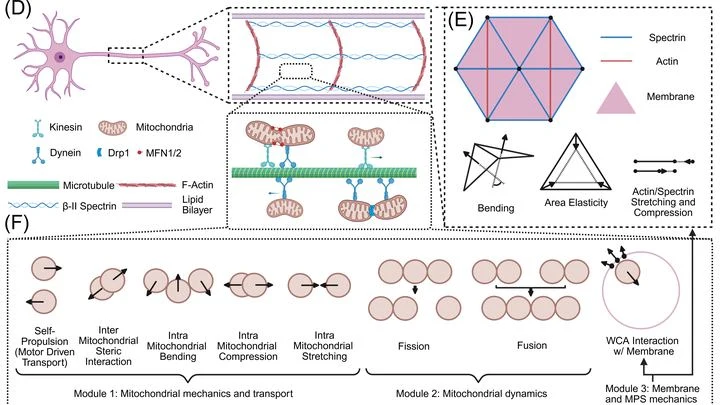
Inside every neuron, there's a long, thin channel, the axon, through which signals travel from the cell body to other cells. To keep this channel working, mitochondria constantly shuttle along it. These tiny organelles produce energy and move in both directions, like cars on a narrow road.
Fusion, the merging of a proton with a boron-11 nucleus, promises a near-perfect energy source: no dangerous neutron flux, just a stream of charged particles that can be directly converted into electric current. But there's a fundamental problem: the Coulomb barrier.
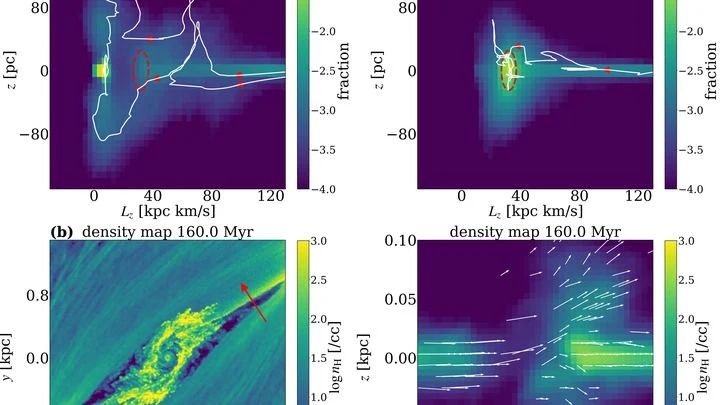
A river flows toward a whirlpool, but a dam with a notch blocks the way. Most water piles up before the dam, but some, gaining height, leaps over it and falls straight into the funnel. So it is with gas in a galaxy: it streams toward the center but hits a ring of stars and gas, like a dam. Usually, everything stops there, swirling into a dense vortex.
Superconducting circuits often rely on Josephson junctions — places where current flows without resistance through a thin barrier. Typically, this barrier is an oxide layer, but its properties are hard to control at the nanoscale. In this new work, the barrier is a thin layer of niobium or titanium nitride sandwiched between niobium layers.
A sheet of graphene one atom thick is like a perfectly smooth tablecloth on which electron marbles roll. Place an electric barrier in their path, and usually they'll bounce back. But in graphene, it's different: under certain conditions, electrons pass through the barrier without even noticing it, as if the wall were made of mist.
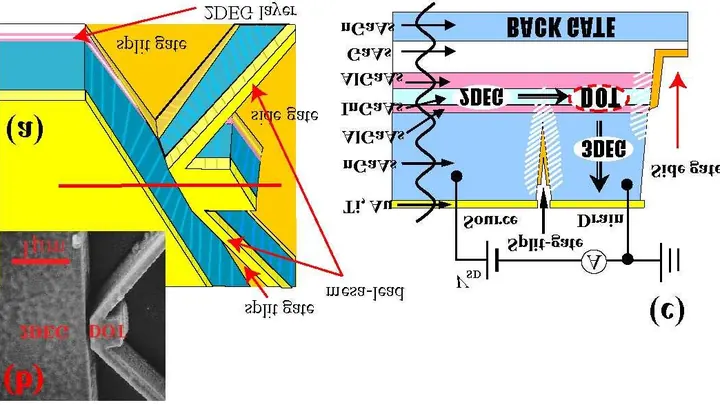
A quantum dot is like a tiny island where one or a few electrons can settle. In this new work, such an island was connected to two 'seas' of electrons: one flat like a pancake, the other bulky like an ocean. Electrons can hop from the island to the seas and back, and this hop depends on the shape of the electron's wave on the island.
An ordinary superconducting qubit is like a swing that any gust of wind can set rocking. The slightest change in electric charge nearby, and the quantum state is already spoiled.
A semiconductor diode normally conducts current in only one direction, like a spring-loaded door: it opens easily one way but pushes back the other. But if you dope the crystal heavily, the door starts behaving strangely: under reverse bias, the current doesn't just flow: it shoots up.
An ion channel in a cell membrane is a gate just a few atoms wide. Every second, millions of charged particles, sodium and potassium ions, pass through it. Classical physics said that to get through, an ion must jump over an energy barrier, like a traveler crossing a high mountain pass.
In a metal crystal, atoms line up in neat rows like bricks in a wall. Knock out a single brick, and you're left with a void — what scientists call a vacancy. Under irradiation, these voids multiply and start merging into large holes, sapping the metal's strength. It's like holes in a brick wall joining up into a gaping breach.
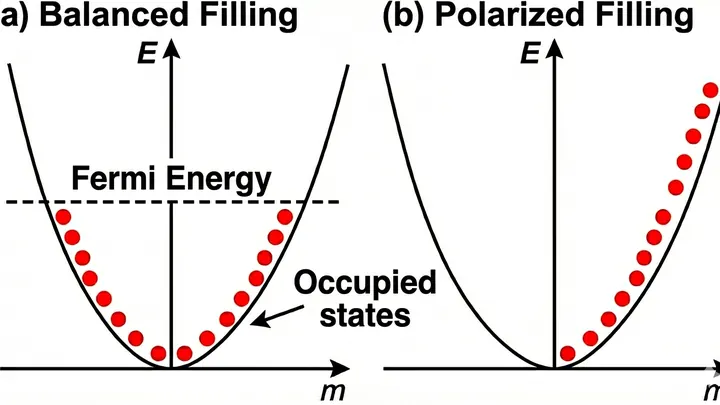
Electrons in a conductor behave like a crowd on an escalator: each one moves on its own, but together they create a flow. If you make them circle around a ring, their angular momentum (a measure of rotation) can couple to a magnetic field, like gears in a clock.
A quantum computer is like an orchestra where every musician must play their own note precisely. But the hall is filled with invisible noise — defects in superconducting contacts that throw qubits off rhythm. These defects are called two-level systems. They are like cracks in glass: tiny, yet capable of ruining the whole picture.
In the superconducting circuits that make up quantum computers, extra particles, quasiparticles, are born from time to time. They are like random passersby who barge into the processor's work and spoil the calculations.
A superconductor is a material where electric current flows without loss, like water through a perfectly smooth pipe. But if vortices appear, the current starts to 'stumble' over these tiny whirlpools. In graphene twisted at a special angle, such vortices can be created and studied one by one.
In a superconductor, electrons move in pairs, like dance partners. Usually, through a junction between two superconductors, one pair passes at a time. But add a third contact, and the dance gets more complex: two pairs can move together, forming a foursome. It's this four-part resonance that has been seen for the first time in a graphene junction with three terminals.
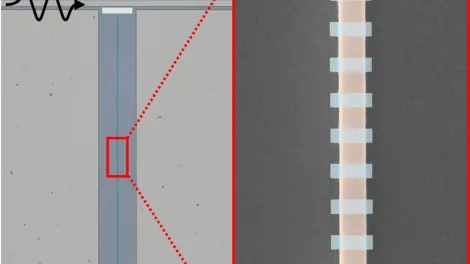
An ordinary wire at high frequencies is like a road full of potholes: the signal jumps, and some energy is lost as heat. A superconducting chain made of aluminum and indium arsenide (a semiconductor) turned out to be a smooth highway for microwaves.
Sound in a thin plate behaves like ripples on water: it travels, reflects off edges, and changes shape. But sound has a peculiar trait: it can pass through places where waves are forbidden to exist. It's as if ripples on a pond suddenly vanished before a stone barrier and reappeared on the other side, without going around it.
Five charged calcium atoms hover in a trap, held by electric fields. Laser cooling saps their excess energy, and they line up into a tiny pyramid with a square base. But this pyramid doesn't stay put: every now and then it flips over, as if someone tosses it into the air and catches it upside down.
A quantum bit is like a tuning fork that rings at its own frequency. To find out its state, you place a microphone-resonator nearby. Usually, the tuning fork and the microphone are connected via a spring-like capacitor: sound gets through, but the tuning fork also starts vibrating from external noise and can get knocked off.
In the quantum world, particles can walk through walls: this is quantum tunneling. If you place a detector right in the path of such a 'ghostly' passage, the moment of detection acts like a starting pistol: the particle gets a sharp kick and flies out of the barrier with excess energy, turning into a tiny engine.
A tiny tungsten tip with a radius of less than a hundred nanometers is the perfect stage for watching a quantum performance. Apply an electric field of a few volts per nanometer, and electrons start flying out of the metal: that’s field emission.