A radio receiver is a device that captures electromagnetic radiation in the radio frequency range and converts it into a usable signal, such as sound or data. It is the essential counterpart to a transmitter, and its design determines the sensitivity, selectivity, and fidelity of the received information. In modern physics, radio receivers are not just for communication; they are critical instruments for astronomy, remote sensing, and fundamental experiments that probe the faintest signals from the cosmos.
History
The first practical radio receiver was built by Guglielmo Marconi in the 1890s, building on the work of Heinrich Hertz who demonstrated the existence of radio waves. The development of the vacuum tube and later the transistor revolutionized receiver technology, enabling the sensitive instruments used today.
How it works
A radio receiver typically consists of an antenna that intercepts the incoming electromagnetic wave, a tuner that selects a specific frequency band, and an amplifier that boosts the weak signal. The amplified signal is then demodulated to extract the information it carries. In advanced applications, such as radio astronomy, receivers use superconducting circuits and quantum-limited amplifiers to detect signals with energies far below the thermal noise floor. The antenna's design determines the directionality and polarization sensitivity, allowing receivers to 'listen' to specific regions of the sky or reject interference.
In practice
Radio receivers are used in everything from smartphones and Wi-Fi to radio telescopes like the Very Large Array, which detect faint radio emissions from distant galaxies and pulsars.
Fun fact
The most sensitive radio receivers, used in quantum communication experiments, are so sensitive that they can detect a single photon of radio-frequency radiation.
A superconducting detector usually works like an honest ruler: absorb a photon, get a pulse whose amplitude is strictly proportional to the energy. This mode is convenient, but it has a ceiling: a weak signal easily gets lost in the amplifier noise.
Now imagine a swing.
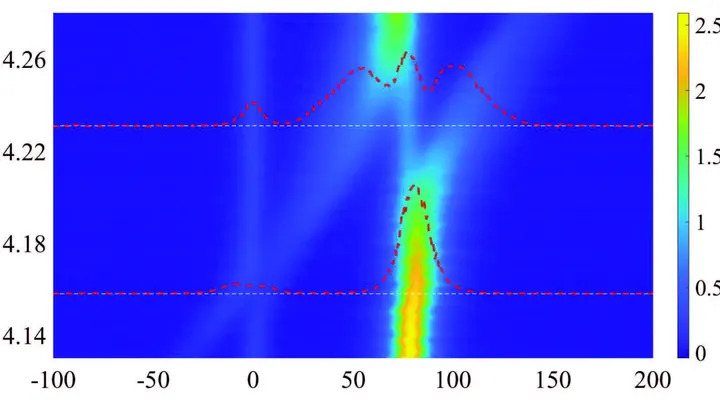
When a radio wave encounters a building in its path, it doesn't just reflect or get absorbed: it bends around it, much like ocean waves flowing around a rock, leaving calm water behind. In radiophysics, this phenomenon creates a radio shadow — a complex pattern of zones where the signal is amplified or attenuated, which scientists call a radio portrait.
The standard way of digitizing speech: taking volume readings thousands of times per second. It's like tasting broth with a teaspoon: each sip is watery, with almost no detail. The data stream swells, though the substance is minuscule.
Scientists proposed first "simmering down" the audio signal.
An ordinary envelope has a rectangular shape, and the letter inside does not change the envelope's properties. With photons, particles of light, the situation is different: their 'shape' in time can vary, and this shape itself carries information.
A conventional antenna array is like a choir: many voices singing in unison, with the sound amplified in only one direction. To catch a signal from another side, you have to rearrange the whole choir. Now imagine a single voice that can change its timbre so that the sound itself focuses in the desired direction.
In giant accelerators, particles zip through detectors in billionths of a second, and telling one from another requires a stopwatch of incredible precision. The new µRWELL-PICOSEC detector acts as such a stopwatch: it captures the moment a particle passes with a precision of 48 picoseconds: that's 48 trillionths of a second.
A gas bubble in water sings loudly — this is Minnaert resonance: the heavy liquid prevents the bubble from compressing quickly, forcing it to vibrate. In air, there's no such effect: air is too light. But if you dress the bubble in a soft silicone shell, like rubber, it plays the role of the water mass. You get an 'elasto-bubble'.
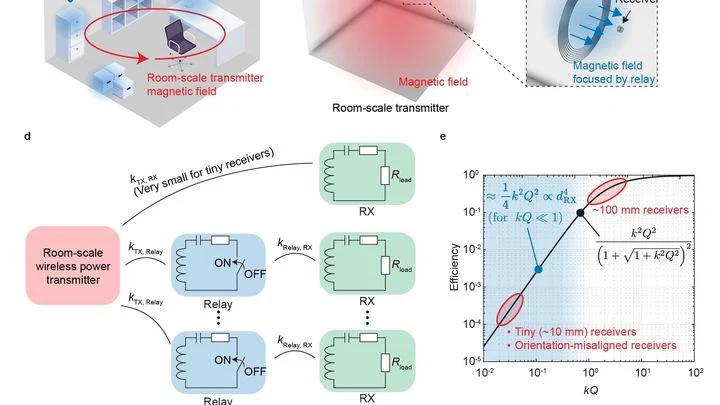
Think of wireless charging in a room as a pool where energy-water is everywhere, and tiny sensor-floats barely bob. Their induction coils are too small to efficiently scoop from this diffuse electromagnetic field. Unlike radio waves, the energy here doesn't travel at the speed of light: it lingers in the near field, waiting to be harvested.
A regular radio receiver picks up waves with a metal antenna. Here, the antenna is a single atom with an electron boosted to a distant orbit, like a satellite in a high orbit around Earth. Such atoms are called Rydberg atoms.
A graphene ribbon nine atoms wide is like a track where electrons race, as water rushes down a narrow trough. Gamma radiation is a stream of particles with enormous energy, capable of punching through metal and plastic.
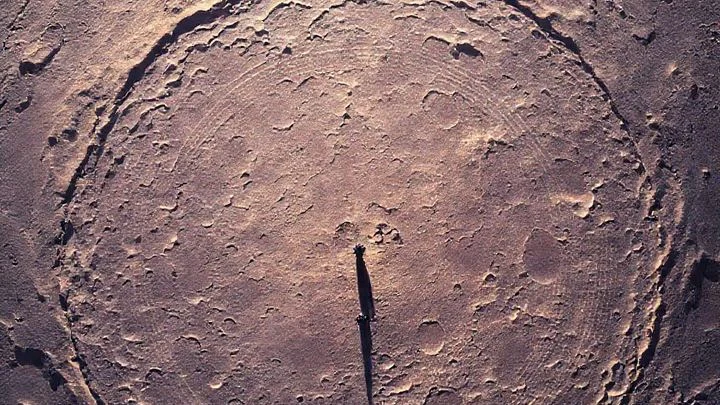
Gravitational waves are ripples in spacetime curvature that imperceptibly stretch and squeeze everything around. But the Moon, like a bell, catches these waves: as a gravitational wave passes through it, it makes our satellite vibrate.
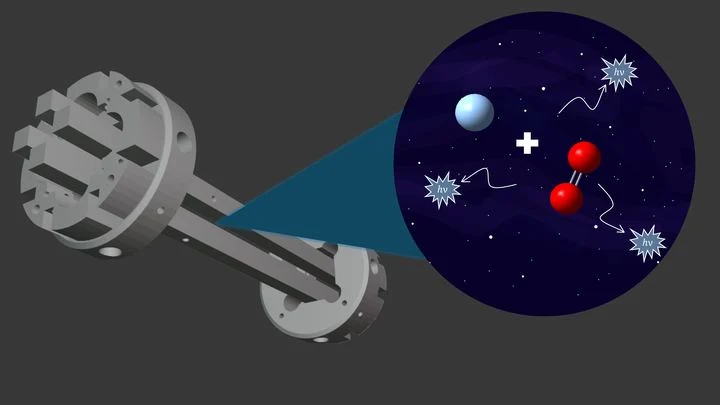
In the cold, sparse clouds of space, particles rarely meet, but sometimes an ion and a neutral molecule pass close enough to stick together. As they do, they emit light, like a muted flash carrying away excess energy. This process is called radiative association, and it is responsible for the formation of many molecules in interstellar space.
The Moon is not just a rocky sphere, but a giant bell. Passing through it, gravitational waves cause it to vibrate almost imperceptibly. This tremor was predicted by Einstein, and Weber was the first to try to hear it with Earth-based detectors.