How Cells Stick Together or Scatter express
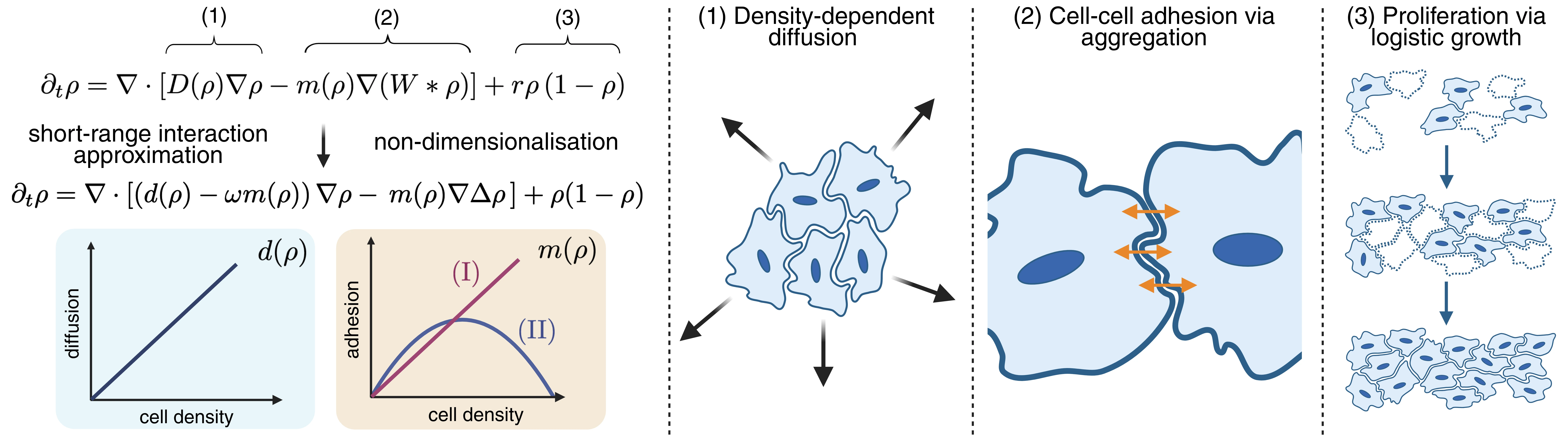
A crowd in a city square behaves differently depending on whether people hold hands. If each person only lightly touches a neighbor's elbow, people easily spread out in all directions — the crowd expands as a smooth carpet. But if they interlock fingers, movement slows down and the crowd breaks into clumps: dense clusters form here and there, with empty corridors between them. Living cells behave much the same way as they grow and colonize space.
Scientists have built a mathematical model that unifies two seemingly different phenomena: the continuous invasion of tissue and the birth of patterns. The model is based on three simple mechanisms: cell-cell adhesion, random motion, and division. By changing the strength of adhesion, one can see how collective behavior changes. With weak adhesion, the cell sheet advances as a stable front, like a calm wave. With strong adhesion, the front begins to wobble, leaving behind clusters of cells that look like islands.
The most interesting twist is when cells can regulate their own stickiness. If adhesion weakens in dense regions, the tissue again expands smoothly, without gaps. This is like a crowd that decides on its own when to let go of hands to avoid a crush. The model shows that the key to order is not a constant adhesive force but the ability to change it in response to crowding.
So the same mathematics describes both the orderly development of an embryo and the dangerous chaos of disease. And in both cases, the main conductor is simple cell stickiness.
Original abstract
as written by the authors arXiv:2604.26928
Cell invasion and spatial pattern formation are two distinct manifestations of cellular self-organisation in development, regeneration, and disease. Here, we develop and analyse a unified theoretical framework that links these two seemingly different behaviours within a single mechanistic model for adhesion-mediated self-organisation in growing cell populations. Using a multiscale analysis, we show that the balance between cell-cell adhesion, self-diffusion, and proliferation controls the emergence of distinct collective dynamics. We find that for weak adhesion, tissues invade through stable monotone fronts. As adhesion increases, invasion slows, fronts become unstable, leading to aggregates and spatial patterns emerging behind the advancing edge. In two spatial dimensions, these instabilities generate fingering morphologies reminiscent of dysregulated invasion in cancer. Crucially, we show that density-dependent regulation of adhesion suppresses these instabilities and restores cohesive tissue expansion. Together, our results identify adhesion strength and its regulation as key determinants of whether tissues invade cohesively or fragment into patterns, and provide a unified framework for understanding collective migration, morphogenesis, and dysregulated growth.
If you take frog embryo cells and weaken their adhesion with a specific protein, they stop assembling into neat layers and form disordered clumps, just like in the described model.
In Greg Bear's novel Blood Music, colonies of cells acquire collective intelligence: their ability to stick together and then separate becomes the basis of thought.