q-bio.TO q-bio.TO

50 articles

articles

q-bio.TO2026-01-022 minarXiv:2601.90002
The Brake That Heals: How One Piece of the p53 Protein Slowed Aging in Mice
A mouse with progeria ages at an accelerated pace: by five weeks it already shows damage in the aorta and skin. Scientists built a switch into its genome that, on command, turns on production of the Δ133p53α protein. This protein is a shortened version of the famous guardian of the genome, p53, which can both halt cell division and set their repair in motion.
q-bio.TO2026-01-041 minarXiv:2601.01315express
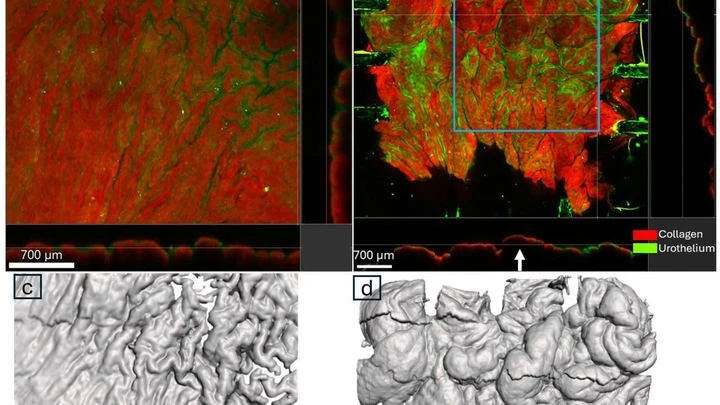
How the Bladder Squeezes Without Paint
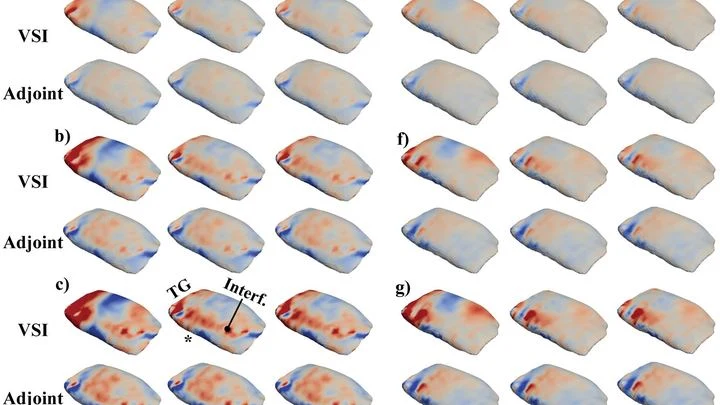
The bladder wall is not a rubber balloon. When the organ empties, its surface wrinkles like crumpled paper, and tension varies from place to place. Previously, to measure this, researchers dotted the tissue with marker spots. But the paint itself changes how living tissue behaves, like an extra layer of tape on a balloon. The new method skips the paint.
Biological Physics2026-01-142 minarXiv:2601.09660express
How a Tendon Tears from Within
The shoulder tendon is like a cable that holds your arm and lets it rotate. When that cable gets injured, its internal structure changes, and it starts to stretch differently. In this study, they took a rat's supraspinatus tendon and pulled it along its fibers while recording how every point inside it shifted.
q-bio.QM2026-01-251 minarXiv:2601.17669express
Kidney Cancer: Math Takes on the Tumor
A tumor in the kidney grows like a weed that has learned to hide from the gardener. The immune system, that very gardener, simply doesn't notice it. Doctors try different drugs, but each person's disease behaves differently. The authors made a computer replica of this battle.
q-bio.TO2026-02-101 minarXiv:2602.09867express
Velcro Cells Build the Body
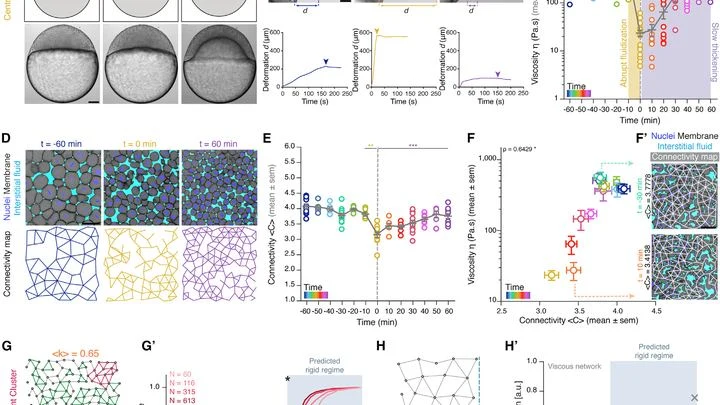
As an embryo grows, its cells don't just divide: they constantly touch their neighbors, like people in a crowded bus. The strength of these contacts determines where a cell moves and what shape the tissue takes. Scientists studied how cell 'stickiness' changes during the earliest stages of development.
q-bio.TO2026-02-173 minarXiv:2602.90007
Why some survival curves are rectangular and others triangular
A survival curve looks like the profile of a crowd walking down a long corridor: at first everyone is together, then some fall behind, and finally only a handful remain. If the corridor ends in a steep cliff, the crowd falls almost simultaneously, which on a graph looks like a rectangle. If the exit is a gentle, long slope, people leave gradually and the curve stretches into a triangle.
q-bio.TO2026-02-191 minarXiv:2602.17265express
Lungs Like a City: How Air Flows Through Bronchial Streets
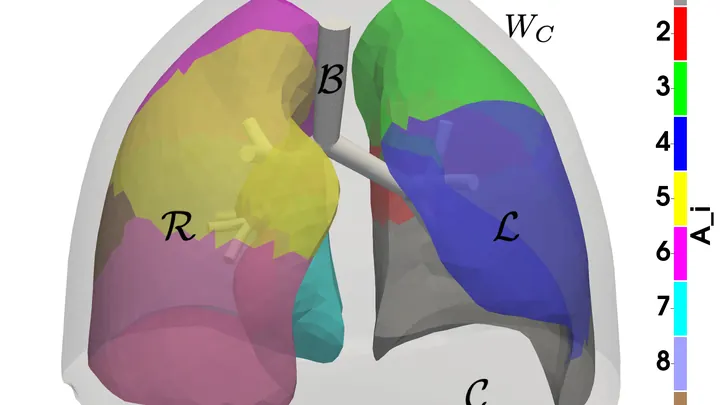
A lung scan reveals a tree: the trunk is the trachea, branches are the bronchi, and leaves are the alveoli. But how does air spread through these branches? Scientists built a computer model that replicates the lung's shape from images obtained via computed tomography.
q-bio.CB2026-02-281 minarXiv:2603.00834express
How Skin Cells Close a Wound: A Dance of Division and Movement
When you cut your finger, skin cells start working in concert: some divide, others crawl toward the wound, and still others pause. But exactly how a cell decides what to do next depends on its internal "schedule"—the cell cycle.
q-bio.TO2026-04-063 minarXiv:2604.90004
A Window into the Night: How Meal Timing Extends Healthy Life
At night, when a mouse in its cage runs on the wheel, an automated feeder opens and dispenses a portion of food. That is how an experiment began in which 528 mice lived their entire lives under the watch of sensors and scales. The scientists were testing a simple idea: if food enters the body only during waking hours, the internal clocks run more precisely and the body ages more slowly.
Biological Physics2026-04-121 minarXiv:2604.10476express
Why a Mouse Runs Hotter Than an Elephant
The heart doesn't push blood in a steady stream but in pulses. Each beat sends a wave racing through the arteries, like ripples along a taut garden hose. For a long time, it was thought that an animal's metabolic rate depended only on how vessels branch, like pipes in a house. But new work flips that view: what matters isn't the shape of the pipes but the pulse itself.
q-bio.TO2026-04-232 minarXiv:2604.90002
The Pill That Wakes Up Your Cells' Energy Sensor
Every cell has a sensor that keeps tabs on energy levels, the way a smart meter keeps tabs on the electricity in your house. When energy runs low, it switches to saver mode: the cell spends less and stores more. Scientists have long suspected that aging is tied to this sensor gradually losing its touch.
q-bio.TO2026-04-292 minarXiv:2604.26928express
How Cells Stick Together or Scatter
A crowd in a city square behaves differently depending on whether people hold hands. If each person only lightly touches a neighbor's elbow, people easily spread out in all directions — the crowd expands as a smooth carpet. But if they interlock fingers, movement slows down and the crowd breaks into clumps: dense clusters form here and there, with empty corridors between them.
q-bio.TO2026-05-012 minarXiv:2605.01083express
How a Cell Transplant Can Set the Heart's Pace
After a heart attack, the dead section of heart muscle can be replaced with living cells grown from stem cells. But a common problem arises: the fresh transplant starts acting as its own pacemaker, and the heart falls out of its proper rhythm. Doctors see the arrhythmia on an ECG, but what exactly happens at the junction between 'self' and 'foreign' remains hidden.
q-bio.TO2026-07-052 minarXiv:2607.04114express
The Salt We Don't Notice
Table salt is one of the most studied substances in medicine. For decades, students were taught Arthur Guyton's model: eat something salty — blood dilutes, volume temporarily increases, kidneys promptly excrete the extra water, and everything returns to square one. A neat scheme, like a float valve in a toilet tank.
q-bio.CB2026-07-172 minarXiv:2607.90001
The youth that survived a transplant
Blood stem cells are like spare keys to a house: they open the door to any room, but over time they wear down and start to stick. In an elderly person, such keys handle the locks worse, and the blood renews itself more slowly. Scientists have long been searching for a way to make a duplicate that stays new even after heavy use.
q-bio.TO2026-07-212 minarXiv:2607.19269express
How Lung Capillaries Dampen the Pulse Wave
A subway train races through a tunnel, yet passengers in the last car barely sway. Blood flow in the lungs works much the same way: the heart pumps blood in powerful spurts, but by the time it reaches the veins, the pulsation has almost vanished.
Machine Learning2026-08-082 minarXiv:2608.08165express
Predicting Clot Growth from Scraps of Data
A clot grows like a snowball rolling down a mountain: small at first, it picks up new layers, and predicting when it will turn into an avalanche is tricky. In the blood, a long chain of reactions, the coagulation cascade, unfolds, where one substance activates another, and the clot gains mass.
q-bio.TO2026-08-112 minarXiv:2608.10331express
The Brain After Impact: Why the Second Hit Is More Dangerous
A single blow to the head is bad enough. But what about a series of blows? That's more complicated, and standard computer models of the brain don't account for it: they treat each impact as if it were the first. But the brain isn't a steel ball: it remembers past strain. Brain tissue is like a rubber band that has been stretched many times.
q-bio.TO2026-08-152 minarXiv:2608.15418express
A Blow to the Head: What Cells Feel
The dummy tips backward in its chair: its head hits the floor. Inside the head, in three Petri dishes, live human nerve cells. They feel the impact just as a real brain would during a fall. The experiment is simple: the dummy was dropped from a sitting position at angles of 30, 60, and 90 degrees.
q-bio.TO2026-08-242 minarXiv:2608.90039
Pulse at the Temple: Where Age Leaves Its Mark
The pulse at the temple beats like a city's main artery: it shows how the roads are aging. At the wrist, the signal looks more like a back street where traffic noise drowns out the important details. Scientists compared these two sites to figure out where age leaves the clearest mark. An optical sensor shines light through the skin and catches every heartbeat.
q-bio.TO2026-08-243 minarXiv:2608.90069
Echoes of the Vessels: How a Reflected Wave Reveals Age
An old water pipe hums differently from a new one. A pipe that has lost its flexibility answers every surge of water with a sharp echo that races back to the pump faster than in a young system. Something similar happens with our arteries: over the years their walls harden, and the pulse wave, having reached the small vessels, reflects back to the heart almost without delay.
q-bio.TO2026-08-253 minarXiv:2608.90014
A Sniper for Aging Cells: How Nanoparticles Restore Immunity
In a fibrotic liver, as in a city after a long siege, neighborhoods appear where life has stalled: working cells are replaced by scar tissue, and hiding inside it are senescent macrophages. These cells have stopped dividing but have not retired. They release substances that push their neighbors to build even more scar and drive off immune patrols.
q-bio.TO2026-08-253 minarXiv:2608.90025
The Worm's Metabolic Dance: How Diet Rewrites the Fate of Nutrients
A worm a millimeter long eats labeled atoms, and then the dance begins. Every carbon and nitrogen atom that enters the body takes its place in the cells: it becomes part of proteins, fats, DNA. The scientists labeled the worm's food with the stable isotopes ¹³C and ¹⁵N, then switched it back to ordinary food and began tracking how quickly the labeled atoms leave the tissues.
q-bio.TO2026-08-263 minarXiv:2608.90018
Two Loads on One Rope: Metabolic Age and Cardiovascular Disease
Imagine someone hauling two sacks up a hill. One is stuffed with sugar the body cannot process. The other is filled with the years the body has lived faster than the calendar. While the sacks are light, the climb is manageable. But if both are filled to the brim, the legs give way, and the person collapses not with one disease but with several at once.
q-bio.TO2026-08-262 minarXiv:2608.90073
The plate that tradition, not your wallet, fills
Every woman's plate in three African countries is assembled from local ingredients, not from universal guidelines. In The Gambia, Kenya and Mozambique, researchers spent three and a half years asking 7715 women what they had eaten in the past 24 hours and sorting the answers onto ten food shelves: grains, legumes, vegetables, fruits, meat, fish, dairy, eggs, nuts and oils.
q-bio.TO2026-08-273 minarXiv:2608.90012
Aspirin doesn't help everyone: which older adults gain healthy years
An aspirin tablet is like a key that doesn't fit every lock. In a large study of older adults, this key usually refused to turn: life without disability was not extended. But for some locks, especially those belonging to people with diabetes, excess weight and high blood pressure, the key did work. Why that happens remained a mystery for a long time.
q-bio.TO2026-08-272 minarXiv:2608.90036
Microglia: the conductor who amplifies only one melody of destruction
The orchestra plays a funeral march, and the conductor is not to blame for the choice of notes. But if he waves his baton more energetically, the music grows louder and the walls of the hall shake. Likewise, microglia, the brain's immune cells, don't start the disease, but they can turn a quiet fading into a collapse.
q-bio.TO2026-08-282 minarXiv:2608.90034
The Clock That Ticks Inside Cells
A forensic examiner arrives at a crime scene and lifts fingerprints. Epigenetic clocks work the same way: from chemical marks on DNA they determine how much a cell has aged. A tumor leaves its own "fingerprints," and almost always they point to decrepitude. The researchers took 5528 samples from the TCGA database, which holds DNA methylation data for eight cancer types.
q-bio.TO2026-08-282 minarXiv:2608.90058
Curcumin Sniper: How a Targeted Spice Shuts Down Tumors from Within
Cells have power plants: mitochondria, which generate energy. But when a cell turns cancerous, those plants start working for the tumor, helping it divide without restraint. Researchers took ordinary turmeric, the familiar yellow spice, and attached a chemical "address" that makes it accumulate specifically in mitochondria.
q-bio.TO2026-08-292 minarXiv:2608.90068
An Uninvited Guest in the House of Metabolism
An uninvited guest turns up in the house where metabolism lives. It doesn't smash walls or haul out the furniture, but it rearranges things so that familiar routes get tangled. In people with Down syndrome, that guest is an extra copy of chromosome 21, and until recently it was hard to tell exactly what it changes in the body's workings.
q-bio.TO2026-08-303 minarXiv:2608.90022
Two Guards at the Ear's Door: Why One of Them Weakens with Age
In a dimly lit hallway stand two guards. One, hearing a loud footstep, grabs the door so it won't slam. The other, sitting by the breaker panel, turns the dimmer knob when the noise becomes unbearable.
Diagnosis by Reaction: What Healthy Brain Tissue Says About Disease
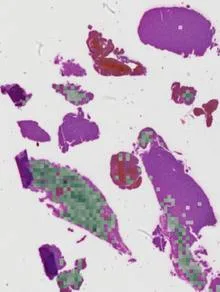
Imagine trying to figure out what happened in a room from the sound that lingers after a gunshot. The shot is gone, but the echo still bounces off the walls. That's roughly how a neuropathologist views a brain tissue section where the tumor itself is absent: the biopsy only captured healthy tissue that reacted to the disease.
q-bio.TO2026-09-022 minarXiv:2609.90011
The key bacteria leave in the lock of the lysosome
Inside every cell there are waste-recycling stations: lysosomes. To digest the trash, they need an acidic environment, and the acid is pumped in by a molecular pump called V-ATPase. With age this pump works more and more weakly, and lysosomes stop keeping up. But the bacteria living in the gut have their own building material, peptidoglycan, and as it turns out, it can serve as a key that restarts the pump.
q-bio.TO2026-09-033 minarXiv:2609.90014
Aging Erases the Organ-Specific Specialization of Endothelium
In a large orchestra, every musician knows their part: the violinist carries the melody, the cello holds the bass, the flute comes in during the pauses. If the violinist suddenly started playing the horn part, the music would fall apart, even though the instruments themselves would remain intact.
q-bio.TO2026-09-042 minarXiv:2609.90012
Urine as a Mirror of Age: Correcting for the Filter
A translator who has finally turned off the noise in the hall hears every word for the first time. In much the same way, urinary aging clocks long confused the noise of the kidneys with the signal of age: the kidneys filter urine, and their work changes the mix of protein fragments by which we judge the wear and tear on the body.
q-bio.TO2026-09-072 minarXiv:2609.90027
The Stiff Old Age of the Gut: How Mechanics Silences Motility
Old age begins with familiar things getting stiffer: skin, joints, blood vessel walls. The intestine is no exception. Its muscular coat accumulates collagen with age, and the tissue stops being elastic. This used to be seen as simply a consequence of wear and tear, but a new study shows that stiffness itself is a command that makes smooth muscle cells forget their job.
q-bio.TO2026-09-073 minarXiv:2609.90032
Echo of a Fading Connection: What a Synapse Fragment Reveals About Muscle Aging
Old wiring in a house doesn't announce itself right away: the bulbs still glow, but the light has dimmed, and switches sometimes respond with a delay. Neuromuscular junctions age in much the same way. These are the contacts through which a nerve tells a muscle fiber to contract.
q-bio.TO2026-09-072 minarXiv:2609.90045
Traces at the Edges of Chromosomes: How Chemotherapy Leaves a Common Fingerprint
A lab dish of cancer cells looks like a city after an earthquake: some buildings held, others collapsed, and the cracks show where the blow landed. Chemotherapy strikes DNA, but seeing that blow directly is hard: the damage is scattered across the genome and across many cells.
q-bio.TO2026-09-082 minarXiv:2609.90022
Customs for Genes: How Tamoxifen Affects Mouse Ovaries
Three mice in a cage, and each has her own schedule. One sniffs the bedding, another gnaws a grain, the third freezes by the water bottle. A month later, one of them will get an injection that temporarily stops her internal clock, while the other two continue living by the schedule.
q-bio.TO2026-09-092 minarXiv:2609.90004
A Gas Pedal You Can Let Go Of
A mouse gets food that is missing a single amino acid, and within five days it loses a fifth of its weight. Its white fat turns darker, as if tiny stoves had lit up inside it. This is not hunger and not exercise: cysteine was simply removed from the diet. Cysteine is a building block of proteins that our body can make on its own from another amino acid, methionine.