Analysis PDEs math.AP

16 articles

Existence and uniqueness, boundary conditions, linear and non-linear operators, stability, soliton theory, integrable PDEs, conservation laws, qualitative dynamics.

articles

Four Notes of the Ocean: Squeezing an El Niño Model into Your Pocket
The Pacific Ocean, ten thousand kilometers wide, breathes: warm water shifts eastward, cold water retreats, and this in-and-out repeats every few years. A model that captures this breathing takes weeks of computation even on a supercomputer.
Fluid Dynamics2026-01-241 minarXiv:2601.17341express
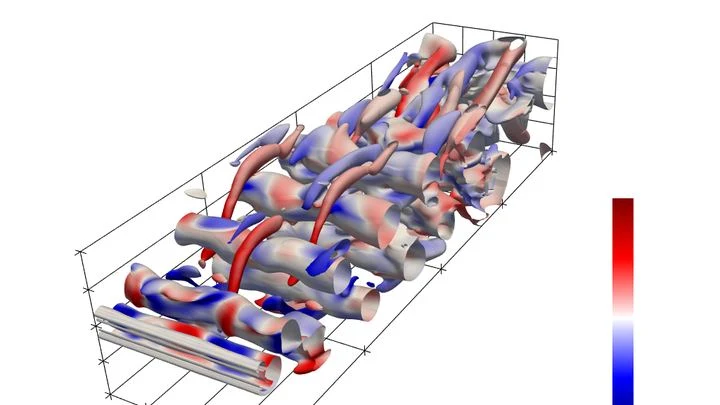
A Thin Plate Wakes Turbulence Early
A thin plate stands across a flow of water or air. Behind it, a wake forms — a region where the flow becomes tangled and mixed. Usually, such a wake becomes turbulent when the flow speed is high enough, quantified by the Reynolds number.
q-bio.PE2026-01-262 minarXiv:2601.18703express
How an Epidemic Flows Through a City
An epidemic is like a forest fire: the flames race toward where there are more dry branches. Similarly, a virus spreads faster where people live in closer quarters. But old mathematical models described infection as an ink blot spreading evenly across paper.
Analysis PDEs2026-02-281 minarXiv:2603.00779express
How Lymph Pumps Itself
The lymphatic system is like a city's network of canals, through which water slowly moves, carrying away waste from tissues. But it has no single pump-heart. Instead, along the vessels are placed small station-locks — lymphangions. Each such lock squeezes itself like a fist and pushes fluid onward. How they coordinate their work has long remained a mystery.
Statistical Mech2026-03-141 minarXiv:2603.13918express
Pores in the Membrane: Three Keys to Accurate Calculation
A cell is a city with gates. Each gate is a protein channel in the membrane: through it, ions, sugars, and signaling molecules pass in and out. Some gates are almost always open, while others open and close randomly, like subway doors that let a passenger through one moment and slam shut in their face the next.
Fluid Dynamics2026-03-181 minarXiv:2603.18061express
Neural Network Catches the Moment a Liquid Tears
Water swirling into a vortex eventually stops being smooth: foam and spray appear. Mathematicians describe such flows with equations, but there's a puzzle — sometimes the solution 'explodes,' becoming infinite, and no one knows why. Stochastic modeling doesn't help here; we need a precise tool.
q-bio.QM2026-04-231 minarXiv:2604.21988express
How a Shell Builds Itself
Every shell is a stone diary of growth. The mollusk doesn't build it from a blueprint like an architect; it simply adds material along the edge, following the same rule over and over. It's as if a snail glued a new strip to its house each day, nudging it slightly sideways and making it a bit bigger. It's this repetition, not complex control, that creates the species' characteristic shape.
q-bio.TO2026-04-292 minarXiv:2604.26928express
How Cells Stick Together or Scatter
A crowd in a city square behaves differently depending on whether people hold hands. If each person only lightly touches a neighbor's elbow, people easily spread out in all directions — the crowd expands as a smooth carpet. But if they interlock fingers, movement slows down and the crowd breaks into clumps: dense clusters form here and there, with empty corridors between them.
General Relativity2026-05-031 minarXiv:2605.01956express
How Einstein's Equations Found Their Voice
A tightrope walker steps along a taut wire. Each step is a search for balance, an instant calculation of forces. In much the same way, Einstein's equations describe how matter and energy cause spacetime to curve.
Analysis PDEs2026-05-162 minarXiv:2605.17121express
Viscous honey and invisible air
A drop of honey spreads slowly across a table, while water spreads quickly. The resistance to flow, viscosity, differs from one fluid to another. But what if the viscosity changes on the fly, as the substance compresses or expands?
General Relativity2026-05-292 minarXiv:2605.31585express
How Waves and Shock Fronts Come Alive in Einstein's Equations
A taut sheet wrinkles. If you tug a corner, a smooth wave runs across; if you sharply bunch the fabric, a sharp crease forms. Space and time in Einstein's equations behave much the same way. Gravitational waves resemble the gentle ripples of the sheet, while shock fronts are like stiff folds where matter's properties change abruptly.
General Relativity2026-06-262 minarXiv:2606.28253express
Kerr Black Holes: Their Eternal Stability Proven
At the centers of many galaxies lurk giant rotating black holes. Astrophysicists have long suspected that these objects are remarkably resilient: after swallowing a star or merging with another hole, they quickly settle down and forget the catastrophe.
Tropical Blueprint: A Neural Network Learns from an Algebraic Skeleton
The number −0.000459 is no random guest in the Blasius equation. It's the coefficient of η⁵, defining the boundary layer on a flat plate — a thin whisper of air friction against metal. Standard numerical methods like Runge–Kutta yield only an approximate curve. Physics-informed neural networks (PINNs) try to guess the entire solution. Often — unsuccessfully.
General Relativity2026-08-091 minarXiv:2608.08863express
How Waves Fade into Infinity
A stone falls into a pond. Ripples spread, weaken, and soon vanish. But if the pond were infinite and the water perfect, the disturbance would last forever, gradually fading. In physics, such decaying remnants are called "tails"—they live long after the main wave has passed.
q-bio.SC2026-08-304 minarXiv:2608.29679
Ink Blots at the Cell Boundary: How Proteins Decide Where to Gather and Which Way to Look
Two ink reservoirs stand on opposite sides of the cell junction. From them, two types of monomers flow onto the membrane, and when they meet, they form viscous droplets of complexes. The droplets barely move, but the free monomers dart around as fast as perfume molecules in a room.
A needle of water: how 10,000 agents made the Navier–Stokes equations blow up
In 1934 Jean Leray proved that the Navier–Stokes equations always have solutions "in a generalized sense". Whether a solution stays smooth or can break down into a singularity he could not tell, and nobody could for ninety years. In 2000 the Clay Institute made the question one of its seven Millennium Prize problems.