Tissue is a biological material composed of cells that work together to perform a specific function, such as the bladder wall or muscle. In physics, tissue is studied as a complex soft material with unique mechanical, optical, and electrical properties. It can stretch, contract, transmit forces, and even guide the movement of cells, making it a fascinating subject for understanding how living systems organize and respond to physical forces.
History
The concept of tissue as a distinct biological material was formalized in the 19th century, but its physical properties have been studied intensively only in recent decades with the rise of biophysics and soft matter physics.
How it works
Tissue is built from cells that adhere to each other and to an extracellular matrix, a network of proteins and sugars. This structure gives tissue its mechanical strength and elasticity. Cells within tissue communicate through chemical signals and physical forces, allowing the tissue to respond collectively to stimuli, such as stretching or injury. The arrangement of cells and matrix determines whether a tissue is stiff like bone or flexible like skin.
In practice
Understanding tissue mechanics is crucial for tissue engineering, where scientists grow artificial tissues for transplants, and for cancer research, where the physical environment influences how tumors spread.
Fun fact
Some tissues, like the bladder, can stretch to several times their resting size and then return to their original shape, a property that relies on the folding and unfolding of the tissue's inner layers.
A sheet of paper tears where tension exceeds strength. Epithelium, the cell sheet lining our organs, behaves similarly, but until recently models could not show how tears appear in it. The classical vertex model describes tissue as a network of polygons tightly packed together and forbids cells from detaching.
In a large orchestra, every musician knows their part: the violinist carries the melody, the cello holds the bass, the flute comes in during the pauses. If the violinist suddenly started playing the horn part, the music would fall apart, even though the instruments themselves would remain intact.
An octopus waits with tentacles spread wide. No central controller directs its arms, but the moment prey touches one, all eight wrap around it. Physicists have recreated a similar trick in the lab with a body that has neither neurons nor muscles: a star polymer with self-propelled arms.
The polymer was assembled from small cylindrical vibrobots on a vibrating plate.
A slice of eucalyptus a tenth of a millimeter thick is placed under a polarized light microscope, and the wood suddenly blooms: blue, yellow, and pink bands twist into spirals, forming rings and swirls. This is not paint but the play of light: the cellulose fibers that make up cell walls transmit light differently depending on their orientation.
The liver is an orchestra in which every cell plays its part from a shared score. Males and females have different scores: in males, the genes responsible for detoxifying foreign substances and steroid hormones sound louder, while in females, the genes for fat metabolism and bile acids do.
The house where a cell lives has four rooms: mitochondria, the nucleus, the cytosol, and the plasma membrane. Until now we could only see that a fire had lit up somewhere, without knowing which room it was in. Now we have four windows, and each one shows its own part of the house.
Epithelium lines our organs like tiles on a floor. At rest, cells cling to each other, and the tissue is elastic. But during embryonic development, wound healing, or tumor growth, this layer begins to flow like thick honey. What exactly triggers such softening?
A bacterial biofilm is like a city made of slime. The houses are the microbes themselves. The streets and bridges are long polymer molecules that bacteria secrete outside. This whole construction is not static: the bridges are constantly breaking and re-forming.
The authors built a "toy" computer model of such a city.
Inside every cell, logistics is in full swing: tiny protein motors, like couriers, haul cargo along a network of microtubules. One of the main workhorses is kinesin, which steps using the energy of ATP (the cell's main energy currency). For a long time, researchers tried to evaluate it like a car: how much fuel it burns, how fast it gets there.
An ordinary flashlight emits light whose waves oscillate in all directions at once. But pass that light through a special filter, and you get a beam that oscillates strictly in one plane: that's polarized light. When such a beam travels through biological tissue, the tissue's internal structure slightly alters the orientation of the oscillations.
Forget the flat sheet: embryonic tissue is a dynamic landscape of hills and folds. On convexities, cells stretch; in concavities, they compress, as if performing a dance governed by laws eerily similar to spacetime curvature.
In the new model, each active particle has an internal rhythm: it spins either left or right. Chirality is key: some twirl clockwise, others counterclockwise. But when such a particle bumps into an obstacle or a neighbor, it flips its spin, like a figure skater who, after touching the board, explodes into a reverse pirouette.
Why do some systems, from gene networks to air travel, preserve imprints of the past longer than others? For a long time, network science blamed topology: the number of connections, modularity, spectrum. But two networks with the same skeleton can remember and forget in completely different ways.
A living sheet of cells resembles a crowd on an escalator. In a calm state, everyone moves smoothly, but as soon as a crush occurs, movement comes to a halt. Similarly, cell layers under load can suddenly stiffen, turning from a pliable mass into an elastic scaffold.
Imagine two immiscible liquids, such as oil and water. Under normal conditions, they tend to separate, forming a clear interface. But introduce microscopic swimmers (bacteria, whose basis is carbon) and the picture changes dramatically.
Your arm lifts a cup from the shelf — a familiar motion you don't notice until muscles tire. Then the trajectory changes: the elbow shifts slightly, the hand trembles. A doctor usually catches these changes by hand, feeling the patient's muscles.
Millions of cilia, thin hairs, work inside the tiny ducts of our bodies. They beat in synchrony, like the oars of a galley, pushing viscous mucus or fluid along. The authors of a new study propose viewing the ciliary carpet as an active porous medium — something like a sponge that squeezes and releases itself, driving water through.
A lump of plasticine, when kneaded, behaves like an amorphous solid — not a crystal, but not a liquid either. Inside such a material, avalanches can occur: one tiny rearrangement triggers neighboring ones, and a wave sweeps through the entire sample.
A rubber band stretches and snaps back. A steel spring compresses and expands. Elasticity seems like a property of simple things — a piece of metal or a drop of gel. But the authors of this work looked deeper.
They showed that the electron's spin, its own tiny rotation, can also be elastic.
A cell crawls over a gel (sometimes viscous, sometimes elastic) and decides on its own when to speed up. It doesn't just glide: its internal chemical motor (noise in gene expression can affect the production of 'fuel') pushes the leading edge, while the rear detaches from the substrate.
A crowd in a city square behaves differently depending on whether people hold hands. If each person only lightly touches a neighbor's elbow, people easily spread out in all directions — the crowd expands as a smooth carpet. But if they interlock fingers, movement slows down and the crowd breaks into clumps: dense clusters form here and there, with empty corridors between them.
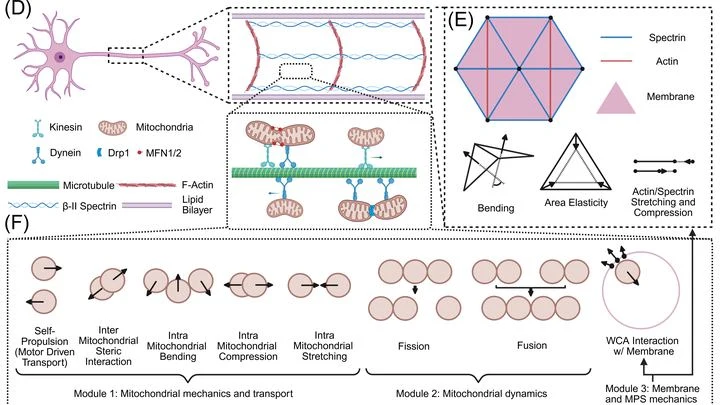
Inside every neuron, there's a long, thin channel, the axon, through which signals travel from the cell body to other cells. To keep this channel working, mitochondria constantly shuttle along it. These tiny organelles produce energy and move in both directions, like cars on a narrow road.
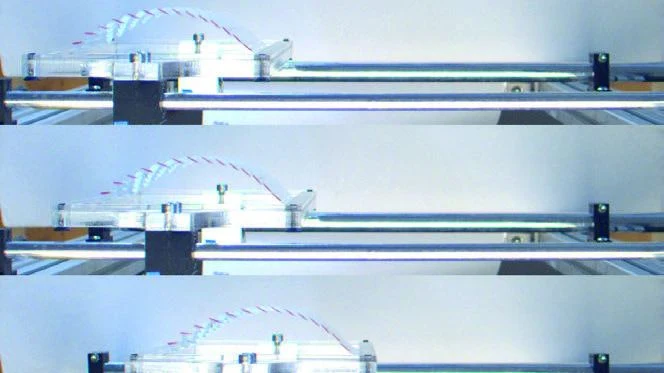
A flat sheet with slits in a flow of water or air behaves like self-adjusting blinds. The pressure opens the gaps, and each strip of material tilts, turning into a miniature wing. Thus, even a sheet placed perpendicular to the flow generates not only drag but also significant lateral lift.
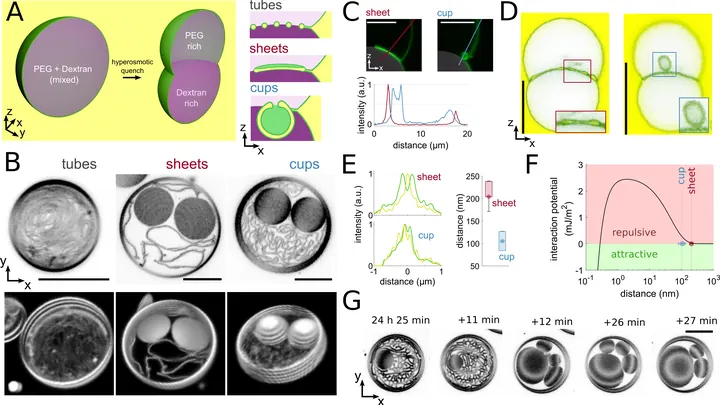
Inside a living cell, droplets float that don't mix with the surrounding fluid, like oil in water. These droplets aren't just passive clumps; they actively press on membranes and make them bend. Scientists observed this process in living plant cells, reproduced it in a test tube, and simulated it on a computer.
A piece of dough, when pulled from the sides, doesn't stretch evenly: in one spot it thins and tears. Living tissue behaves similarly, but instead of a tear, shear bands appear — narrow zones where cells begin to slide past each other, like cards in a deck when cut.
The layer of cells lining internal organs is like a crowd in a packed subway: everyone stands shoulder to shoulder, but sometimes the crowd starts to flow, and people slip past each other. Biologists call this behavior a transition from a jammed, solid state to a fluid one.
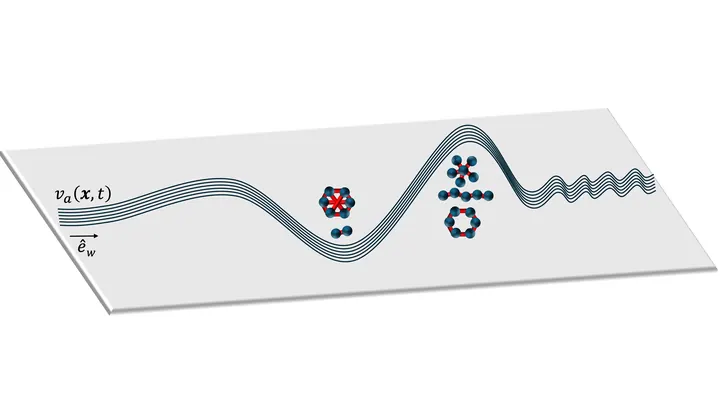
Polymers are long threads of carbon and hydrogen atoms. In living cells, they encounter streams of chemical signals that pulse like the surf. Long chains and closed rings behave like skilled surfers: they catch the wave and glide with it. Short fragments and tight coils, counterintuitively, move strictly against it.
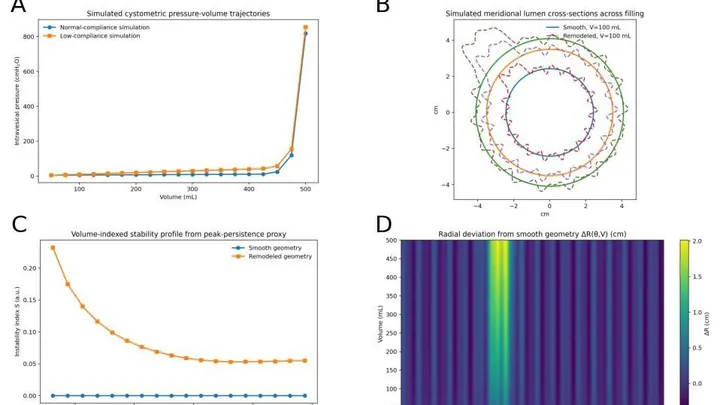
The bladder is like a balloon: as it fills, the wall stretches and the shape changes. Doctors usually monitor the pressure inside and how much fluid has entered, but they rarely look at the geometry itself — how the surface curves. Yet irregularities can appear before the usual metrics deteriorate.
Inside every cell, there is a scaffold of filaments, like construction scaffolding that gives the cell its shape and allows it to move. These filaments are connected by crosslinking proteins: some simply hold them together like ropes, while others act as tiny motors that crawl along the filaments and pull them toward each other.
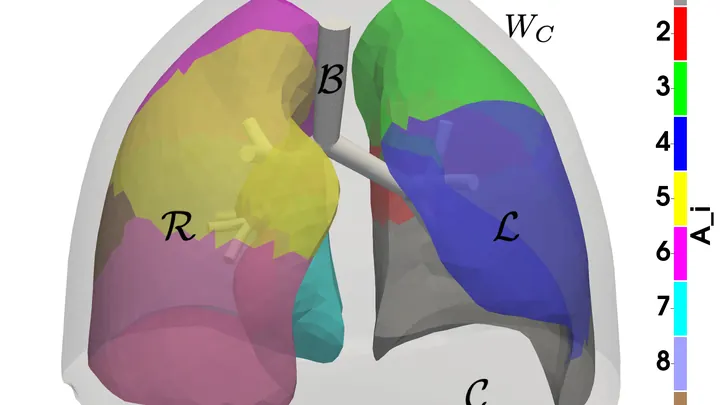
A lung scan reveals a tree: the trunk is the trachea, branches are the bronchi, and leaves are the alveoli. But how does air spread through these branches? Scientists built a computer model that replicates the lung's shape from images obtained via computed tomography.
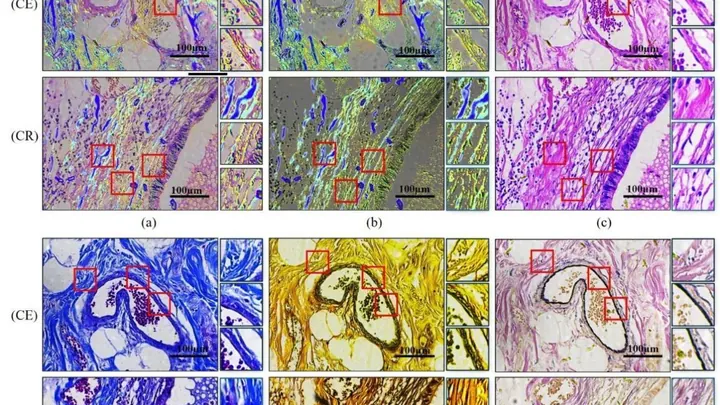
Inside our bodies, between cells, there is a support network — the extracellular matrix. It's like scaffolding made of proteins and carbohydrates that holds cells in place. When the fibers in this network change, it can be a sign of disease — for example, cancer or fibrosis.
Usually, to see these fibers, tissue is cut into thin slices and stained with special dyes.
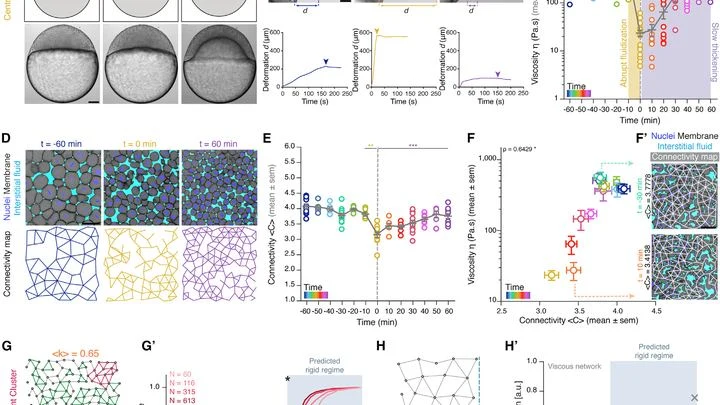
As an embryo grows, its cells don't just divide: they constantly touch their neighbors, like people in a crowded bus. The strength of these contacts determines where a cell moves and what shape the tissue takes. Scientists studied how cell 'stickiness' changes during the earliest stages of development.
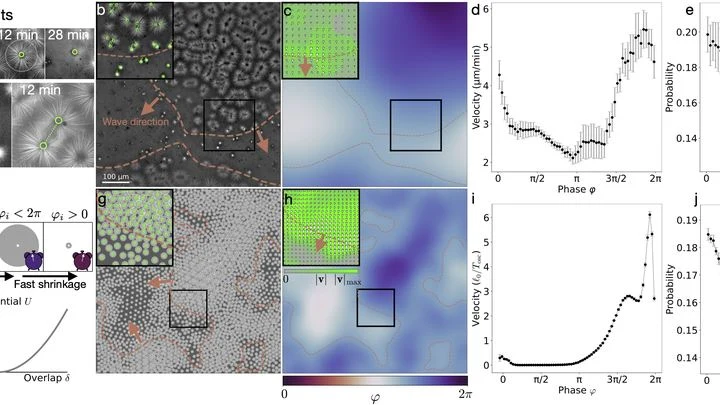
Inside a fertilized frog egg, waves ripple, like ripples on water, but made of proteins that command cell division. These waves travel millimeters, even though the egg itself is less than a millimeter across. Previously, it wasn't understood why they didn't fall out of sync. It turns out the waves clear their own path.
A thin rubber film lies on a table. Someone grabs it by the middle and slowly pulls upward. The film doesn't just rise: it arches into a dome, then wrinkles run along the dome's edge, like pleats on a skirt. Pull higher — the wrinkles gather into large folds that cross the entire film. And if you start lowering it, the folds don't disappear but collapse into new shapes.