One Neuron, One Memory: Inequalities to Unlock Brain Secrets express
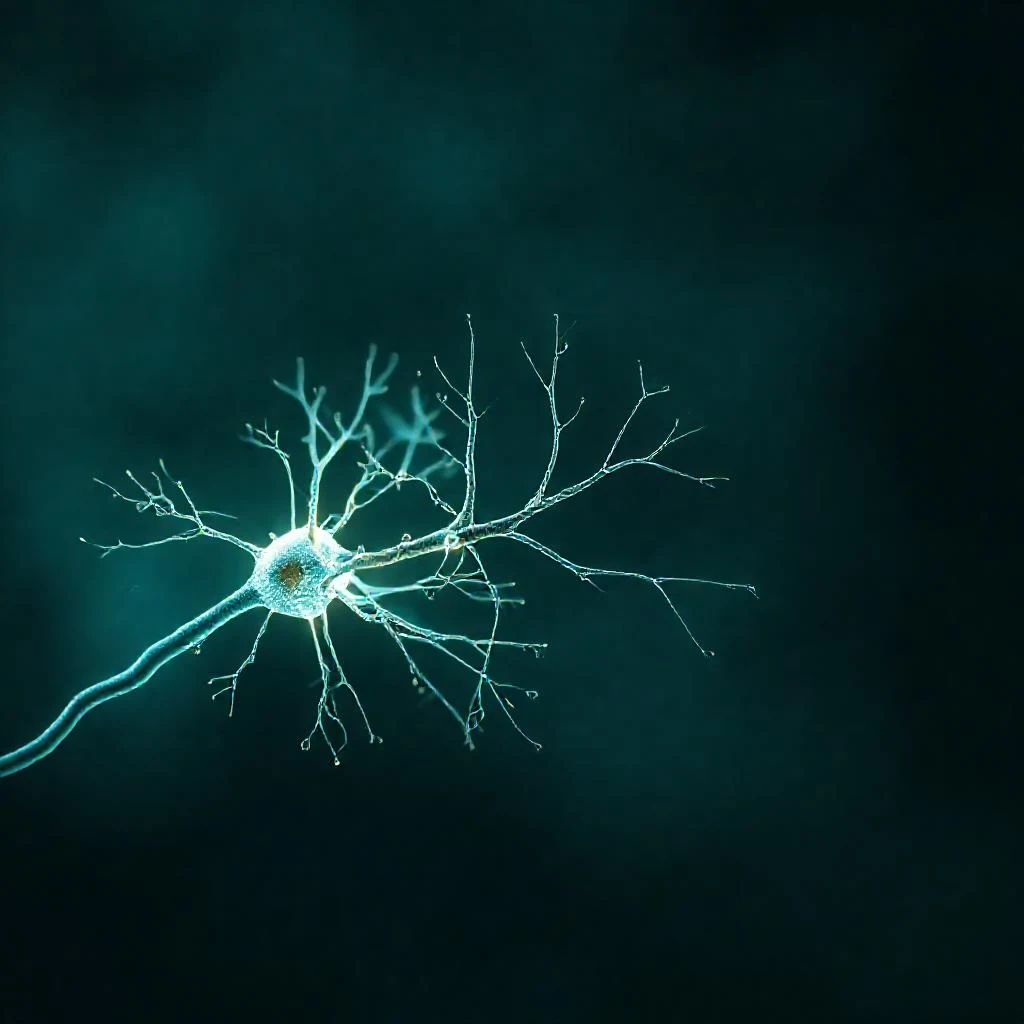
Neurons communicate via electrical impulses. For a long time, their behavior was described by the standard model: after each firing, the cell completely 'forgets' the past, like a car that screeches to a halt the moment you kill the engine. But what if a neuron is more like a car that coasts on its own momentum? Then its previous activity smoothly influences the next — the cell gains memory.
To test this, scientists applied the idea of Bell's inequalities, shifting them from quantum particles to the timeline. If the neuron 'coasts along,' the math test will catch it. Surprisingly, even a simple LC circuit with an inductor and capacitor can violate such inequalities — no quantum weirdness required. Moreover, the calculations unexpectedly echoed the Dirac equation from particle physics.
Discovering memory in single neurons will reshape our view of brain entropy: order increases, and temporal connections acquire curvature, as if the cell fine-tunes its internal clock to context. This approach will reveal just how complex a lone neuron can be.
Original abstract
as written by the authors arXiv:2605.12126
We propose an experimental programme to test Leggett--Garg-type temporal correlations in single-neuron dynamics. The goal is to distinguish between diffusive (Wiener/cable-equation) models and non-diffusive persistent stochastic models based on Kac-type finite-velocity processes leading to the Telegrapher's equation. We show that while purely diffusive dynamics satisfies Leggett--Garg inequalities, persistent stochastic dynamics can produce oscillatory temporal correlations capable of violating these inequalities. The Leggett--Garg inequality may be viewed as a temporal analogue of Bell-type constraints. In the present context, however, violation is interpreted conservatively not as evidence of microscopic quantum coherence, but as evidence against a simple trajectory-based diffusive description. The resulting temporal correlations indicate persistence, memory, and contextual temporal structure mathematically analogous to that encountered in quantum systems. Using the analytic continuation connecting Kac processes to Dirac-like envelope equations, we argue that finite-velocity persistent stochastic transport provides a natural mechanism for such non-diffusive temporal correlations. These tests therefore offer a possible experimental probe of contextual and non-Markovian structure in neural dynamics without requiring claims of microscopic quantum coherence in the brain.
Similar tests were once used to search for quantum consciousness, but a neuron doesn't need quantum weirdness to violate inequalities — a simple electric circuit with a coil and capacitor would suffice.
In William Gibson's 'Neuromancer,' computers store 'wet memory' like neurons — perhaps the future will learn to harness the internal memory of living cells for cybernetics.