Mini

Graviton Laser: Translating Gravity into the Language of Light

Original: "Reflecting Gravitons: The Graviton Laser and the Gertsenshtein effect"
arXiv:2605.14050v1 · 2026-05-13 · CC BY 4.0 · ⏱ 1 min · General Relativity HEP Theory
The Gertsenshtein effect briefly turns gravitons into photons, paving the way for the first laboratory amplifier of gravitational waves — and perhaps a new way to listen to the Universe.
Links in the knowledge graph 1

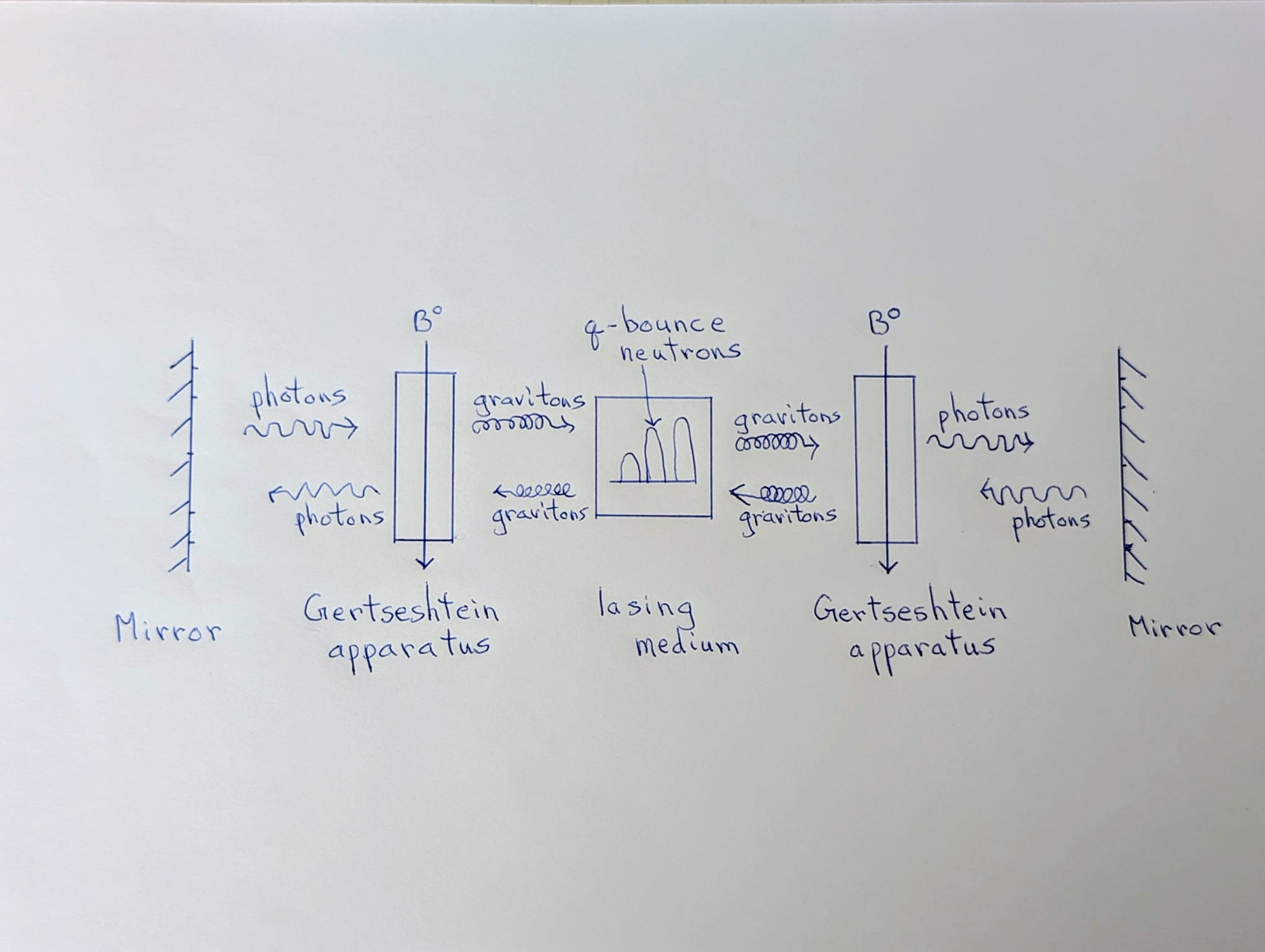
From black hole mergers fly 10⁷⁸ gravitons — more than atoms in the Solar System. They pass through everything like ghosts. But physicists have found a quantum translator: a strong magnetic field momentarily turns a graviton into a photon, and a photon can be reflected. Thus the idea of a graviton laser is born — a tool capable of amplifying spacetime itself.

🎯 Every black hole merger produces 10⁷⁸ gravitons — more than the number of atoms in the Solar System. These particles, capable of piercing right through the Earth, barely interact with matter. The Planck area (about 10⁻⁷⁰ m²) is that microscopic target they need to hit. But when there are so many particles, even the smallest target can't resist.

🎬 In Star Trek, graviton beams tow starships, and in Greg Bear’s novel The Anvil of Stars, aliens use gravitational weapons. A laboratory graviton laser turns these fantasies into an engineering challenge — a first step toward technologies that will change our relationship with spacetime.

\sigma \simeq \frac{\hbar G}{c^3} f_{if}
The cross-section is proportional to the Planck area (ℏG/c³ ≈ 10⁻⁷⁰ m²) and a dimensionless factor f_if, depending only on the geometry of the states.
P_{g\rightarrow \gamma} = \sin^2\!\left(\frac{2\kappa B_0 q \sqrt{MN} L}{c}\right)
κ is the gravitational constant, B₀ is the magnetic field, q is the wave vector, M and N are the numbers of photons and gravitons in the beam. With a large number of particles, the sine argument can become significant, ensuring a high conversion probability.
Scientists
Christian DopplerD. B. McLaughlinDidier QuelozMichel MayorR. A. RossiterNiels Bohr
Tags
gravitational waves electromagnetism Quantum Field speed of light magnetar black hole dark matter superposition gravity
Laws
Doppler effectHeisenberg uncertainty principleHawking radiationgravitational lensingprinciple of constancy of the speed of lightNoether's theorem
Original: arXiv:2605.14050v1 · CC BY 4.0 · bridge42worlds