Reflecting Gravitons: The Graviton Laser and the Gertsenshtein Effect ✛ ✦
Context
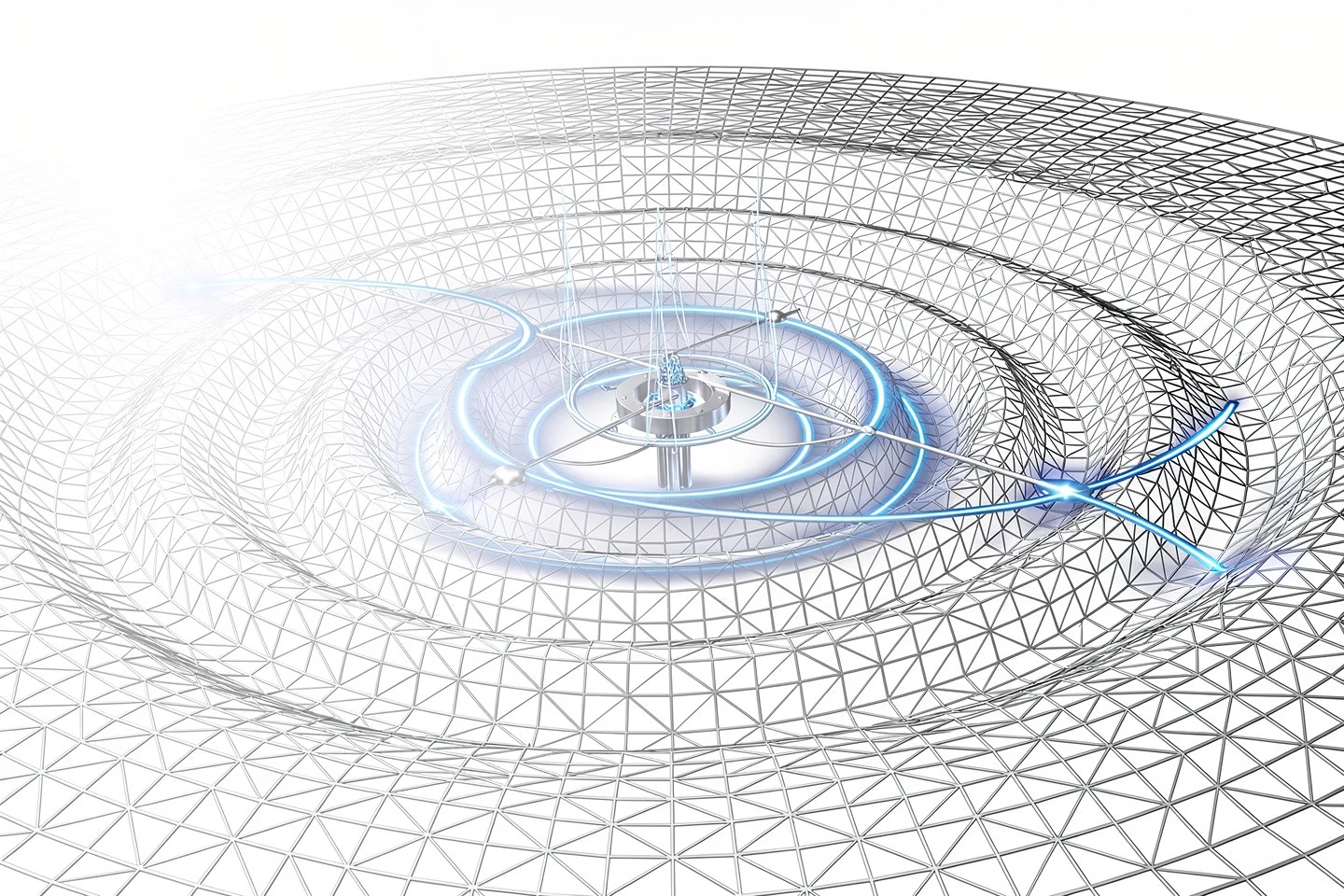
Building a graviton laser faces a fundamental obstacle: gravitons—quanta of gravitational waves—barely reflect off any substance. For a regular laser, the radiation must bounce back and forth through the amplifying medium many times, impossible without mirrors. The proposed scheme skirts this limitation by converting gravitons into photons, which are easily reflected, and then back into gravitons. This opens a path to the first laboratory amplification of gravitational waves and direct exploration of the quantum nature of gravity.
Methods
The researchers applied the Gertsenshtein effect—predicted in 1962—the conversion of gravitons into photons in an external electromagnetic field. In the quantum field description, the interaction Lagrangian of quantized fields contains cross-terms that mix the graviton and photon states when they move at the same speed. Upon entering a region of constant magnetic field, the particle's wave function turns into a superposition of photon and graviton components, resulting in partial conversion. The outgoing photons can be bounced off an ordinary mirror and then sent back through a reverse converter, regenerating gravitons. As the amplifying medium, ultracold neutrons in a gravity field, ultralight dark matter orbiting black holes, or macroscopic quantum oscillators like the mirrors in LIGO could serve. The cross section for stimulated emission of a graviton turns out to be universal—on the order of the Planck area with a dimensionless form factor.
Results
The analysis showed that the conversion amplitude depends on the parameter αL/c, where α is proportional to the product of the gravitational constant, the magnetic field, the wave vector, and the square root of the number of gravitons and photons in the beam. Under earthly lab conditions (100 Tesla magnetic field, 1 meter long region, 500 nm wavelength), αL/c ≈ 10⁻⁴⁵—vanishingly small. However, for enormous graviton fluxes, such as from merging black holes (number of gravitons ~10⁷⁸), the suppression factor disappears. Moreover, in the extreme fields of magnetars (~10¹¹ Tesla), the effect is amplified by many orders of magnitude. This means that with a sufficiently powerful initial gravitational signal, nearly complete conversion of gravitons into photons and back can be achieved, enabling multi-pass amplification in a graviton laser.
Implications
Realizing a graviton laser would be a breakthrough in quantum gravity, akin to the invention of the maser by Charles Townes. Understanding the conversion mechanism deepens the connection between gravity and electromagnetism, rooted in the theories of Einstein and Maxwell. Laboratory amplification of gravitons would allow direct investigation of quantum properties of spacetime.
Future development
In the future, detailed calculations of losses in realistic setups and identification of optimal amplifying media are needed. Harnessing the ultra-strong fields of magnetars or building compact powerful magnets could be possible. Astrophysical sources like merging black holes could serve as natural 'seeds'. Accounting for quantum fluctuations and decoherence will also be necessary, potentially yielding new predictions in quantum gravity.
Impact
A successful graviton laser would revolutionize gravitational-wave astronomy and quantum field theory.
Next steps
First and foremost, an analysis of realistic photon losses in the mirror and magnetic field system, as well as quantum noise in the amplifying medium, is needed to determine the lasing threshold.
Key open problems
This work directly ties into the unsolved problem of quantizing gravity and the nature of spacetime at the microlevel. Laboratory amplification of gravitons would provide an experimental foundation for testing theories of quantum gravity and the role of gravitational waves in particle physics.
The knowledge machine's view
This section is addressed to the author of the paper and their colleagues. Neighbouring works were found by meaning-based search across our archive, not by word overlap. We do not review: we show the field around the work.
What the work does
The paper proposes a graviton laser scheme that leverages the Gertsenshtein effect to convert gravitons into photons and back, bypassing the lack of mirrors for gravitational waves. The authors analyze the conversion amplitude as a function of the parameter αL/c and show that with astrophysical graviton fluxes and the extreme magnetic fields of magnetars, significant amplification is possible.
Where its strength is
A strong point is the concrete mechanism linking quantum gravity to experimentally accessible electrodynamics through the mixing of graviton and photon states, which opens a path to laboratory studies of the quantum properties of gravity.
Where it could go next
- It might be interesting to see how the Gertsenshtein effect manifests in magnetar environments, where magnetic fields are extreme, which could provide observational signatures to test the proposed mechanism.based on: Magnetars as Gravitational Echoes arXiv:2606.12546
- Nearby work on the direct conversion of gravitational waves into light may offer alternative approaches to conversion and broaden understanding of the conditions for efficient processes.based on: Gravitational Waves Turn into Light arXiv:2607.24930
- It could be useful to consider how gravitational waves interact with quantum systems, for instance in the context of detection, which might inspire new ways to amplify or register them.based on: A Quantum Net for Gravitational Waves arXiv:2608.02733v1
Worth trying
- Test whether accounting for realistic magnetic field profiles of magnetars provides additional conversion enhancement compared to a uniform field.
- Assess whether superconducting cavities could be used to increase the effective interaction length and thus the conversion probability.
- Consider using nonlinear optical media to mimic graviton-photon mixing under laboratory conditions.
Why this may matter
If the proposed scheme is realized even partially, it would be a first step toward tools for manipulating gravitational waves in the lab, potentially leading to new tests of quantum gravity and, in the long run, to technologies analogous to lasers for electromagnetic radiation.
Nearby works in our archive
- Magnetars as Gravitational Echoessimilarity 0.66
- Light Whirlwinds for Electronssimilarity 0.65
- How Gravity Repaints Gravitational Wavessimilarity 0.65
- Gravitational Waves Turn into Lightsimilarity 0.64
- Radio Telescopes Hear Gravitational Ripplessimilarity 0.64
- A Quantum Net for Gravitational Wavessimilarity 0.63
The closest work in the archive sits at 0.66 by meaning — the usual level for our corpus.
Original abstract
as written by the authors arXiv:2605.14050v1
Graviton lasers have been considered in the past, \cite{gl}, but practical terrestrial implementations appear infeasible. The absence of any known mechanism to reflect gravitons means that it remains unclear how a graviton beam could be directed repeatedly through a putative lasing medium. Astrophysical graviton lasing is still a possibilty as circular graviton orbits around blackholes afford the possibility of an arbitrarily long path length through the lasing medium of ultra-light dark matter \cite{bhgl,nhaxs}. In this essay, we consider the possibility of a graviton laser that could be constructed in a laboratory setting. The graviton lasing medium could be one of many possible gravitating systems, of which we give three possible examples. We calculate the possibility of reflecting the gravitons by using the conversion of gravitons into photons in an external magnetic field, the Gertsenshtein effect, \cite{Gertsenshtein1962}. We may convert the gravitons to photons, then reflect the photons, then reconvert the photons into gravitons via the same effect, and then pass them through the graviton lasing medium. With an identical apparatus on the other side, we can essentially extend the path length of the gravitons through the lasing medium as arbitrarily long as desired.
The Planck area (~10⁻⁷⁰ m²) is the surface area of a sphere with the Planck length as its radius. For comparison, if you blew an atom up to the size of Earth, the Planck length would be smaller than a millimeter. This minuscule scale sets the probability of graviton interactions, but astronomical numbers of particles can compensate for it.
The idea of controlling gravity has long excited sci-fi imaginations. For instance, in the 'Star Trek' series, graviton beams are used to tow objects, and in Greg Bear's novel 'Anvil of Stars', aliens create gravitational weapons. A lab-based graviton laser is a first step toward that dream.
Key numbers
- Planck area: 10⁻⁷⁰ m²
- number of gravitons in a black-hole merger: 10⁷⁸
- wavelength of gravitons (visible range): 500 nm (q ≈ 2×10⁻⁸ GeV)
- magnetic field of 100 Tesla: 2×10⁻¹⁴ GeV² in natural units
- length of magnetic region 1 meter: 5×10¹⁵ GeV⁻¹