Mirror for the Invisible: Making Gravity Reflect ✛ ✦
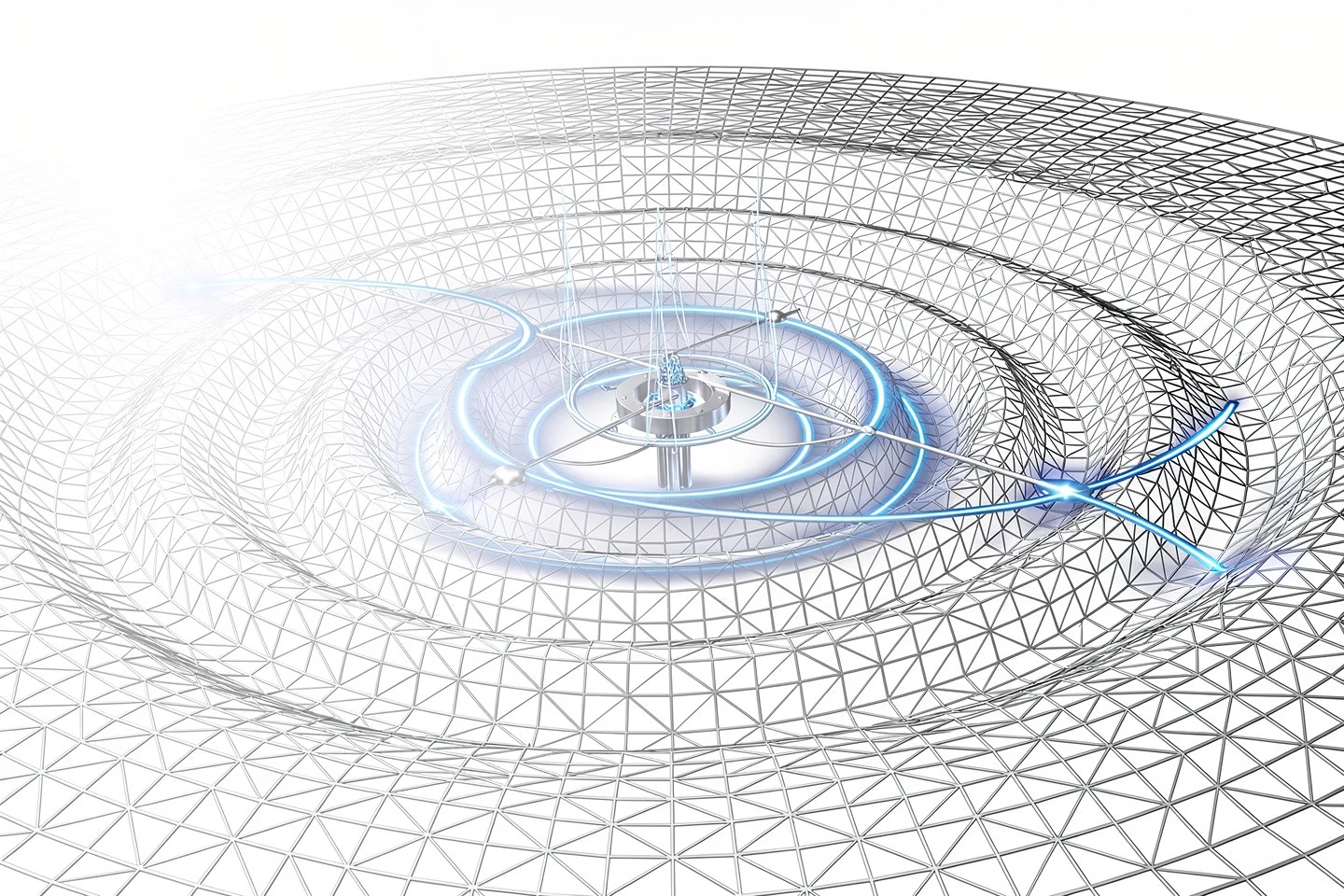
Lasers amplify light by bouncing it back and forth between mirrors. But gravity particles — gravitational waves — pass through any mirror without stopping. The solution: dress them in a mask of light.
Gravitons and photons travel at the same speed of light, so a powerful magnetic field acts like a costume department. In a short stretch, it tailors a photon outfit for the graviton, and according to quantum field theory, the particle becomes dual — neither one nor the other, but both at once. This hybrid slips into a box with mirrors. Inside, it bounces around, causing the amplifying medium — a cloud of dark matter or ultracold neutrons — to spawn more and more doubles. At the exit, a second field strips off the disguise, returning a pure but amplified gravitational beam.
The odds of pulling off this trick in the lab are one in 10⁴⁵. But a black hole merger churns out 10⁷⁸ gravitons, and the trick works. The effect is even stronger with magnetars — stars with mind-boggling magnetic fields. Nature is already running these experiments.
The idea continues the path from the maser of Townes and the quest for a unified picture begun by Einstein and Maxwell. Gravitational lasers promise to become detectors that pick up the gravitational whispers of deep space.
The Planck area is a fundamental unit tied to quantum gravity. If you scaled an atom up to the size of Earth, the Planck length (from which this area comes) would be smaller than a tenth of a millimeter.
Controlling gravity is a long-time dream of sci-fi. In Star Trek, graviton beams are used to tow objects, and in Greg Bear's novel The Anvil of Stars, aliens create gravitational weapons. A laboratory graviton laser is a step toward that fantastic reality.