Martian Spores: How Life Could Have Flown to Earth express
The idea of extraterrestrial origin of life has long excited minds. Fred Hoyle believed bacteria travel between stars. A new study tested a similar but closer route: from Mars to Earth. In ancient times, Mars had water, and asteroid impacts knocked rocks with microbes into space. They fell on our planet — interplanetary delivery without a sender.
In the lab, spores (nature's nanocapsules) were covered with a layer of dead cells, creating a protective shield, and exposed to harsh solar ultraviolet — hundreds of times stronger than on Earth. Even with the rock rotating, many survived. And calculations showed that such a rocky container reaches Earth in a year — faster than Magellan circumnavigated the globe.
This doesn’t prove life came from Mars, but it confirms: carbon building blocks of life can travel inside cosmic dust. Interplanetary mail works.
Original abstract
as written by the authors arXiv:2605.15595
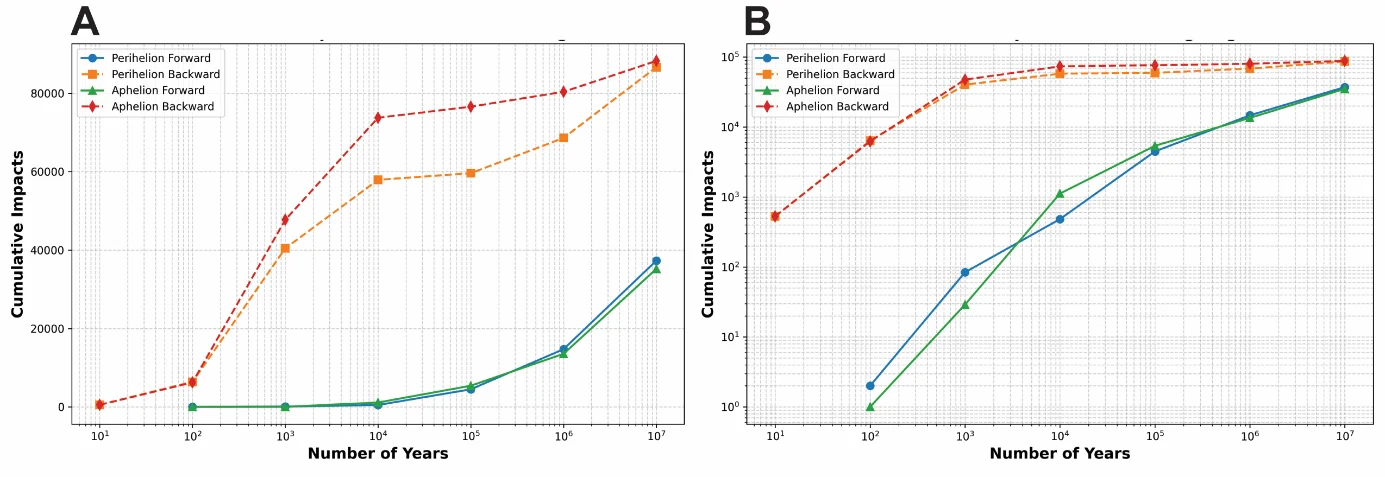
The study of the origin of life on Earth has been broadened due to panspermia models that suggest that early life may have been transferred between planets. Mars likely once had conditions that could support life, and it is interesting therefore to consider the question of early interplanetary transfer of life from Mars to the Earth. Endospore forming bacteria are ideal candidates for these studies as they can withstand harsh environmental conditions. For this reason, the idea that early life could have been delivered to Earth on Martian ejecta in the late Hadean period has gained considerable interest. To assess this, we have performed a series of both biological and astrophysical experiments. We exposed endospores shielded by a lysed colony of bacteria to extended UVC irradiation under a variety of rotation regimes, to simulate interplanetary exposure on ejecta with a variety of rotation periods. We also performed detailed n-body simulations of particles ejected from Mars at both perihelion and aphelion, finding that Martian ejecta can reach the Earth on timescales of just a few years - suggesting that, with ejection at the ideal time, transfer could occur within one year. Taken together, this study suggests this interplanetary transfer of biologically viable material from Mars to Earth is plausible under favourable conditions.
Among meteorites on Earth, there are fragments of Mars — pieces of crust knocked off by asteroid impacts and delivered straight to us.