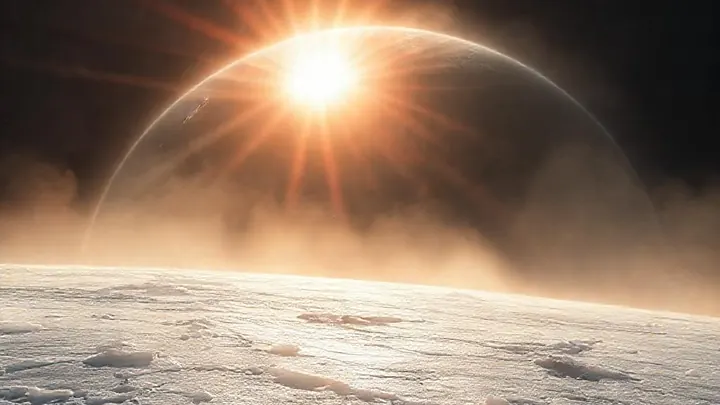
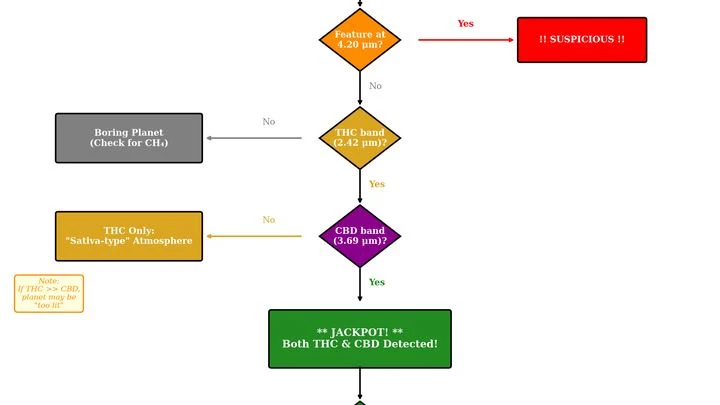
A biosignature is any detectable phenomenon (gas, mineral, color) that can only be explained by biological activity. The most compelling biosignatures are gases in chemical disequilibrium; for instance, the simultaneous presence of oxygen (O₂) and methane (CH₄). It is crucial to rule out non-biological sources (volcanoes, photochemical reactions) that can produce false signs of life.
History
The first ideas about possible signs of life on Mars were voiced back in the 19th century (Schiaparelli's canals). A systematic approach emerged in the 1960s, when James Lovelock analyzed Earth's atmosphere as a product of the biosphere. Carl Sagan and others developed the concept of thermodynamic disequilibrium. With the discovery of exoplanets in the 1990s, the search for biosignatures became a central goal of astrobiology.
How it works
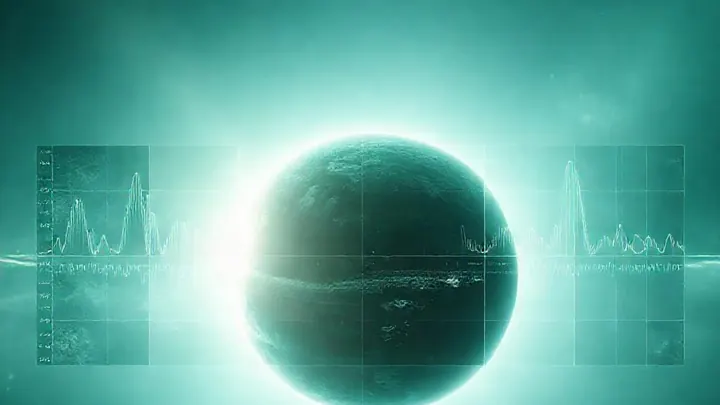
During a transit of an exoplanet in front of its star, part of the starlight is filtered by its atmosphere, and absorption lines of molecules appear in the spectrum. Each molecule has a unique spectral 'fingerprint'. By measuring the depth of lines at different wavelengths, the gas composition is determined. A biosignature is considered reliable if a combination of gases is detected that cannot be maintained without a biological source, and all known abiotic pathways under the given conditions (temperature, radiation, geology) are ruled out. Principles of spectroscopy and photochemical modeling are used.
In practice
The search for biosignatures in exoplanet atmospheres is the main method for finding extraterrestrial life, driving the development of cutting-edge telescopes.
Fun fact
Earth, with its oxygen-methane atmosphere, would have shone like a beacon for hypothetical alien astronomers for two billion years already.
An old mattress stops bouncing back: the filling clumps up, and the springs lose their resilience. The ovary changes with age in much the same way, except that instead of filling, stiff connective tissue grows inside it, and the role of springs is played by the cells that support the eggs.
Every fall, Issaquah Creek in Washington State turns into a maternity ward for thousands of salmon. The fish swim in, spawn, and die, and the water carries away their molecular traces: fragments of DNA, short-lived RNA, chemical marks on the genetic text. From September through November 2024, researchers collected a liter of water every week and ran it through a filter to catch those traces.
A doctor looks at a screen and sees two images of the same part of the body. One shows where blood is rich in oxygen, the other shows how fast it rushes through the finest vessels. Previously, these images were made by different devices, and combining them was difficult. Now engineers have built a device that takes both images simultaneously.
A drop of water on glass trembles and shimmers: it seems to have a life of its own. Similar behavior can now be observed in the world of colloids: tiny particles suspended in a liquid. Researchers simulated particles that emit chemical signals. These signals, like scents in the air, spread around and cause neighbors to either draw closer or move apart.
The light of a distant star carries within it the silent hum of the atmospheres of planets orbiting it. For a long time, capturing it was like trying to make out a whisper over a roaring waterfall. But with the advent of the 39-meter Extremely Large Telescope (ELT) and the ANDES spectrograph with a resolution of 100,000, this task is no longer hopeless.
Imagine a packed subway car at rush hour. Passengers don't just stand there: they breathe, release moisture, squeeze toward exits, and sometimes get stuck in doors, blocking movement. Now imagine these passengers can remodel the car's walls, add handrails, or turn the floor into gel.
In 1960, the Tatel radio telescope spent weeks listening to emptiness around Tau Ceti and Epsilon Eridani. Project Ozma was searching for technosignatures — traces of another mind at work.
The search for life beyond Earth is like tuning an old radio: we listen to the chemical whisper of distant exoplanets' atmospheres, trying to pick up signs of biological activity.
In 1981, Alan Guth proposed a scenario of cosmological inflation — a lightning-fast expansion of space that stretched quantum fluctuations to the scale of entire galaxies. Since then, cosmologists, like archaeologists, have been excavating this event from the structures of the Universe.
Imagine an artist whose canvas is an entire planet, and whose palette is molecules drinking starlight. His brush is billions of years of evolution, and his painting is a spectral portrait visible even from another star system.
Every star is a living archive, and its spectrum a multilayered manuscript. Over billions of years, the history of the galaxy is written into it: the galactic chemical evolution of the Milky Way leaves a smooth trace in elemental abundances.
In 1944, Erwin Schrödinger asked the question "What is life?", foreshadowing quantum explanations of biology. Almost a century later, physicists return to this puzzle, armed with the apparatus of quantum field theory.
Tiny seeds of life can cross the black void on icy wanderers like comet 3I/ATLAS. The James Webb Space Telescope found water and methane on it for the first time, and light analysis revealed an unusual gas composition.
Studying distant exoplanets, scientists look for signs of life — for instance, water and carbon — and signs of technology: radio signals, megastructures. But between these clues there is a yawning gap. If intelligence hasn't created machines or they've vanished, we won't notice it.
Earth's magnetic field is like an invisible shield that protects us from cosmic radiation. But if you look closely at its long-term averaged pattern, you'll notice that this shield isn't perfectly smooth: it has its own "seams" and "patches." New research using computer simulations of the geodynamo shows that…
The Moon is a natural archive that has been collecting cosmic dust for billions of years. Among the microscopic grains that arrived from distant stars, there could be techno-specks — particles created by alien civilizations.
From childhood, we're used to thinking of space as infinite and isotropic. But Einstein and Lemaître were already asking: could the Universe be closed in on itself, like a Möbius strip or a 3-torus?
The atmosphere of Titan, discovered by Christiaan Huygens, is opaque to ordinary telescopes. But spectral analysis finds 'windows' of transparency — narrow regions where the haze parts.
In the attic, you find an old, worn suitcase. From the stickers and scratches, you can guess where it's been. Astronomers have long searched for a similar 'sticker' for planets, and thought they found it in carbon monoxide molecules. Ordinary carbon monoxide consists of a carbon-12 atom and an oxygen atom.
Civilizations in the Universe are separated not just by distance, but by the vast gulf of time. Hunting for their traces is like archaeology: instead of palace ruins, we find clouds of cosmic dust.
In the orchestra of interstellar life search, every note counts. And the score here is dictated not by man, but by a distant star. For the planet TRAPPIST-1 e, one of seven in the system of an ultracool red dwarf, the conductor's baton is harsh ultraviolet light.
In the orchestra of interstellar life search, every note counts. And the score here is dictated not by man, but by a distant star. For the planet TRAPPIST-1 e, one of seven in the system of an ultracool red dwarf, the conductor's baton is harsh ultraviolet light.
The MethaneSAT satellite scans for leaks of метана — a gas that's invisible but packs a powerful planetary warming punch. Its "nose" is a спектрометр, a device that spots the subtlest color changes in light passing through the atmosphere — the telltale sign of methane.
From carbon, nitrogen, oxygen, and sulfur, you can assemble 10⁶⁰ different small molecules: that's a 1 with 60 zeros, more than the stars in the visible universe. Life uses only a tiny fraction of this menu, but not randomly.
The idea of extraterrestrial origin of life has long excited minds. Fred Hoyle believed bacteria travel between stars. A new study tested a similar but closer route: from Mars to Earth. In ancient times, Mars had water, and asteroid impacts knocked rocks with microbes into space.
The search for extraterrestrial life is like a detective investigation: from tiny clues, you must distinguish traces of life from random imprints of non-living nature. On Saturn's moon Enceladus, the investigators are lucky — geysers burst from cracks in the icy crust, ejecting water from the subsurface ocean straight into space.
When the light of a distant planet is split into colors, it suddenly jumps at the boundary between red and invisible infrared, as if someone flipped a switch. This is how the vegetation red edge manifests itself: chlorophyll is transparent to near-infrared radiation, and the leaf, to avoid overheating, reflects it away.
The hunt for life on distant planets is like diagnosing a rare disease with a test of unknown accuracy. A single positive result means nothing: maybe it's a glitch? We search the atmospheres of exoplanets (worlds around other stars) for traces of water and other compounds, but any signal could be a false alarm.
The smell of fresh bread unmistakably signals a nearby bakery. But to know if baking is happening right now, it's better to catch not the aroma itself but its intensification — the continuous stream of hot air from the oven. This everyday analogy helps grasp a revolution in the search for extraterrestrial life on exoplanets — planets beyond our solar system.
Around small, cool, but extremely restless red dwarfs, planets the size of Earth often orbit. Such a star is like a temperamental stove that intermittently erupts flares: powerful streams of light and particles batter the planet's atmosphere, as if someone splashed fire into a simmering soup pot.
A world that for years refused to show its face. Planet GJ 1214 b is exactly such a case. It is larger than Earth but smaller than Neptune, and its dense envelope made the atmosphere invisible to telescopes: starlight passed through it without leaving clear traces. But astronomers' persistence and a new sensitive instrument provided the first clue.
Light from a distant star, passing through the atmosphere of planet K2-18b, left unusual "fingerprints" in its spectrum. Astronomers spent 420 hours collecting this light with the James Webb Space Telescope and split it into colors, like a rainbow.
A chemical detective searches for life on other planets. Its tool is a mass spectrometer that identifies molecules by weight (the same device earthly forensic scientists use to analyze clues).
When a planet passes in front of a star, the light pierces its atmosphere and absorbs the flavor of gases. Each gas leaves its color fingerprint in the light — a bitter or sweet stroke. Scientists try to read this recipe: what substances and in what proportions are mixed in the air of an alien world.
Gait is not just a way to get from point A to point B. Each step, arm swing, and torso tilt is like a signature the body leaves in space. Doctors have long noticed that disease alters gait, but they considered it merely a symptom of a specific problem: if you limp, your leg hurts. Now it turns out that gait is a whole book about health, and you can read it with an ordinary camera.
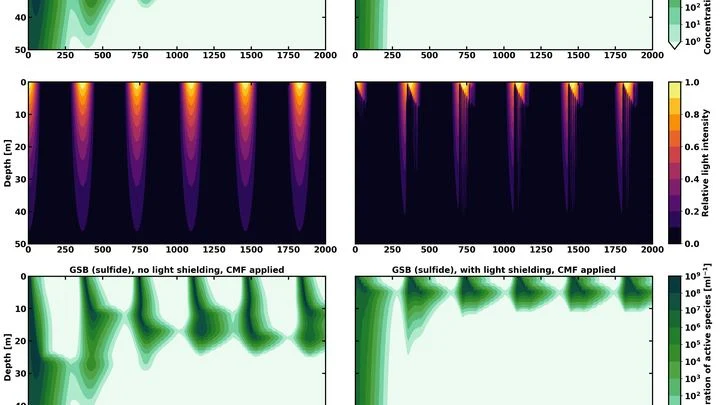
Simple equations that describe fox and rabbit cycles have been turned to bacteria on distant exoplanets, like K2-18 b. These worlds hold deep oceans under thick hydrogen skies. Like duckweed on a pond, light-eating microbes cover the sunlit water surface, stealing light from those below.
A telescope stares at a planet 124 light-years away and sees gases in its atmosphere that on Earth are produced by microbes. The immediate thought: life. But it's not that simple.
Planet K2-18b is a sphere wrapped in a thick layer of hydrogen. In such a layer, like in a giant chemical flask, reactions take place.
Scientists built a model of Earth with all living organisms removed — from bacteria to trees. Over billions of years, this 'empty house' didn't turn into an icy desert. Volcanoes, like a furnace, release carbon dioxide, and rock weathering, like a thermostat, absorbs it.