The origin of life is the scientific inquiry into how non-living chemical compounds on early Earth (or other planets) assembled into the first self-replicating, metabolically active structures. This field bridges chemistry, geology, and biology, seeking to explain the transition from simple organic molecules to the first cells. Research in this area often focuses on the conditions of early planetary environments, such as the availability of water, energy sources, and organic building blocks like amino acids and nucleotides.
History
The modern scientific study of abiogenesis began with the Miller-Urey experiment in 1953, which demonstrated that amino acids could form spontaneously under simulated early Earth conditions. Earlier ideas date back to Darwin's 'warm little pond' hypothesis and Oparin's 1924 proposal of a 'primordial soup'.
How it works
Scientists investigate prebiotic chemistry by simulating early Earth conditions in the lab, such as lightning discharges in a reducing atmosphere (the Miller-Urey experiment) or hydrothermal vents on the ocean floor. The key steps involve the formation of organic monomers, their polymerization into larger molecules like RNA, and the eventual emergence of self-replicating systems. Recent work also considers the role of meteorites delivering organic compounds and the potential for life to arise in diverse environments, including those with high radiation or extreme pH.
In practice
Understanding the origin of life informs astrobiology, guiding the search for habitable exoplanets and biosignatures, and also inspires synthetic biology efforts to create artificial life-like systems.
Fun fact
Cyanide, often considered a deadly poison, is now recognized as a likely key player in prebiotic chemistry, as it can catalyze the formation of nucleotides and amino acids under early Earth conditions.
Stated relations:part of →DNA · part of →RNA · part of →gene · describes →mutation · describes →enzyme
In a psychologist's quiet office, a fourteen-year-old fills out a questionnaire about childhood. The scores climb, and on the MRI scans the amygdala climbs with them: a small node deep in the brain that teaches us to fear and to remember danger. In a rat held in a narrow tube for three hours a day, the same structure grows faster than in its calm counterparts.
Inside a cell there are tiny droplets that have no membrane yet behave like separate compartments. One such droplet, made of identical short RNA fragments, resembles fresh aspic: it is transparent, springy, and easily changes shape. But if you watch it long enough, something resembling a sponge begins to grow inside it.
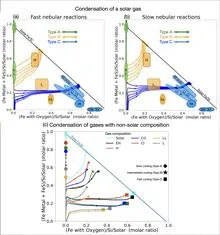
Three cabinets full of rocks. In one, metallic grains and the gray mineral enstatite; in the second, the same grains but with rusty streaks; in the third, layered clays swollen with water. All three sets were pulled from meteorites that fell to Earth: chondrites. They were born in the same gas-and-dust disk around the young Sun, yet somehow turned out so different.
The liver is an orchestra in which every cell plays its part from a shared score. Males and females have different scores: in males, the genes responsible for detoxifying foreign substances and steroid hormones sound louder, while in females, the genes for fat metabolism and bile acids do.
Life begins with a bubble. In a warm puddle on ancient Earth, fat molecules could gather into tiny spheres — prototypes of cells. Inside such a sphere, a polymer happened to be present that accelerated the uptake of new fats from the surrounding water. The bubble grew, divided, and passed its composition to offspring.
When an antibody meets a virus, it doesn't latch on with a single death grip. Rather, it's like two bunches of grapes tumbling in water, catching each other with dozens of short tendrils. Each tendril is weak on its own, easily torn by the thermal jitter of water molecules, but together they hold tight.
A jazz ensemble: at first, a cacophony of random notes. Then — a catchy riff that plays over and over. Such is the riddle of the origin of life — only in the language of chemistry.
In the black depths of space, on the surfaces of tiny icy dust grains, a quiet construction is underway. There, where temperatures drop to near absolute zero and harsh radiation abounds, the ordinary amino acid glycine, the simplest protein building block, links up with itself.
In 1970, mathematician John Conway invented the Game of Life — a cellular field where just three rules generate surprisingly complex patterns. Forty years later, SmoothLife appeared: a version where space is no longer cellular but smooth, like a blurred patch. The authors of the new study took an even simpler variant of this continuous game: now everything changes smoothly in time as well.
A tuning fork struck once rings pure and long. But if you shake the fork itself while it sounds, the tone wavers and dies out quickly. Something similar happens to electrons in any piece of matter. Atoms in a lattice never stay put: thermal vibrations keep them jittering.
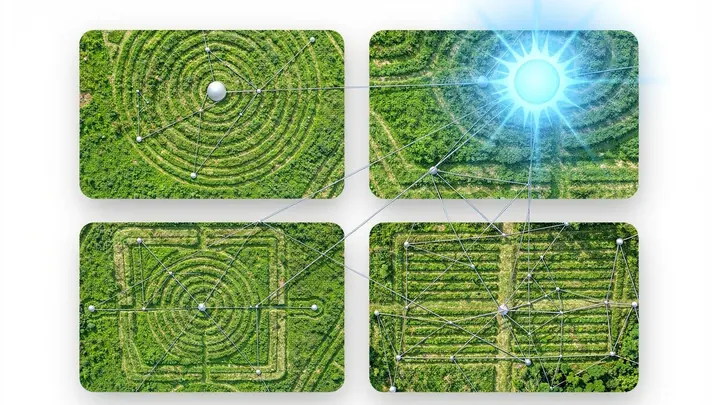
Deep in the Amazon rainforest, beneath a multi-layered canopy of leaves, lie vast earthen figures — squares, rectangles, the occasional rhombus. For decades they teased archaeologists with their silent geometry, until a researcher armed with orbital optics saw them as an astronomical instrument.
Imagine a packed subway car at rush hour. Passengers don't just stand there: they breathe, release moisture, squeeze toward exits, and sometimes get stuck in doors, blocking movement. Now imagine these passengers can remodel the car's walls, add handrails, or turn the floor into gel.
The search for life beyond Earth is like tuning an old radio: we listen to the chemical whisper of distant exoplanets' atmospheres, trying to pick up signs of biological activity.
Imagine an artist whose canvas is an entire planet, and whose palette is molecules drinking starlight. His brush is billions of years of evolution, and his painting is a spectral portrait visible even from another star system.
For years, the Sun teased astrophysicists. In its atmosphere, refractory elements, like spices in a basic recipe, were slightly less abundant than in nearly identical twin stars. Suspicion arose: could our star be modest, skipping the planetary "dessert" that others devour with gusto?
In 1944, Erwin Schrödinger asked the question "What is life?", foreshadowing quantum explanations of biology. Almost a century later, physicists return to this puzzle, armed with the apparatus of quantum field theory.
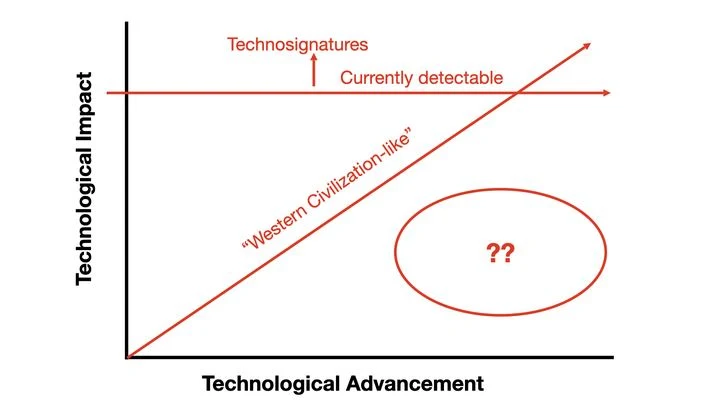
The Drake Equation is an attempt to guess the number of intelligent civilizations in our Galaxy. It’s like counting finished cakes in an unknown bakery: you know the ovens (stars), the baking sheets (planets), and the baking time. But were eggs added to the batter? Western science, relying on a single earthly recipe, considers them a rare ingredient.
A living organism is a machine that constantly channels energy through itself and converts it into heat. This internal cycle is called internal entropy production (a measure of energy dissipation). But about 2.5 million years ago, our ancestors switched on a second loop — an external one. They picked up a sharpened stone, and then a burning branch.
Life is a constant dance between order and chaos. Back in the mid-20th century, Erwin Schrödinger noted that living things feed not so much on matter as on "negative entropy"—the ability to maintain their own order by increasing disorder around them.
In the heart of the Milky Way, in the cloud G+0.693, astronomers caught a sweet signal — emission lines of erythrulose, a simple sugar with four carbon atoms and four oxygen atoms.
A city is a living system: it consumes resources, produces waste, and its 'circulatory system'—the road network — delivers people and goods to their destinations. But while engineers design transport arteries as rigid geometry of straight lines, nature has spent millions of years perfecting ideal distribution networks.
From carbon, nitrogen, oxygen, and sulfur, you can assemble 10⁶⁰ different small molecules: that's a 1 with 60 zeros, more than the stars in the visible universe. Life uses only a tiny fraction of this menu, but not randomly.
A tightrope walker inches across a chasm. As long as they keep their balance and avoid sudden moves, they're safe. But one overcorrection, and a fall is inevitable. Life works much the same way at every level — from proteins inside a cell to entire ecosystems.
The idea of extraterrestrial origin of life has long excited minds. Fred Hoyle believed bacteria travel between stars. A new study tested a similar but closer route: from Mars to Earth. In ancient times, Mars had water, and asteroid impacts knocked rocks with microbes into space.
The search for extraterrestrial life is like a detective investigation: from tiny clues, you must distinguish traces of life from random imprints of non-living nature. On Saturn's moon Enceladus, the investigators are lucky — geysers burst from cracks in the icy crust, ejecting water from the subsurface ocean straight into space.
If you don’t stir a layered cocktail, the heavy syrup sinks to the bottom. A young planet is much the same — a seething ocean of molten rock. As it cools, minerals crystallize: some, like iron, get heavy and sink, while others float. You’d think a dense layer would pile up at the core.
Three craftsmen work in the same workshop. The first tries to figure out whether tiny hourglasses are built into nature's own machinery. The second attaches a laser pointer to a microscope to see details invisible to the naked eye. The third, conversely, takes living threads and carefully weaves them into fragile quantum circuits.
Globular clusters are dense 'balls' of hundreds of thousands of stars that orbit the center of the Milky Way. Some were born in our Galaxy, others were captured when the Milky Way swallowed dwarf satellite galaxies. They can be distinguished by chemical composition, but astronomers now have a new tool — dynamical age.
The smell of fresh bread unmistakably signals a nearby bakery. But to know if baking is happening right now, it's better to catch not the aroma itself but its intensification — the continuous stream of hot air from the oven. This everyday analogy helps grasp a revolution in the search for extraterrestrial life on exoplanets — planets beyond our solar system.
Neutrinos are almost elusive particles: they zip through planets without noticing atoms. So every catch is a stroke of luck. Recently, the underwater detector KM3NeT snagged a neutrino with energy millions of times greater than Earth's most powerful accelerators can produce.
A pot of water sits on the stove. The temperature drops: plus one degree, zero, minus one — the water stays liquid. But at some point, a light breath is enough to make the whole mass instantly freeze into ice. Physicists call such jumps first-order phase transitions.
A star inherits the chemical makeup of its parent gas cloud, just like a child inherits genes from its parents. Astronomers turned this into a method: by measuring the fraction of carbon and other elements with spectroscopy (splitting light into colors), they construct family trees for the stars in a galaxy.
A rock knocked off one planet by an asteroid impact hurtles through space and lands on another. If microbial spores are hiding inside, they might survive the cold, the radiation, and the rough landing. That's panspermia — the idea that life travels between worlds. But imagining such a journey is one thing; calculating every step is quite another.
Mars is an icy desert with an average temperature of minus 60. To warm it without biology, scientists propose three approaches with a single idea: create a thick heat-trapping blanket.
First, deploy transparent film-blankets over bases. They let sunlight in but keep heat from escaping, allowing us to harvest water from the soil and grow plants.
A chemical detective searches for life on other planets. Its tool is a mass spectrometer that identifies molecules by weight (the same device earthly forensic scientists use to analyze clues).
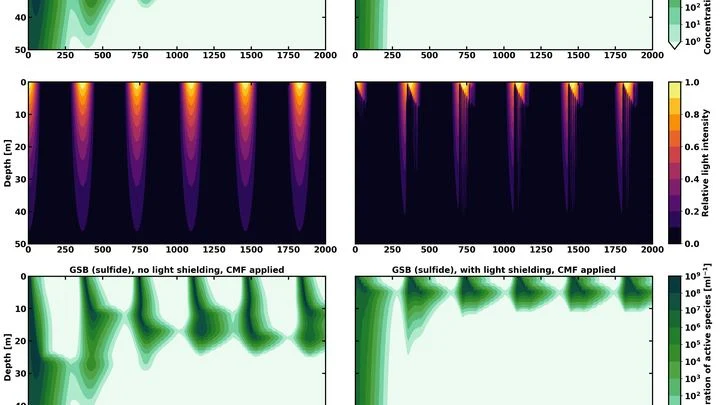
Simple equations that describe fox and rabbit cycles have been turned to bacteria on distant exoplanets, like K2-18 b. These worlds hold deep oceans under thick hydrogen skies. Like duckweed on a pond, light-eating microbes cover the sunlit water surface, stealing light from those below.
When a baker kneads dough, the grains of flour can tell you which mill they came from. It's the same with Earth: the composition of iron in its depths preserves a memory of where the pieces that assembled the planet were born.
At the dawn of Earth, about four billion years ago, the planet was a harsh place: a dim sun, frequent asteroid impacts, and air without oxygen. Under such conditions, the first steps of life seem almost impossible.
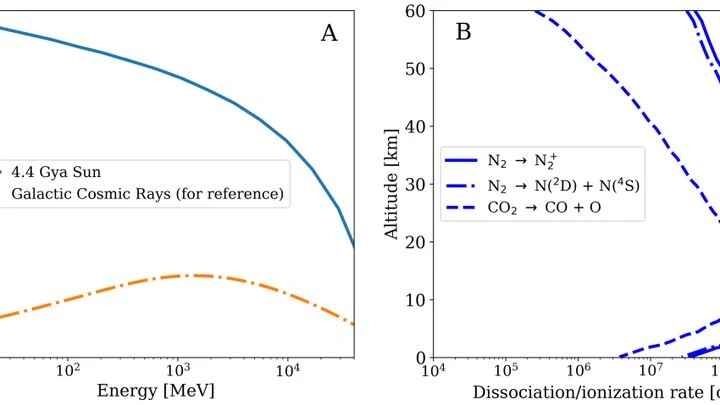
In its youth, our Sun radiated about 30% less energy than it does today: this faint young Sun paradox long troubled planetary scientists: with such a heat deficit, Earth's oceans should have frozen, yet geological evidence says otherwise.
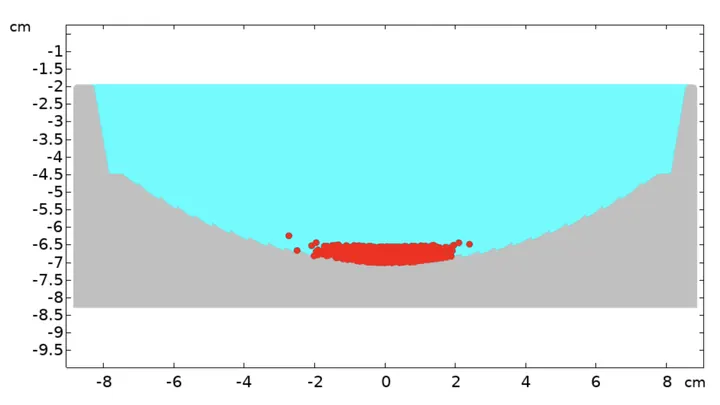
4 billion years ago, the young Earth was mercilessly bombarded by meteorites, leaving behind impact craters. Rains filled them with water, forming shallow ponds where lipid bubbles accumulated. These bubbles, like soap bubbles but with a double-layered lipid membrane (just like modern cells), formed spontaneously when water mixed with fat-like substances.