A planetary embryo is an intermediate stage in planet formation, a solid body roughly the size of the Moon to Mars that has grown by accumulating smaller planetesimals. These embryos are the building blocks of terrestrial planets and the cores of gas giants. In the early solar system, hundreds of such embryos formed within a few million years, and their subsequent collisions — sometimes merging, sometimes shattering — sculpted the final architecture of planetary systems. Understanding embryos is key to explaining why some planets become rocky worlds and others become gas giants, and why some systems have hot Jupiters while ours does not.
History
The concept of planetary embryos emerged in the 1970s and 1980s from numerical simulations of planet formation, particularly the work of George Wetherill and later the 'Nice model' team, who showed how embryos evolve into the current planets.
How it works
Planet formation begins with dust grains in a protoplanetary disk that stick together to form pebbles and then kilometer-sized planetesimals. These planetesimals gravitationally attract each other and merge, growing into embryos. The process is self-limiting: as embryos grow, they stir up the surrounding planetesimals, increasing their relative velocities and making further accretion less efficient. This 'oligarchic growth' phase ends when the disk gas dissipates, leaving a set of embryos that then undergo giant impacts over tens of millions of years to form full-sized planets.
In practice
Embryo formation models guide the search for exoplanets, helping predict which stellar systems are likely to harbor Earth-likeplanets and informing observations of protoplanetary disks with ALMA and JWST.
Fun fact
The Moon is thought to be the result of a giant impact between the early Earth and a Mars-sizedplanetary embryo, a collision that vaporized the outer layers of both bodies and formed a disk that coalesced into our satellite.
In a dense cloud of gas and dust where massive stars are born, two young stars recently passed very close to each other. Their dance has lasted only about sixty years, and astronomers have now seen it in detail for the first time.
Two stars circle each other like dancers who come together and drift apart. Over time, one swells, and its outer layers spill onto its neighbor. The star that receives foreign matter looks no different from a single star, but its surface remembers everything.
In the first half-billion years after the Big Bang, galaxies grew like crazy. Gas fell in rapidly and collapsed into stars without any resistance. This period is called 'unimpeded star formation.' It's like frying pancakes on a scorching skillet without a lid: splatters fly, but nothing holds them back.
The birth of a moon is a cosmic car crash. Two young planets collide, and a cloud of scorching debris swirls around the surviving world. From this disk, like clay on a potter's wheel, a satellite gradually takes shape. That's probably how our Moon came to be.
A quarter-century ago, Michel Mayor and Didier Queloz discovered the first hot Jupiter, and shattered all the rules of planet formation. A gas giant on a days-long orbit couldn't have formed next to the star: it's far too hot and lacks building material. So, it must have been born far away and then migrated.
Around some young stars where star formation has recently ended, there swirl not just dust rings but actual planetary battlefields — extreme debris disks.
Forget the familiar images of planetary cores — a sharp boundary between rock and gas is a thing of the past. The Juno probe, diving into Jupiter’s gravitational field, and Cassini, into the embrace of Saturn, discovered that heavy elements are not gathered at the center but smeared over a vast region, as if someone carelessly shook a cocktail.
When we peer deep into space, we see the past. Edwin Hubble’s law turns redshift into a time machine: light from galaxy UDS 12999 traveled to us for 7.6 billion years — more than half the age of the Universe.
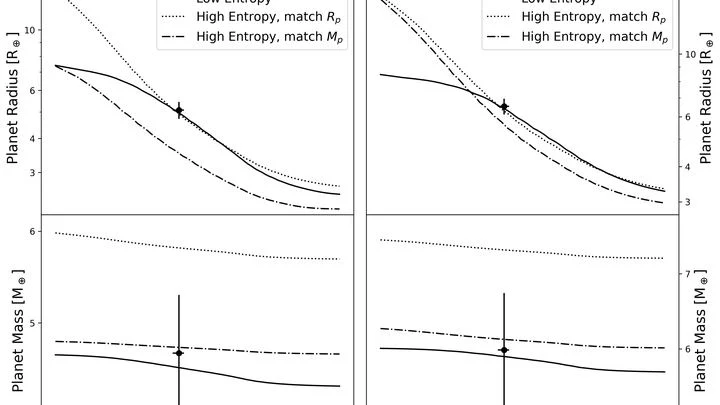
A ball, almost weightless for its size, circles its star every four days. Planet TOI-2195 A b is a real riddle: by mass it's slightly heavier than Neptune, yet bloated to Jovian volumes. If there were an ocean big enough, this exoplanet would float on its surface like a giant inflatable ball.
Lenticular galaxies are the cosmic quiet types: they have a disk but no bright spiral arms. For a long time, their origin remained a mystery. A team of scientists ran the Hydrangea computer simulation and traced the fate of each galaxy from its youth to the present day.
On the mass–size diagram, these galaxies line up in a V shape.
Young Earth was a boiling sphere of liquid rock, while Theia, which crashed into it, had had time to cool and solidify. It’s like dropping a chunk of cold butter into a pot of soup: the soup splashes out, but the butter barely moves. Similarly, Earth’s interior spewed into space, forming a cloud of cosmic dust and debris.
A living organism is a machine that constantly channels energy through itself and converts it into heat. This internal cycle is called internal entropy production (a measure of energy dissipation). But about 2.5 million years ago, our ancestors switched on a second loop — an external one. They picked up a sharpened stone, and then a burning branch.
In the catalogs of exoplanets, there are many worlds with sizes between Earth and Neptune. They are divided into two groups: rocky super-Earths and gaseous mini-Neptunes. The Solar System has none of these, and scientists debate where they come from.
The authors of the study looked into each planet's 'passport'—its orbit.
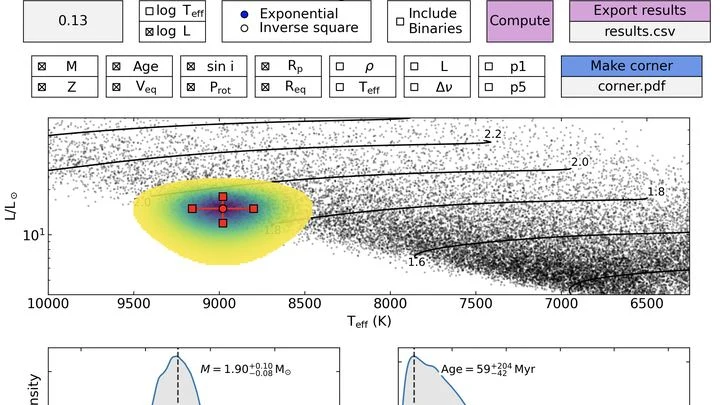
Imagine a person in an old photograph standing in a crowd while spinning — guessing their age would be nearly impossible. That's roughly how astronomers determine the ages and masses of distant stars, and they often get it wrong. For stars slightly heavier than the Sun (from 1.4 to 2.5 solar masses), standard methods like chemical-composition 'clocks' work poorly.
Eight hundred million years ago, in the main asteroid belt, a giant inkwell shattered. The parent body, over a hundred kilometers in diameter, made of primitive carbonaceous chondrites, suddenly broke apart near the J3:1 resonance with Jupiter.
Detectors pick up the “ripples” of gravitational waves from mergers of black holes or neutron stars — like an echo from the kitchen where a cosmic dish was being prepared. Astronomers are trying to reconstruct the recipe: how two massive stars turned into an exotic pair and collided.
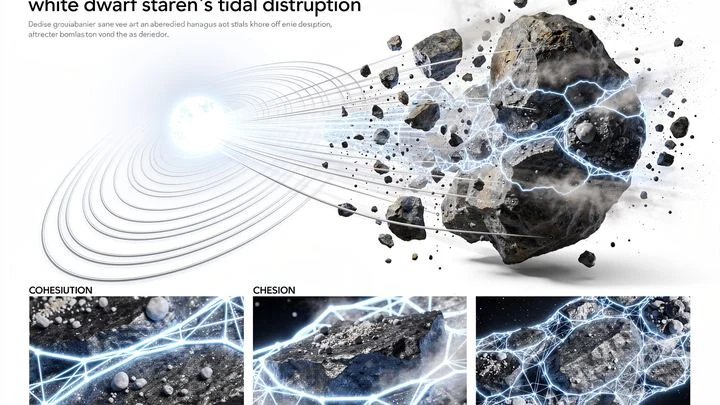
When a telescope catches the light of a distant white dwarf, the spectrograph sometimes fishes out heavy elements — calcium, iron, magnesium. These metals could not have stayed in the thin atmosphere of the stellar remnant; they are the traces of recently fallen planetary debris.
The idea of extraterrestrial origin of life has long excited minds. Fred Hoyle believed bacteria travel between stars. A new study tested a similar but closer route: from Mars to Earth. In ancient times, Mars had water, and asteroid impacts knocked rocks with microbes into space.
Cosmology is going through strange times. On one hand, the standard model with dark matter and dark energy beautifully describes the large-scale structure. On the other, it's cracking at the seams.
In the early Universe, star clusters were so dense that they gave birth to giants the size of the Solar System. If such a giant had taken the place of the Sun, its edge would have reached as far as Jupiter. These stars sometimes swallowed small black holes. The black hole would sink into the core and begin to grow, turning the star into a ghostly glow — a quasi-star.
A rock knocked off one planet by an asteroid impact hurtles through space and lands on another. If microbial spores are hiding inside, they might survive the cold, the radiation, and the rough landing. That's panspermia — the idea that life travels between worlds. But imagining such a journey is one thing; calculating every step is quite another.
The Kepler telescope spent years watching thousands of stars, spotting planets by the tiny dips in starlight when a planet passes in front of its star. Such a passage, or transit, lets us measure the planet's size but not the shape of its path.
Dough rises faster when it already contains yeast. Similarly, galaxies may have assembled faster if they already had black holes inside. Astrophysicists considered a scenario where the universe contained primordial black holes from the very beginning — objects that could have formed in the first instants after the Big Bang.
The young Solar System resembled a giant construction site: around the newborn Sun swirled a disk of gas and dust, and from this dust gradually assembled stones, boulders, and then planetary embryos — planetesimals. Today, their fragments fall to Earth as meteorites.
4 billion years ago, the young Earth was mercilessly bombarded by meteorites, leaving behind impact craters. Rains filled them with water, forming shallow ponds where lipid bubbles accumulated. These bubbles, like soap bubbles but with a double-layered lipid membrane (just like modern cells), formed spontaneously when water mixed with fat-like substances.
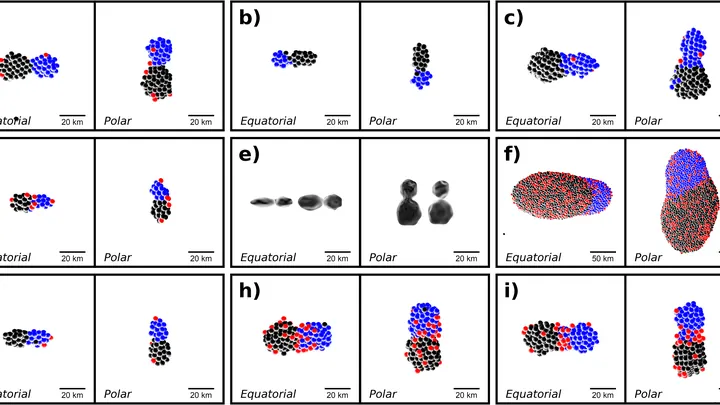
The icy body Arrokoth looks like a snowman: two spheres pressed together. Many such two-headed objects exist beyond Neptune's orbit, in the Kuiper Belt. For a long time, it was thought they formed from the slow collision of two separate bodies.
New simulations show a different path. A cloud of small pebbles around the young Sun collapses under its own gravity.
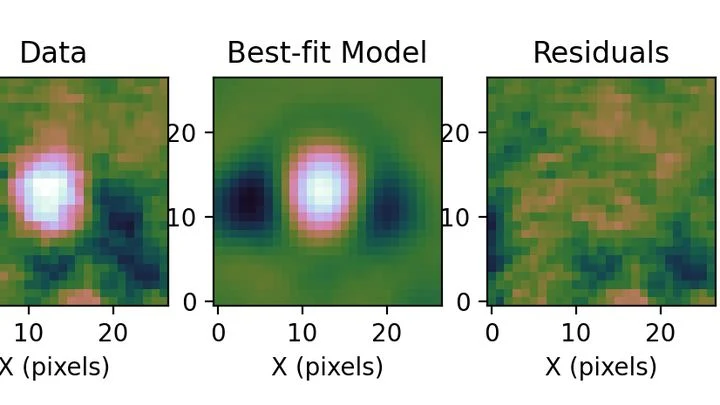
The young star PDS 66 is surrounded by a flat disk of gas and dust — the cradle of future planets. In the cold outer regions of such a disk, silicon and sulfur are usually hidden inside dust grains, but astronomers spotted a bright patch of gas at about 60 astronomical units from the star.
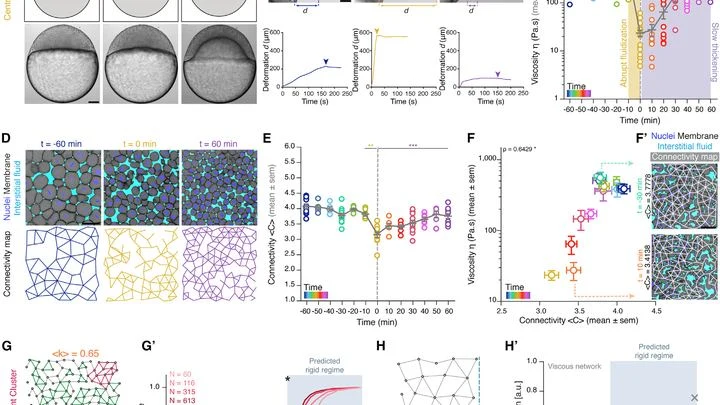
As an embryo grows, its cells don't just divide: they constantly touch their neighbors, like people in a crowded bus. The strength of these contacts determines where a cell moves and what shape the tissue takes. Scientists studied how cell 'stickiness' changes during the earliest stages of development.
Earth is like dough mixed to a precise recipe: two parts water to one part land. Too much water, and the planet becomes a vast ocean where intelligence has nothing to grasp onto. Too much land, and water retreats deep, leaving a desert. Scientists put this culinary analogy to the test with statistics.
In the northern part of Arabia Terra, there are fields that look like a giant brain: ridges and troughs wind like convolutions. On Earth, similar patterns form in cold regions when water in the soil freezes and thaws, causing stones to sort themselves into stripes. But the Martian ridges are taller — averaging 3.29 meters — while Earth's mechanisms produce less than half a meter.
Two stars circle each other like a pair of figure skaters on ice. Both resemble the Sun, but one shines brighter and has puffed up, while the other remains compact. Astronomers peered into their light using spectrographs, instruments that split light into colors, and found something odd: one star is clearly poorer in heavy elements than the other.
350 light-years away, four planets orbit the star V1298 Tau. They are 5–10 times larger than Earth but lighter than they appear. For nine years, astronomers tracked their motion to understand what they are made of and how they lived in the past.
The planets are lined up in a chain: their orbital periods are nearly in 3:2, 2:1, and 3:1 ratios.
The young star TOI-451 wobbles slightly as three planets circle it. Each wobble is like the tremor of a spiderweb when a tiny spider crawls across it. Astronomers caught this tremor to learn how heavy the planets are.
They watched the star for several months using telescopes on Earth. The planets kept passing in front of the star, briefly dimming its light.
Using the Keck telescope and spectroscopy (light analysis that reveals rotation speed), astronomers measured 32 objects: from giant planets to brown dwarfs — bodies heavier than planets but lighter than stars that never ignited.
In a star cluster, like on a crowded dance floor, massive stars rarely stay single. More often they whirl in pairs or triples, and the distance between them can be less than from Earth to the Sun. But how do they manage to get so close to each other?
Simulations showed: it's all about the disk of gas and dust that envelops the pair. This disk, like a drain funnel, swirls the stars and slowly pulls them inward.
In the early Universe, just a few hundred million years after the Big Bang, special 'seeds' were born in dense gas clouds — supermassive black holes. Computer modeling showed that these embryos were ten times heavier than previously thought: each weighed a million Suns.
Around each seed, a gas disk spun rapidly.
Two stars whirl in a tight dance. One is a neutron star — an ultra-dense sphere the size of a city but with a mass of one and a half Suns. The other is an ordinary star that swells and spills its matter onto its neighbor. Sometimes this transfer happens too fast, and the stars become enveloped in a shared gas shell, like two spoons in one pot of boiling soup.
When countless asteroids pummeled the young Earth, they tore chunks from its mantle. These fragments spiraled in a cosmic disk around the planet and, like a snowball in a blizzard, fused into the Moon.
Just as yeast turns flour into fluffy dough, radioactive 'seasoning' from a supernova — the explosion of a massive star at the end of its life helps mold a rocky planet. The key ingredient here is aluminum-26, a radioactive isotope that releases heat as it decays.