Popular

Martian Spores: How Life Could Have Flown to Earth ⚡ экспресс

Original: "Could life have been transferred from Mars to Earth? Laboratory and computational simulations of Martian ejecta"
arXiv:2605.15595 · 2026-05-15 · CC BY 4.0 · ⏱ 1 min · Exoplanets
Bacterial spores inside a rock can survive a flight from Mars to Earth — confirmed in the lab.
Abstract

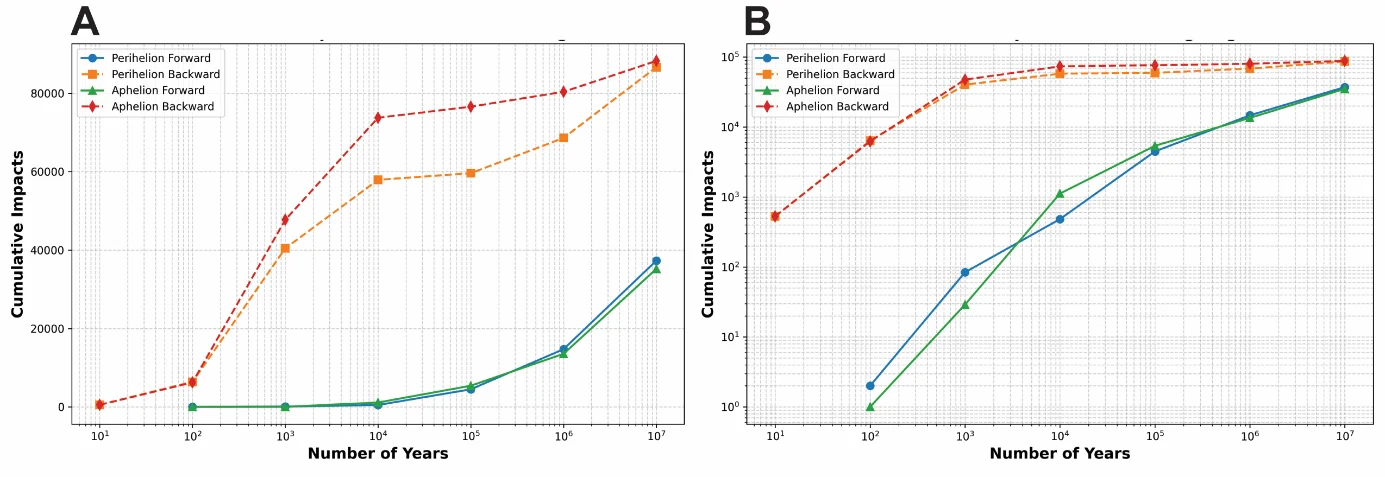
The panspermia hypothesis suggests that life could have been brought to Earth from other planets. Scientists tested whether bacterial spores can survive an interplanetary journey: they were irradiated with ultraviolet light and rotated, simulating a rock fragment's flight. Computer modeling showed that particles ejected from Mars reach Earth within a few years, and under favorable circumstances — in just one year. The experiment confirms: transplanting life from Mars to Earth is quite real, as if nature invented "cosmic hitchhikers."

Links in the knowledge graph 1

📄 Showing the "Simple" version — "Popular" is not ready yet. Add it to favorites to help prioritize it.

The idea of extraterrestrial origin of life has long excited minds. Fred Hoyle believed bacteria travel between stars. A new study tested a similar but closer route: from Mars to Earth. In ancient times, Mars had water, and asteroid impacts knocked rocks with microbes into space. They fell on our planet — interplanetary delivery without a sender.

In the lab, spores (nature's nanocapsules) were covered with a layer of dead cells, creating a protective shield, and exposed to harsh solar ultraviolet — hundreds of times stronger than on Earth. Even with the rock rotating, many survived. And calculations showed that such a rocky container reaches Earth in a year — faster than Magellan circumnavigated the globe.

Dead cells act as a sacrificial screen: they absorb radiation, preserving the living spores.

This doesn’t prove life came from Mars, but it confirms: carbon building blocks of life can travel inside cosmic dust. Interplanetary mail works.

🎯 Among meteorites on Earth, there are fragments of Mars — pieces of crust knocked off by asteroid impacts and delivered straight to us.

Scientists
Ludwig BoltzmannJames JeansDaniel BernoulliLeonhard EulerFred HoyleMargaret Burbidge
Tags
Water Sun cosmic dust carbon
Laws
Stefan–Boltzmann lawJeans instabilityBernoulli's principleArchimedes' principletriple-alpha process (Hoyle process)
Original: arXiv:2605.15595 · CC BY 4.0 · bridge42worlds