The Kilometer Barrier: Why Tidal Disruption of Asteroids Leaves Only Boulders ✦
Original: "Size limits on tidal debris around white dwarfs: the km-size barrier"
Tiny cohesive forces inside an asteroid become a kilometer barrier: a dead star cannot grind it to dust — only city-sized boulders remain.
Links in the knowledge graph 1
Tiny van der Waals forces, binding sand grains together, clash with the titanic gravity of a dying star — and win. The asteroid tears apart, but the fragments remain skyscraper-sized: this is the kilometer barrier. Like a coral reef, it breaks into massive blocks rather than crumbling into roe. Thus dust disks are born around white dwarfs, heralding the finale of our planetary system.
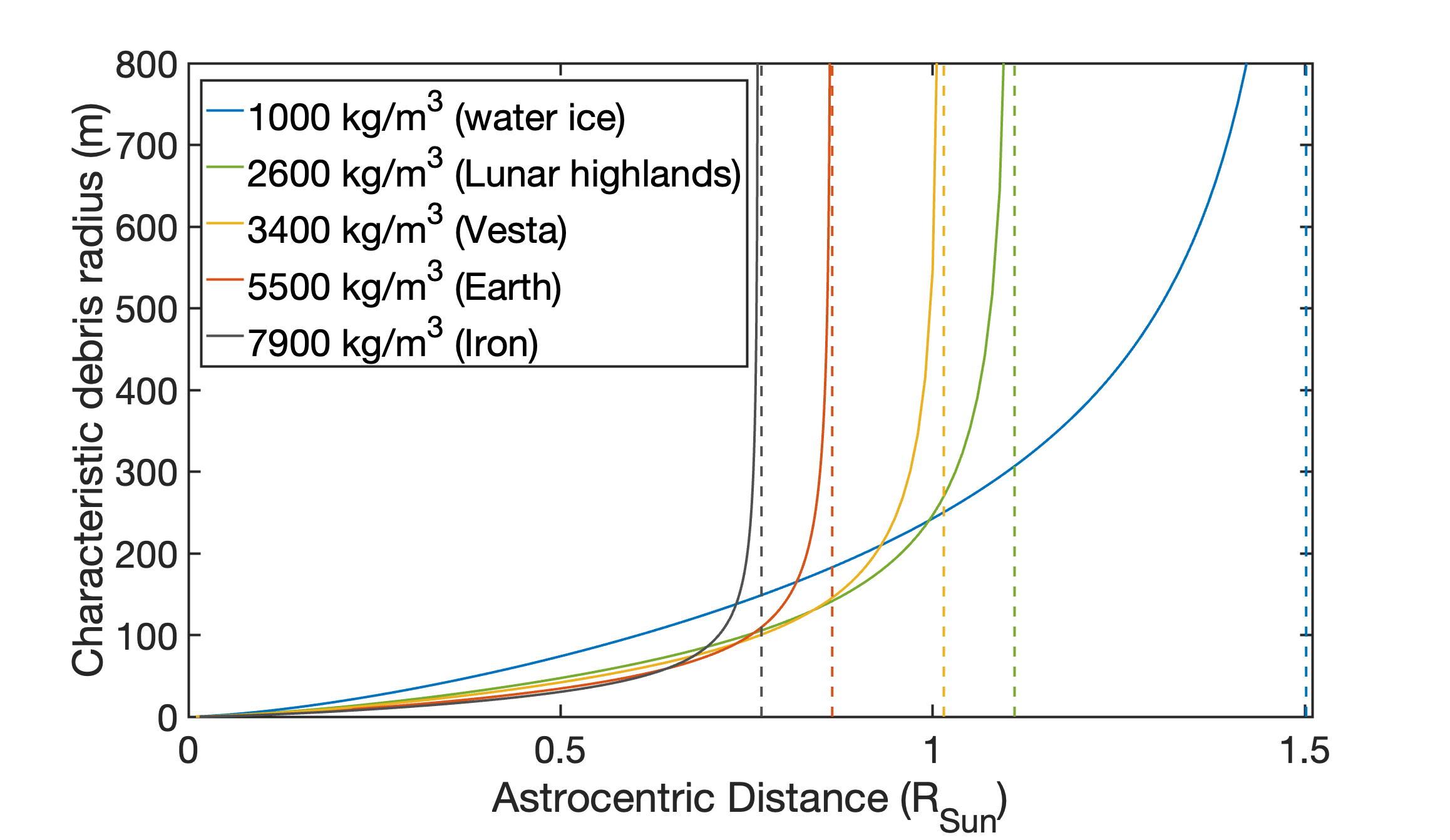
🎯 As they dive toward the Sun, Kreutz sungrazers after tidal disruption leave a swarm of kilometer-sized boulders — exactly as the model predicts.
\frac{GM\rho s^4 r}{(r^2 - s^2/4)^2} = \sigma s^2 + G\rho^2 s^4
The left-hand side — the tidal force tearing apart a fragment of size s at distance r from a white dwarf of mass M; the right-hand side — the binding sum of cohesion (strength σ) and self-gravity. From this balance arises the kilometer-scale minimum size of a stable fragment.
Scientists
Christian DopplerD. B. McLaughlinDidier QuelozMichel MayorR. A. RossiterAlbert Einsteinwhite dwarf
exoplanet
asteroid
comet
cosmic dust
spectroscopy
photometry
transit method
JWSTLaws
Doppler effectgravitational lensingKepler's third lawMaxwell's equationsPlanck's lawPlanck–Einstein relation