Simple

The Kilometer Barrier: Only Large Chunks Survive from Asteroids

Original: "Size limits on tidal debris around white dwarfs: the km-size barrier"
arXiv:2606.02457v1 · 2026-06-01 · CC BY 4.0 · ⏱ 1 min · Exoplanets Stellar
Asteroids near white dwarfs don’t crumble to dust — they first shatter into kilometer-sized pieces.
Links in the knowledge graph 1

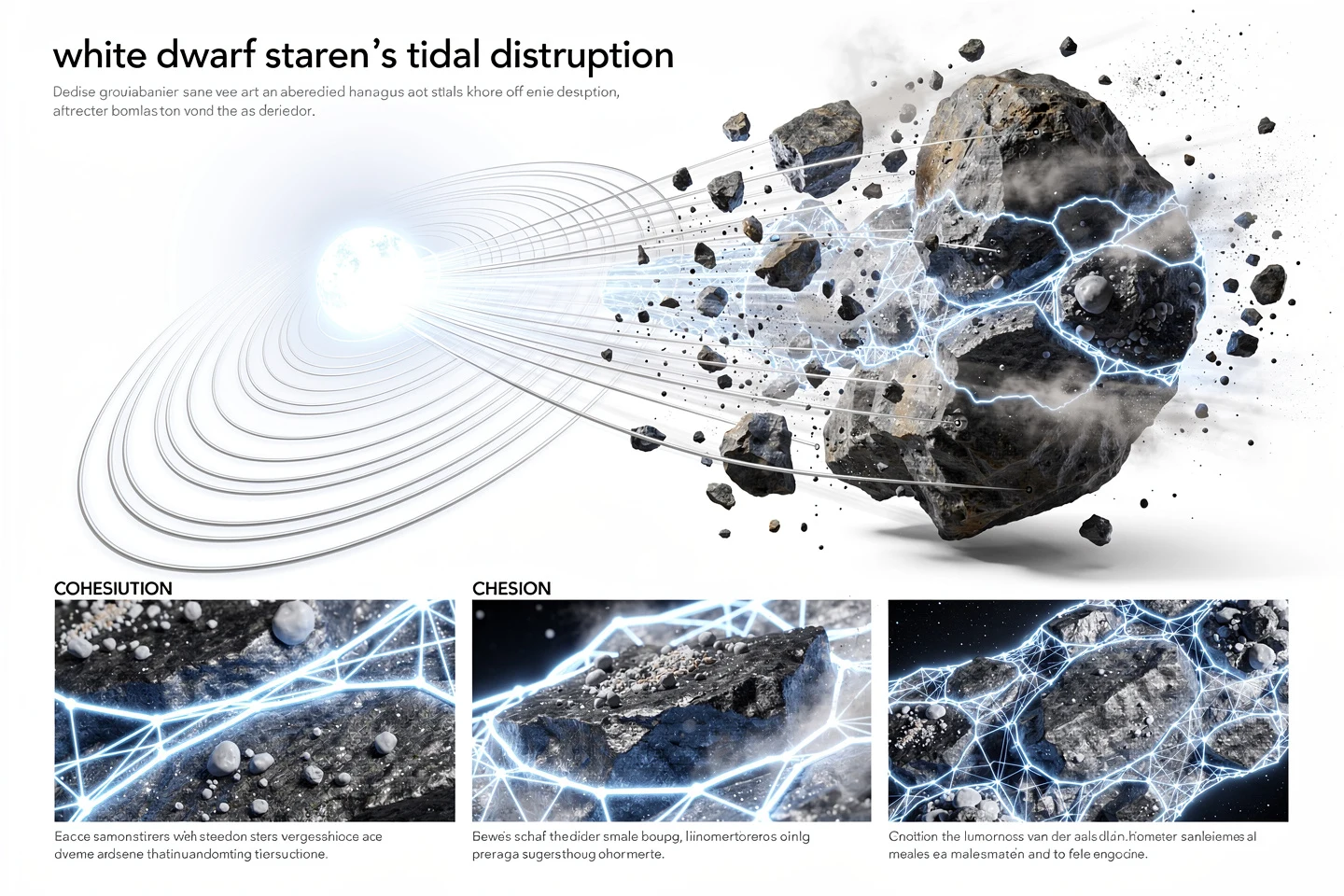
When a star turns into a white dwarf — a super-dense remnant the size of Earth — its tidal pull rips apart passing asteroids and comets from the remnants of planetary systems. It’s like squeezing a dry cookie in your fist: it breaks into large chunks, not crumbs.

The force holding particles together keeps fragments from becoming smaller than a few hundred meters — giving rise to a “kilometer barrier.” Only after countless collisions inside a dense swarm do they gradually grind down into cosmic dust.

The fragments move almost in sync — their speeds differ by a millionth, slower than fingernail growth — so the swarm doesn’t spread out for centuries.

This dust factory explains the star’s flickering: sometimes dust eclipses it. Astronomers track this via light analysis, brightness measurements, and eclipse observations. The James Webb Space Telescope will check the details. By the way, a white dwarf can’t be heavier than 1.4 Suns — a limit discovered by Chandrasekhar.

🎯 In the Solar System, sungrazing comets, as they approach the Sun, also break apart into kilometer-sized chunks — consistent with the model.

\frac{GM\rho s^4 r}{(r^2 - s^2/4)^2} = \sigma s^2 + G\rho^2 s^4
The left-hand side — the tidal force tearing apart a fragment of size s at distance r from a white dwarf of mass M; the right-hand side — the binding sum of cohesion (strength σ) and self-gravity. From this balance arises the kilometer-scale minimum size of a stable fragment.
Scientists
Christian DopplerD. B. McLaughlinDidier QuelozMichel MayorR. A. RossiterAlbert Einstein
Tags
white dwarf exoplanet asteroid comet cosmic dust spectroscopy photometry transit method JWST
Laws
Doppler effectgravitational lensingKepler's third lawMaxwell's equationsPlanck's lawPlanck–Einstein relation
Original: arXiv:2606.02457v1 · CC BY 4.0 · bridge42worlds