The Kilometer Barrier: Why Tidal Forces Leave Only Large Fragments from Asteroids ✛ ✦
Context
Understanding how planetary systems evolve after a star dies is a key goal in modern astrophysics. When a white dwarf—the leftover core of a Sun-like star—becomes polluted with metals, spectroscopy of its atmosphere reveals chemical elements that couldn’t have survived there since formation. This points to recent infall of planetary material, raising the question: how exactly do debris from exoplanetary systems reach the star’s surface? A typical white dwarf’s mass can’t exceed the Chandrasekhar limit (about 1.4 solar masses), which dictates its compactness and powerful tidal forces.
Methods
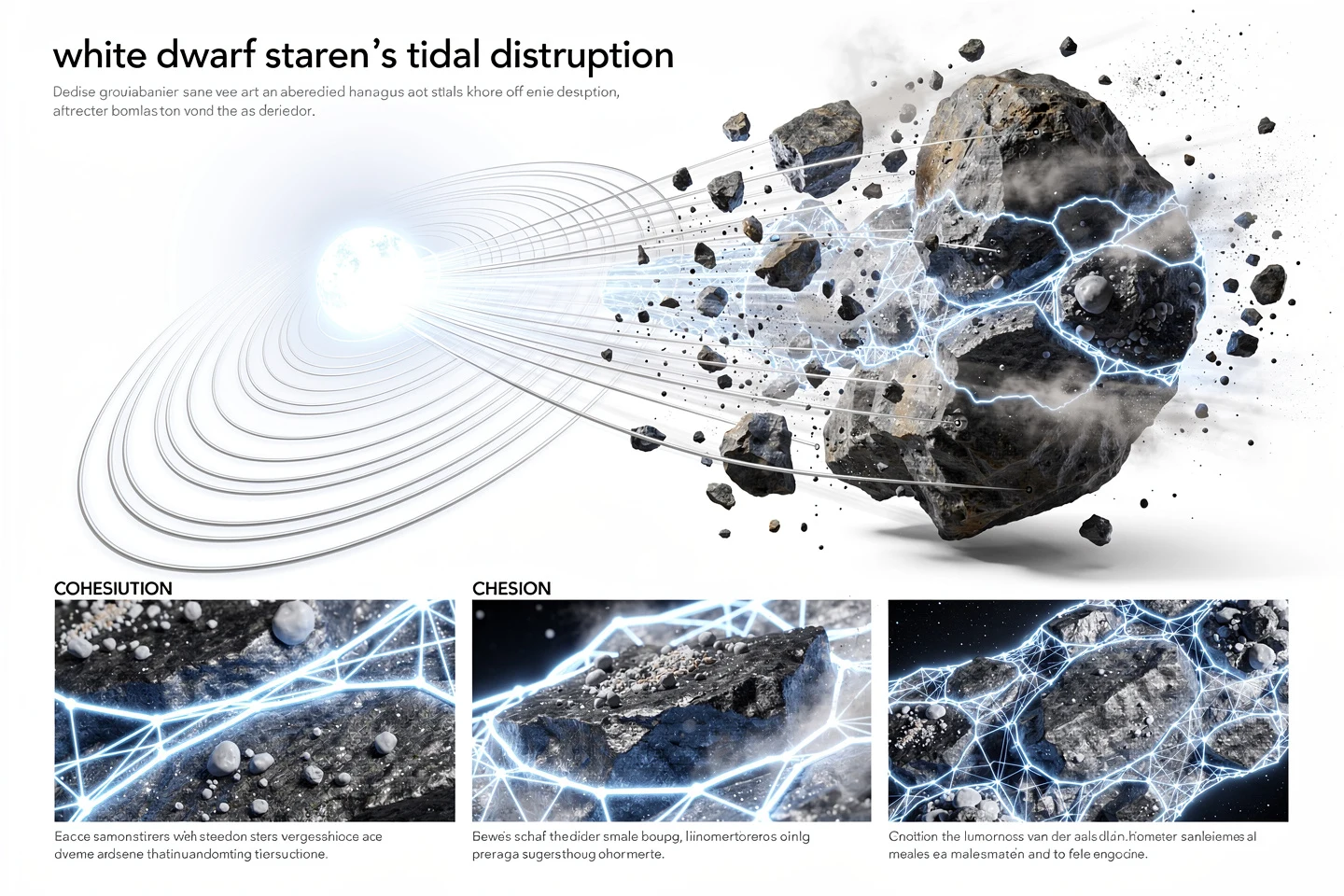
To find the typical fragment size, the authors built a simplified model of an asteroid as two touching cubes pulled apart by tidal forces. This approach gives a conservative estimate, since real comets and asteroids often have lower strength. The balance includes cohesive forces (from Van der Waals), the body’s own gravity, and tidal forces from the white dwarf. Equilibrium of these forces sets the minimum stable fragment size at a given distance.
Results
The calculations show that regardless of the parent body’s size and density (from 1000 kg/m³ for ice to 7900 kg/m³ for iron), tidal disruption produces fragments with a typical size of about 0.1–1 km. This 'kilometer barrier' appears for planetesimal strengths as low as 10–1000 Pa. Larger fragments cannot survive inside the Roche limit, so cosmic dust in disks isn’t born directly but via later collisional grinding. Interestingly, the velocity spread among fragments after breakup is tiny—around one part per million—keeping them on almost identical orbits.
Implications
The findings change how we think about dust disk formation around white dwarfs. Because most of the mass stays in kilometer-sized fragments, they aren’t affected by the Poynting–Robertson effect (radiation drag on dust) until they break down to micron sizes. This requires a collisional evolution stage, explaining the observed photometric variability of many disks—outbursts and brightness changes picked up by the transit method could be tied to cascading fragmentation.
Future development
With data coming from the James Webb Space Telescope, we’ll be able to study disk structures in more detail and test the predictions of kilometer-sized fragments through high-resolution spectroscopy. Detailed simulations that combine collisions, rotational disruption, and radiation effects are also needed.
Impact
The results will impact white dwarf pollution models, disk evolution theories, and methods for detecting exocomets in other systems.
Next steps
The next step is numerical modeling of the collisional cascade from kilometer-sized bodies to dust, including gas–dust interactions, to reproduce the observed variability.
Key open problems
The kilometer barrier links small-body dynamics to unsolved problems in material strength: we still know little about regolith cohesion in exoplanetary systems. Also, the origin of long-lived dust around old, cool white dwarfs, where radiation effects are weak, remains a mystery—collisions could be the key.
The knowledge machine's view
This section is addressed to the author of the paper and their colleagues. Neighbouring works were found by meaning-based search across our archive, not by word overlap. We do not review: we show the field around the work.
What the work does
You have built a simple model of tidal disruption of asteroids and comets near white dwarfs, taking into account van der Waals forces, and shown that the disruption stops at fragments of order 0.1–1 km in size, not reaching dust. This leads to the conclusion that a subsequent stage of collisional grinding is necessary to form the observed dust disks.
Where its strength is
The model with a minimal number of parameters yields a universal result—the 'kilometer barrier'—independent of the parent body's size and composition, which sets clear initial conditions for further simulations of debris disk evolution.
Where it could go next
- It might be interesting to see how the collisional evolution of kilometer-sized fragments leads to the formation of complex molecules, which are then observed in the atmospheres of white dwarfs.based on: Cosmic Mill: Dust Grain Collisions Spawn Complex Molecules arXiv:2607.22213v1
- Nearby lies work on the birth and death of blanets near black holes, where tidal forces also play a key role; perhaps one should compare the disruption criteria and characteristic fragment sizes in these different regimes.based on: The Rapids of a Black Hole: The Birth and Death of Blanets arXiv:2606.06884v1
- In the archive, there is a study of protoplanetary disk dynamics, where accretion and collisions are considered in a more general context; perhaps their approach to modeling collisional cascades is applicable to white dwarf disks as well.based on: How Dust Disks Dance Around Newborn Stars arXiv:2608.02204v1
Worth trying
- Test how the kilometer barrier changes when accounting for the rotation of the parent body and its non-spherical shape.
- Estimate how long it takes for collisions to grind kilometer-sized fragments down to micron-sized dust, and compare with the observed accretion rate onto the white dwarf.
- Consider whether tidal forces during repeated close passages near the star can break fragments into smaller sizes if they have internal defects.
Why this may matter
If the kilometer barrier is universal, it determines the rate of material delivery to white dwarfs and, consequently, the interpretation of their chemical composition as an 'archaeological record' of planetary systems.
Nearby works in our archive
- The Rapids of a Black Hole: The Birth and Death of Blanetssimilarity 0.62
- Why Tiny Black Holes Didn't Form in the Early Universesimilarity 0.61
- Stellar Droplets from Quark Soupsimilarity 0.60
- Quasi-interstellar objects: when the Solar System meets its own exilessimilarity 0.58
- How Dust Disks Dance Around Newborn Starssimilarity 0.58
- A Star Sneezes and Drifts Awaysimilarity 0.58
- Cosmic Mill: Dust Grain Collisions Spawn Complex Moleculessimilarity 0.57
The closest work in the archive sits at 0.62 by meaning — the usual level for our corpus.
Original abstract
as written by the authors arXiv:2606.02457v1
Compact disks of planetary debris orbiting white dwarfs provide a crucial window into our understanding of evolved planetary systems. The formation of these disks has been widely modeled with tidal fragmentation of minor planets that are rubble piles with no internal strength. However, rubble piles do have non-zero cohesive strength from Van der Waals forces, and here we demonstrate the consequences: breakup of these rubble piles sets a maximum fragment size, and we calculate this size \jks{for water ice, iron, and material densities corresponding to the lunar highlands, Vesta and the Earth}. We find that for typical minimum rubble pile strengths of $$\sim$$10-1000 Pa, the maximum fragment size is as large as small asteroids (0.1-1 km). This limit -- the km-size barrier -- also represents the characteristic sizes of tidal fragments. Most of the debris mass is contained in fragments of this size. Consequently, subsequent disk evolution should first feature a prominent dust-forming process, such as collisional grinding, before Poynting-Robertson drag can significantly shape the final disk. \jks{Further, we find that non-zero internal strength more narrowly radially confines the fragments than in the strengthless case.} This correction to previous assumptions adds to the growing evidence of the importance of collisions in the formation and evolution of white dwarf debris disks, while also helping to bound the size distribution in these disks for modeling efforts.
Fun fact: In our Solar System, the Kreutz family of sungrazing comets that passed close to the Sun show a similar pattern: the largest fragments are about 1 km across, and most of the mass is in them, not in dust.
Key numbers
- Typical fragment size: 0.1–1 km
- Minimum material strength: 10–1000 Pa
- White dwarf mass: 0.6 M☉
- Ice density: 1000 kg/m³
- Iron density: 7900 kg/m³