The Kilometer Barrier: Why Tidal Disruption of Asteroids Leaves Only Boulders ✛ ✦
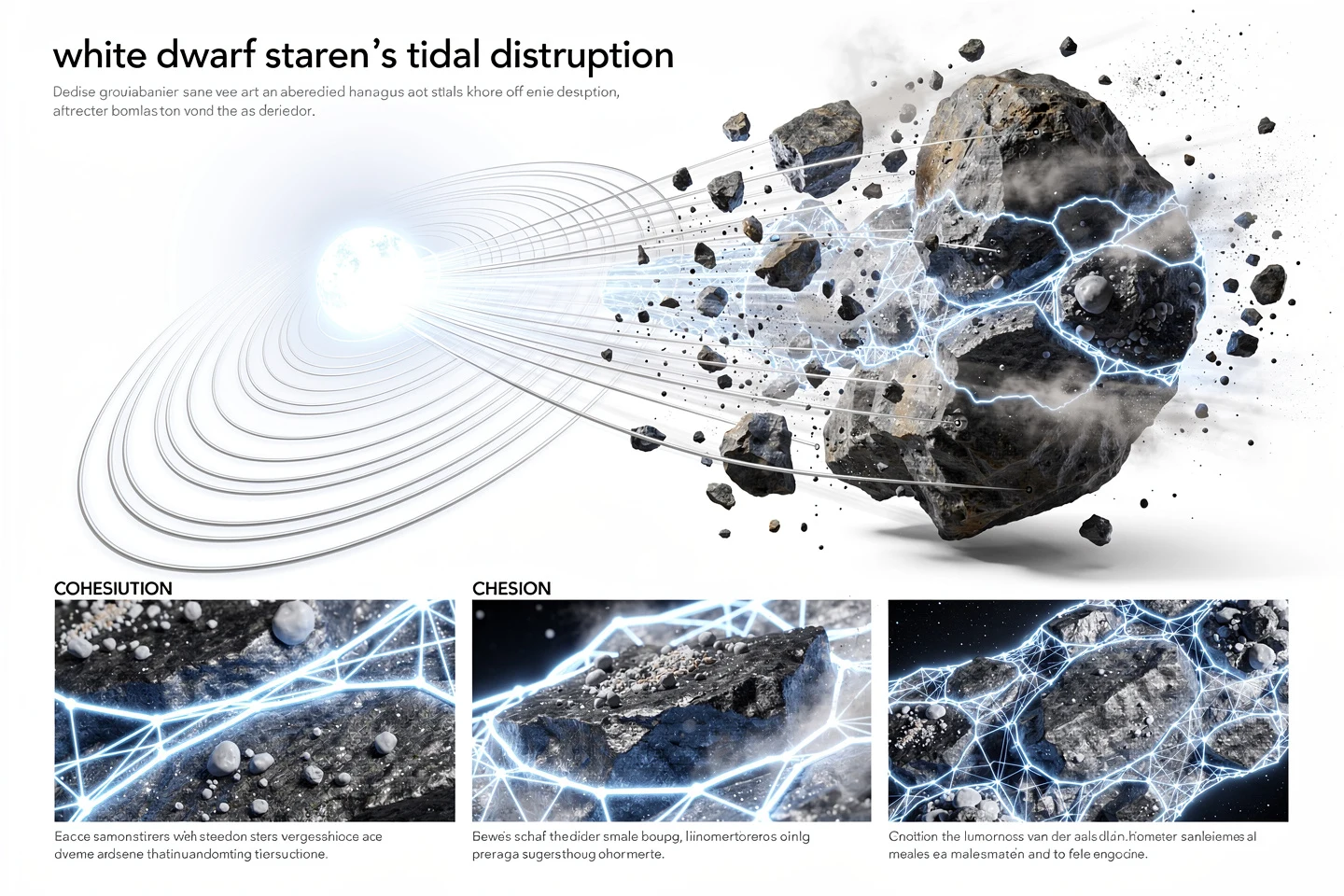
When a telescope catches the light of a distant white dwarf, the spectrograph sometimes fishes out heavy elements — calcium, iron, magnesium. These metals could not have stayed in the thin atmosphere of the stellar remnant; they are the traces of recently fallen planetary debris. Spectroscopy of polluted white dwarfs paints a picture of graveyards of exoplanetary systems that survived the death of their sun. But how exactly does matter traverse the final kilometers to the fiery surface?
For a long time, it seemed: tidal forces ruthlessly stretch any body within the Roche lobe. They crush asteroids and comets into fine cosmic dust — which then spirals into the star. New work flips this picture. It turns out, a planetesimal is not a handful of sand, but rather a coral reef.
In deep space, regolith grains are bound together far more strongly than one might think. The minuscule van der Waals forces that arise between touching grains — in a vacuum without moisture, they are an order of magnitude stronger — create a "cement" that keeps the boulder from crumbling. And when the white dwarf's tide tries to tear it apart, the coral polyps — individual particles — do not scatter. The reef breaks into massive blocks. The scientists' model, simplified as it is (two glued cubes), captured the essence of the contest. On one side — destructive tidal acceleration, growing as it approaches the star, on the other — cohesion and the fragment's own gravity. Their struggle is described by an elegant balance: \[ \frac{GM\rho s^4 r}{(r^2 - s^2/4)^2} = \sigma s^2 + G\rho^2 s^4 \] The left side — the tidal force tearing apart a fragment of size \( s \) at a distance \( r \) from a dwarf of mass \( M \), the right side — the sum of cohesion (with strength \( \sigma \)) and self-gravity. Solving this equation yields a kilometer surprise: even for the flimsiest parent bodies — be it loose ice or porous iron — the minimum size of surviving fragments turns out to be on the order of hundreds of meters, and often exceeds a kilometer. The white dwarf's mass is capped by the Chandrasekhar limit (about 1.4 solar masses), and the star's compactness only sharpens this physical threshold.
So pristine dust is not born in the breakup act. The kilometer barrier forces the debris disk to live a second, collisional life. Boulders collide, shatter, and only then, descending in a cascade down the size scale, does that very dust appear that is registered by photometric observations. This explains the brightness variability of many white dwarfs — sudden eclipses when yet another collision kicks up a dense cloud of micron-sized grains. James Webb with its infrared vision will be able to peer into the inner zones of these dust disks and perhaps see "dust factories" in action — the tidally spawned retinue of large bodies. Transit method, detecting dips in brightness, becomes a tool for cataloging invisible kilometer-sized debris.
The work not only reassembles disk evolution. It builds a bridge to fundamental physics: regolith cohesion under exotic conditions is still poorly measured. And a mystery remains: why old, cooled white dwarfs, where radiation pressure should no longer efficiently blow away dust, still exhibit thick disks. Perhaps the answer lies in those same endless collisions of kilometer-sized boulders. Before us is a somewhat grim blueprint of the future: when in billions of years the Sun sheds its envelope and becomes a white dwarf, Earth and other planets, if they survive, may turn into slowly colliding boulders, their dance stretching across eons.
As they dive toward the Sun, Kreutz sungrazers after tidal disruption leave a swarm of kilometer-sized boulders — exactly as the model predicts.