Stellar Orthography: How ExoVeil Reads Missed Planets ✦
Original: "One Transit Is All You Need: Detecting Exoplanets Through Learned Stellar Behaviour with EXOVEIL"
ExoVeil's machine learning algorithm finds exoplanets from a single transit, learning the 'grammar' of stellar brightness and reacting to any anomalies.
Links in the knowledge graph 1
A single exoplanet transit is like a missing letter in a long book. ExoVeil learns the grammar of starlight, catching the slightest 'typos' in light curves. A star pulsates like a heart, and even a slight rhythm glitch betrays an unseen planet. With this approach, the PLATO mission will be able to find Earth twins, even if they only flicker once against their sun. We are beginning to read the language of the Galaxy.
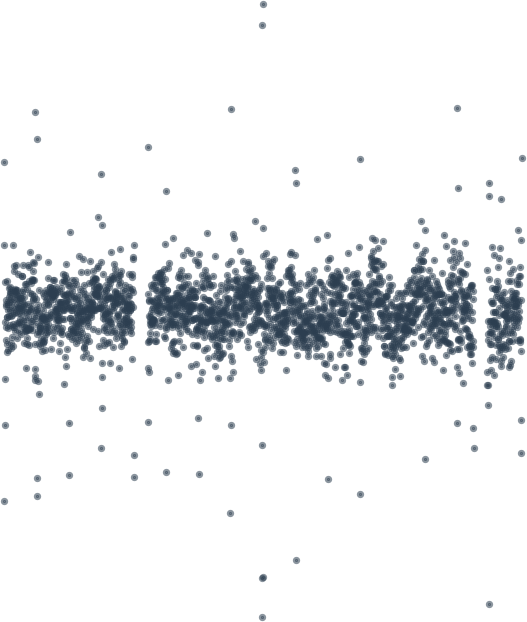
🎯 The first version of the detector, based on hand-crafted rules, yielded an AUC of 0.36—worse than random guessing (0.5). The residuals from eclipsing binaries turned out deeper than planetary ones, and the algorithm deemed them more reliable signals.
\delta = \left(\frac{R_p}{R_s}\right)^2
Transit depth—the fraction of light blocked by the planet—is set by the ratio of squared radii. Jupiter covers 1% of the Sun's disk area, Earth only 0.008%.
\text{SNR} = \frac{\sum_i (r_i \cdot m_i) / \sigma_i^2}{\sqrt{\sum_i m_i^2 / \sigma_i^2}}
The matched filter weights prediction residuals r_i with the transit template m_i and inverse noise variance. Quiet sections of the light curve get more weight, boosting sensitivity.
Scientists
Christian DopplerD. B. McLaughlinDidier QuelozMichel MayorR. A. RossiterDavid Charbonneauexoplanet
transit method
photometry
spectroscopy
Sun
red dwarf
white dwarf
galaxy
Water
methane
carbon dioxideLaws
Doppler effectKepler's third lawMaxwell's equationsPlanck's lawPlanck–Einstein relationWien's displacement law