How a Neural Network Eavesdropped on the Noise of Life express
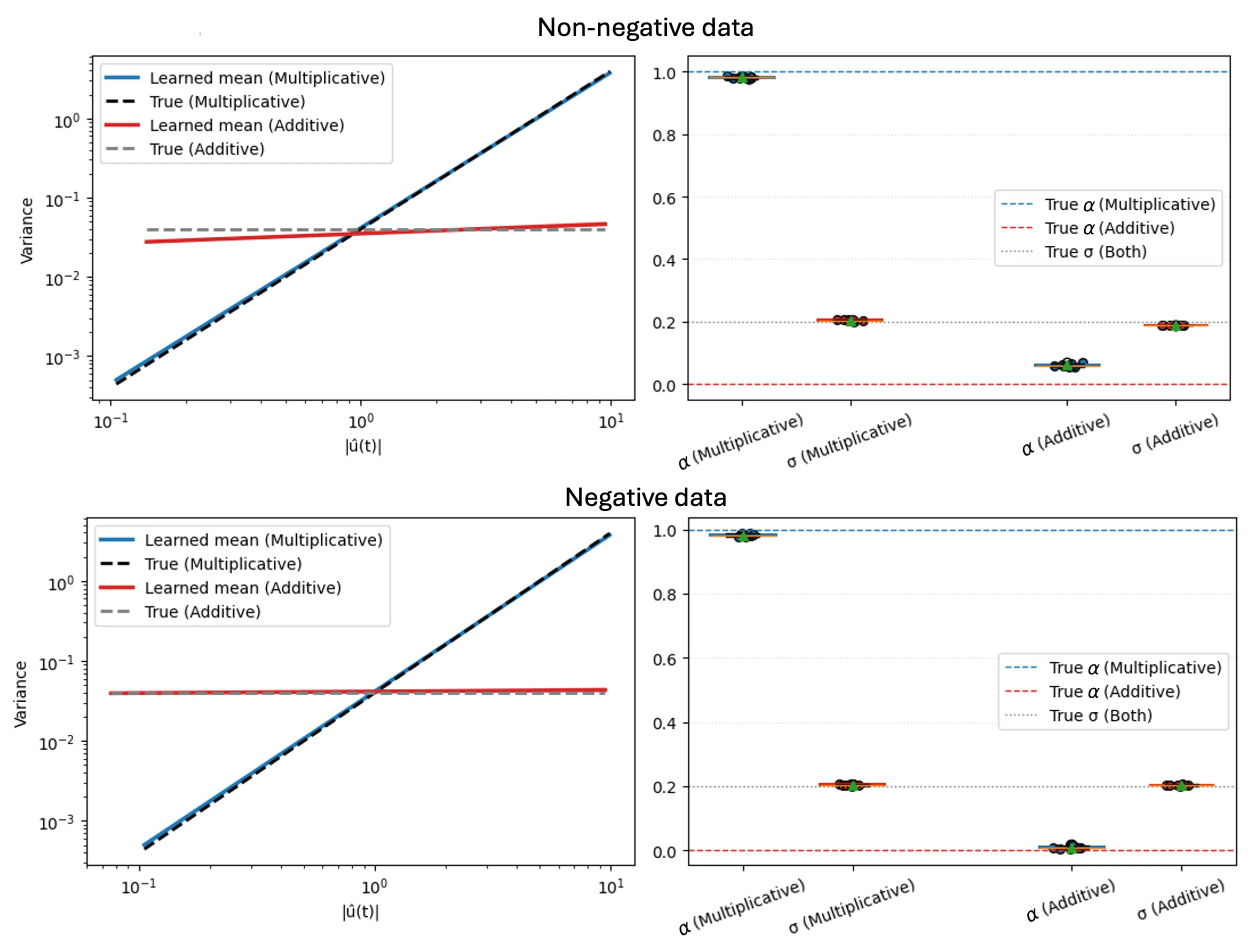
Population growth from a distance looks like a train picking up speed: it crawls at first, then gains momentum. But look closely at the data, and the picture blurs. One measurement shows a dozen individuals, another a hundred. Classical models wipe away this scatter like annoying smudges on a lens. They assume the noise is uniform and simply ignore it. The new work suggests listening to this noise, like a doctor listening to a patient's breathing. Wheezes and whistles tell you what's going on inside.
The authors built on biologically informed neural networks (BINNs). These are like regular neural networks with a biology textbook sewn in, so they don't invent nonexistent laws. To this 'textbook,' they added a trainable block that adapts on the fly to uneven scatter. In statistics, this property is called heteroscedasticity (literally 'different scatter'). Using population growth as an example, the network not only recovered the hidden law but also figured out on its own where data are more reliable and where they're like a stress-induced cardiogram.
The result surprised them: by learning to distinguish 'loud' from 'quiet' noise, the network became more accurate at predicting growth itself. It turns out that the structure of variability is not an enemy but an ally. It encodes information about how the population responds to the environment, crowding, and random strokes of fate. This approach is useful not only in ecology but also in medicine — where patient-to-patient variability isn't a flaw but a key to personalized treatment.
Original abstract
as written by the authors arXiv:2606.13475
In recent years, neural ordinary differential equation frameworks such as Biologically-Informed Neural Networks (BINNs) have shown promise for learning mechanistic laws from sparse data. However, most existing approaches implicitly assume homoscedastic Gaussian noise, and therefore do not account for potentially meaningful structure in biological variability. Here, we present an extension to the existing BINNs framework that includes a learnable noise model, allowing discovery of the noise model directly from data. Using population growth as an example, we demonstrate that the framework accurately recovers the underlying noise structure and improves predictions of the underlying growth laws compared to existing approaches. As such, this work establishes a general likelihood-based framework for jointly learning dynamics and heteroscedastic noise within mechanistic neural network approaches.
The term 'heteroscedasticity' was coined by an economist studying income inequality, but today it's more often heard in conversations among biologists and engineers than financiers.
In 'Westworld,' host androids gradually gained consciousness through behavioral variability: their 'noise' became not a bug but an engine of evolution.