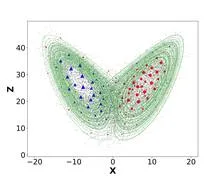
A stochasticdynamical system is a mathematical model where the state evolves over time according to deterministic rules but is also subject to random perturbations, or noise. This combination allows the system to exhibit behavior that is not purely predictable, even if the underlying dynamics are well understood. Such systems are ubiquitous in physics, biology, economics, and climate science, where external fluctuations or internal randomness play a significant role.
History
The formal theory emerged in the early 20th century with the work of Albert Einstein on Brownian motion and Norbert Wiener's rigorous construction of stochastic processes, later extended by Itô and Stratonovich in the 1940s–60s.
How it works
The evolution is typically described by a differential equation that includes a deterministic term (e.g., forces or rates) and a stochastic term (e.g., white noise or random jumps). The noise can represent unresolved small-scale processes, measurement uncertainty, or genuine randomness. Solutions are often analyzed using probability distributions rather than single trajectories, with tools like the Fokker–Planck equation or Monte Carlo simulations.
In practice
They are used to model stock prices, neural activity, climate variability, and particle diffusion, among many other phenomena.
Fun fact
The same mathematical framework that describes the jitter of a pollen grain in water also underpins models of how El Niño events might be triggered by random atmospheric 'noise'.
In an aquarium the size of a dining table, two schools of black neon tetras swim in adjacent compartments separated by a transparent wall. They cannot touch each other, but they see every movement. And here's the surprising part: when one school decides to turn left, the other does the same a moment later. It's like two pendulums hanging behind glass, starting to swing in rhythm.
In a nine-story building with a thousand rooms on each floor, some people whisper and others shout. Neighbors pass the message along, but if everyone speaks too softly, the message fades by the third floor. If too loudly, by the top floor it becomes an unintelligible roar. Between these extremes, there is a regime where a whisper makes it all the way through without distortion.
A forest does not live in a static world. Between winter and summer, day and night, conditions shift, and each fluctuation is like a rhythm that all its inhabitants must keep pace with. Yet until now, ecologists have mostly studied how communities of living beings persist in an unchanging environment, like testing a bridge's strength only in calm weather.
Rare species in a large community are like thin branches on a tree: a random gust can easily snap them. Even if conditions are stable, a small population simply lacks enough individuals to survive a bad season. In a new study, scientists added this factor to an ecosystem model and watched the community clean itself out.
A cluster of glowing dots drifts through the darkness, now compressing into islands, now spreading out in waves. These are not fish or birds: this is a mathematical model of active matter, where each particle spends its own energy on movement, and also is born, dies, and competes with neighbors for space.
In an oven, as temperature rises, molecules move faster and disorder increases. With language models like ChatGPT, it's the opposite. When developers increase the 'temperature' parameter, the model gets access to a wider choice of words, but its long texts suddenly start looping.
A team of researchers tested 11 different AIs by generating 12,000 text continuations.
A mosquito swarm resembles a living cloud — hundreds of bodies circle together, but no one lines up or mimics a neighbor's movements like starlings or fish. For a long time, it was unclear what held such unity together. The authors of a new study suggested that the insects communicate by sound.
Many natural processes are described by differential equations, but scientists often have only fragmentary data — a sort of torn map. The new computational method works like a cartographer who reconstructs a complete map of the terrain from a few landmarks.
Machine learning has long ceased to be just a tool — it is becoming an investigator, independently fishing out the laws of nature from data. But how does a silicon mind come to understand?
In a world striving for chaos, rhythm sometimes arises. The Belousov–Zhabotinsky reaction has amazed for decades: in a test tube, color waves run on their own, as if a living organism breathing matter. Something similar lurks in crystals where iron atoms balance between two magnetic states — high-spin and low-spin.
You can think of a political system as a vast galaxy — a gravitationally bound system of stars, gas, and dust. In this analogy, parties are the stars, radiating the light of public activity, while their supporters are dark matter, the invisible substance that emits no electromagnetic radiation but whose mass holds the whole structure…
A living sheet of cells resembles a crowd on an escalator. In a calm state, everyone moves smoothly, but as soon as a crush occurs, movement comes to a halt. Similarly, cell layers under load can suddenly stiffen, turning from a pliable mass into an elastic scaffold.
A crowd at a metro station during rush hour. Some hurry toward the escalator, others slow down at the departure board, still others weave around a column. Each step is not merely a reaction to what's right in front of your nose. A person estimates in advance where a neighbor will be a second from now and adjusts their route accordingly. Physicists call this forward-looking behavior anticipatory.
Population growth from a distance looks like a train picking up speed: it crawls at first, then gains momentum. But look closely at the data, and the picture blurs. One measurement shows a dozen individuals, another a hundred. Classical models wipe away this scatter like annoying smudges on a lens. They assume the noise is uniform and simply ignore it.
The familiar metronomes placed on a movable platform eventually start to swing in sync. In the quantum world, this trick long eluded scientists. But now physicists have synchronized even the most exotic state — a Fock state, where the number of light particles is precisely defined, like in a counter.
A time crystal resembles an eternal clock: its atoms spontaneously perform rhythmic movements. In ordinary clocks, a pendulum is driven by a spring or battery, but here the motion arises without an energy supply — the system simply returns to its initial state at regular intervals. This idea was proposed by Frank Wilczek in 2012.
Two quantum particles are linked by an invisible thread: one loses energy, the other gains it, but the total remains unchanged. If you watch only the first, its oscillations don't fade — the rhythm is steady, like that of a cosmic pulsar, even though it seems that entropy and chaos are increasing.
An orchestra plays without a conductor. Each musician has a score: that's the genes. But the volume and tempo depend on the acoustics of the hall, the mood, and the neighbors on stage. That's roughly how heredity and daily life together shape a teenager's behavior.
Two musicians play a duet. In a perfect hall, they hear each other perfectly and gradually fall into resonance. But try playing in a room where someone keeps slamming the door. You'd think the rhythm would be thrown off. But no: sometimes that very random slam makes both of them sync up instantly.
A drop of ink in a glass of water spreads evenly, but in a cup with chunks of fruit jelly, the ink will take winding paths — sometimes getting stuck, sometimes slipping through. Similarly, molecules in living cells or porous materials don't move on a smooth field but through a disordered medium: denser in some places, thinner in others.
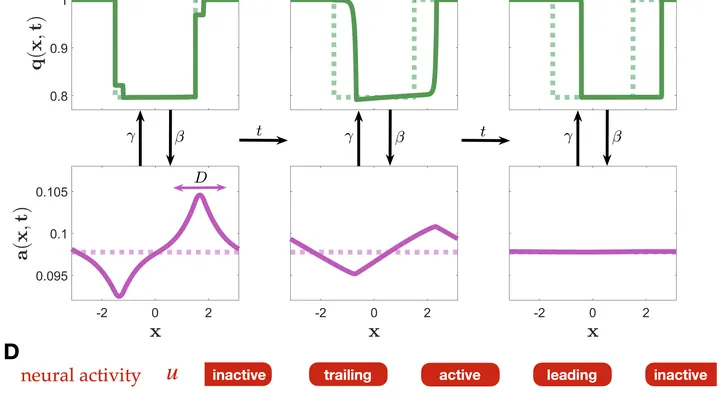
Holding a phone number in your head while you dial it: that's working memory. In the brain, a group of cells is responsible for this, sending signals to each other like people passing a bucket along a chain. But every transfer has a cost: it requires messenger substances that get used up.
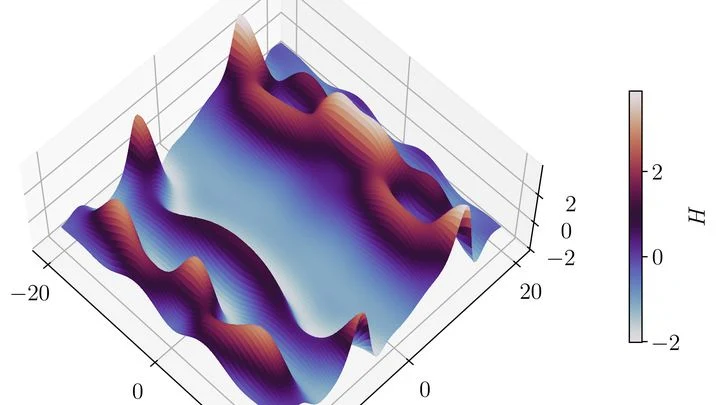
A neural network learning something new is like a traveler in mountainous terrain. Each piece of learned knowledge is a depression in the landscape into which the traveler rolls and gets stuck. To escape and reach a new basin, energy is needed. But as the traveler gains experience, the walls of their pit become steeper, and each subsequent climb requires more effort.
A thin stream of water on a shower glass gathers into winding rivulets that quiver and shift before your eyes. Such a liquid film flowing down a vertical surface is a classic example of chaos in nature: it all flows downward, sure, but the surface lives its own unpredictable life.
A tiny particle floats in a laser beam like a speck of dust in a flashlight's glow. Water molecules constantly jostle it — randomly, from all sides. Usually these bumps are a nuisance: the particle twitches, and precise measurements turn into a lottery. But physicists have figured out how to turn the interference into an advantage.
Thick honey spreads slowly across a plate. In such a world, where friction suppresses inertia, motion is governed not by force but by viscosity. This is how many soft materials behave: polymer gels, colloidal suspensions, the contents of living cells.
Turbulent water flowing through a pipe and the swing of a pendulum may seem worlds apart. But they share something fundamental: both follow their own laws of motion, which can be described by numbers. A neural network trained on just one such 'dance of numbers' suddenly starts to understand another — without a single extra example.
Every few years, the warm current off the coast of Peru shifts, and fishermen come home empty-handed. This is El Niño, the breath of the tropical Pacific, which affects weather from Indonesia to California. Predicting its arrival is as hard as predicting where a stone thrown into a raging river will roll.
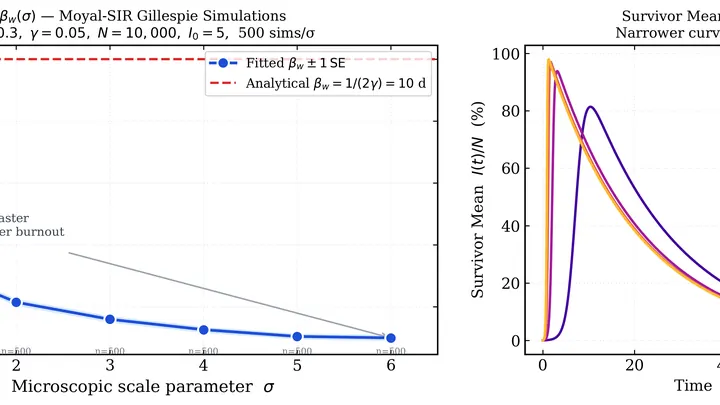
An epidemic is not a steady stream but a series of hits. One carrier may infect no one, while another infects fifty people at once. Such rare but powerful events are called 'dragon kings': they stand out from the overall pattern and determine how severe a disease wave will be.
In the new study, the virus is compared to a billiard ball.
A rubber band is stretched, and suddenly snaps. In the atomic world, a similar picture emerges: the string binding particles can break. In a new study, physicists took a chain of Rydberg atoms and tracked how such a string breaks.
Under weak tension, the string breaks completely, and the system splits into several independent pieces, as if a rubber band shattered into segments.
A pot on a stove receives heat, but not work: the gas under the lid just heats up. But what if the stove is not ordinary, but quantum? Then heat and work can arrive simultaneously, like from an engine that also heats.
In a new study, exactly this case is described: a classical system (say, a pendulum or a small mirror) bathes in a quantum environment.
Time crystals are an exotic phase of matter that exhibits periodic motion not in space but in time, even while in its ground, unexcited state. This idea, reminiscent of a perpetual clock that never needs winding, was first proposed by Frank Wilczek.
A group of people searches for a lost item in a large park. Some get tired and leave, others join along the way. The number of searchers is constantly changing. How does this affect the search time? Until now, science had no clear answer.
In a new study, a general model of such a process has been built. In it, independent participants randomly enter and leave the search.
Our Universe may have arisen from a highly unstable state that physicists call the false vacuum. Imagine a glass of water cooled below its freezing point: the liquid remains liquid only until the first jolt, which instantly triggers crystallization into ice.
A thin thread in a water flow is like a hair in a shower stream. If you jerk the water back and forth, the hair either stretches out with the flow or crumples up. The researchers took real protein threads (actin, which makes up muscles) and placed them in a microscopic channel where the fluid oscillated at different frequencies.
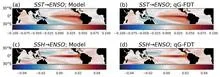
You can sit on a seesaw and pump your legs, or you can just tip from one side to the other. The Pacific Ocean does both. Every few years, warm water off the coast of Peru gives way to cooler water, and rainfall patterns, winds, and entire ecosystems across half the planet reshuffle. These shifts are called El Niño and La Niña, together known as ENSO: Earth's climate seesaw.
A density of four people per square meter is the threshold beyond which a crowd ceases to be a sum of individual pedestrians and becomes something else. In Pamplona's Plaza Consistorial during the San Fermín festival, local density reached nine people per square meter.
A quantum state under continuous measurement is not a frozen picture but a random dance. Each measurement outcome nudges the state one way or another, and to predict the future you have to track the entire trajectory.
In winter, air over the Northern Hemisphere does not move haphazardly; it spends days at a time in the same pattern before rearranging itself. These patterns are like rooms in a maze: the system enters, lingers, then finds a door to another room. Each room has its own weather: somewhere over Europe it is warm and humid, while over Siberia it is frosty and clear.
Every winter, the Pacific Ocean warms slightly off the coast of Peru, and every summer it cools. This rhythm is set by the gears of the climate machine, but some turn fast, others slow, and still others speed up or stall. Linear inverse models have helped us glimpse these gears in data for decades, but they were blind to seasonal changes in pace.