Bayesian evidence, also known as the marginal likelihood, is the probability of the observed data under a given model, with all parameters integrated out. It is computed as the integral of the likelihood times the prior over the entire parameter space. This quantity is central to Bayesian model comparison: the ratio of evidences for two models (the Bayes factor) tells you how much more likely one model is than the other, given the data. A key property is that it automatically penalizes model complexity — a model with more parameters does not automatically get higher evidence, because the extra parameter space dilutes the prior probability mass.
History
The concept dates back to the work of Harold Jeffreys in the 1930s, who introduced the Bayes factor for hypothesis testing. The term 'evidence' was popularized by John Skilling in the context of nested sampling in the 2000s.
How it works
To compute the evidence, you integrate the product of the likelihood and the prior over all parameter values. For simple models, this integral can be done analytically; for complex models, it requires numerical methods like nested sampling or thermodynamic integration. The evidence balances fit and complexity: a model that fits the data well but has many parameters will have a lower evidence than a simpler model that fits almost as well, because the prior mass is spread over a larger volume.
In practice
Bayesian evidence is used in cosmology to compare models of the universe (e.g., with or without dark energy), in exoplanet detection to decide if a signal is a planet or noise, and in machine learning for automatic model selection.
Fun fact
The Bayesian evidence automatically implements Occam's razor: if two models fit the data equally well, the simpler one will have higher evidence, purely from the mathematics of probability.
In a rubber band stretched in the lab, three different elasticity mechanisms operate simultaneously. At small strains, Hooke's law prevails; at intermediate strains, entropic chain elasticity; at large strains, strain-induced crystallization.
A protein engineer is like a chef trying to make a dish that is tasty, healthy, and cheap all at once. Change one ingredient, and you risk ruining another. In the past, computer assistants could only evaluate protein properties one at a time, missing how they are connected.
An interpreter gets distracted by every rustle in the hall, and a one-hour meeting stretches into two. Similarly, molecular foundation models learn the language of molecules from vast corpora, but each new conversation requires fine-tuning. Monroe changes the rules: it doesn't learn a new language but instantly finds common meaning from a few examples.
A lone fish sees a shadow overhead. Should it flee? If it's just a leaf, it wastes energy and gives away its position to a predator. If it's a heron, hesitation is fatal. That's the eternal trade-off of the solitary individual: quick reactions mean many false alarms, while caution means risking being eaten.
In a school, it's different.
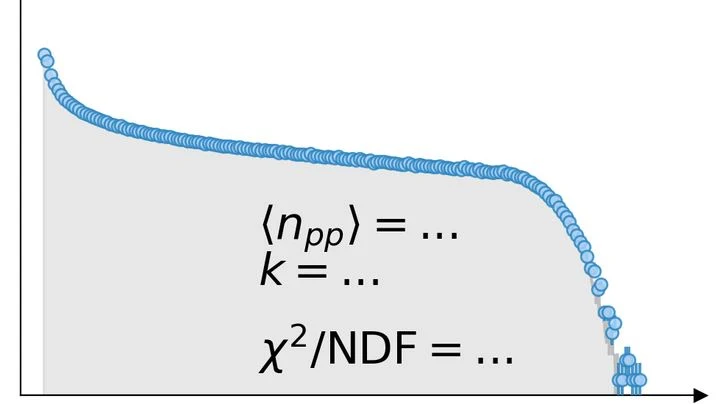
When two heavy nuclei smash into each other at enormous speeds, they don't collide as whole objects like billiard balls. Only part of their matter comes into contact. How many nucleons (protons and neutrons) actually took part in the collision, and how many flew past, is not known in advance. All subsequent measurements depend on this number, but it cannot be observed directly.
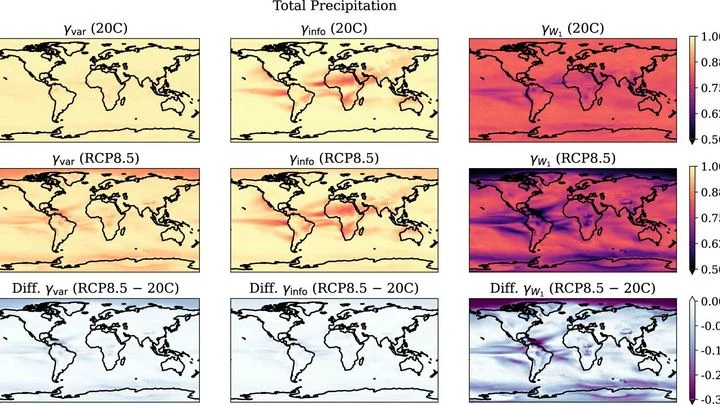
In winter, one part of town gets three times as much snow as the neighborhood next door. One year is a scorcher, the next is a cold snap. That's the whims of weather. But over decades, a different, slow shift emerges: winters, on average, get milder. Telling the two apart is the central challenge for climate scientists.
In 1998, mathematician David Boyd noticed something strange. He was studying the Mahler measure of polynomials, a quantity that gauges the "complexity" of their roots, and found that for a family of curves, it always equals a special rational number times the derivative of an L-function.
A Dictyostelium amoeba crawls across glass. Its path is recorded — a chain of points on a plane. But what forces are pushing it? Inside the cell, a molecular motor works: proteins pull, the membrane springs, water presses.
Two hundred million stars. In the heart of the Galaxy, where the future survey by the Nancy Grace Roman telescope will aim, about 250 times during its mission the light of one of them will flicker at an invisible touch.
4 610 universes — that's exactly how many cosmological models astrophysicists needed to show that the familiar Gaussian mask no longer works for next-generation data. Future sky surveys, such as the Euclid mission and the Vera C.
On a topographic map, raindrops choose their path: falling on one slope, they flow into River A; on the other, into River B. An observer sees only the winding rivers (the response variables Y) and knows which slope the water came from (the instrument Z), but cannot see the drops themselves (the unobserved factors ε).
A doctor scrolls through a patient's chart and sees a line: "The drug reduces risk." But how much can you trust that? Is the claim based on a couple of case reports or on tens of thousands of patients in a blinded trial? The answer determines the treatment.
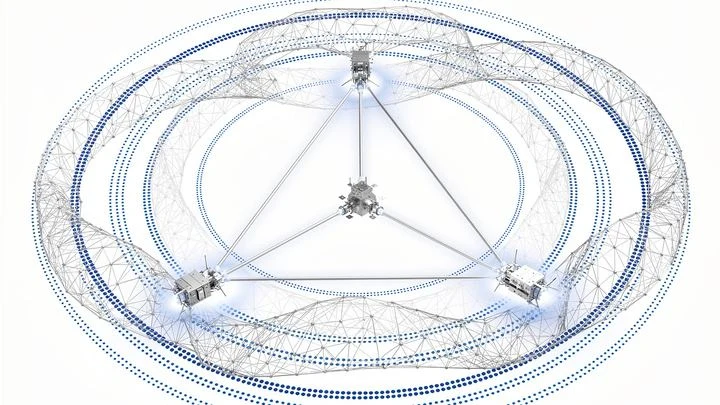
The Universe is not silent: it is filled with a continuous gravitational-wave hum. In a decade, the LISA space observatory will tune its "ears" to the millihertz range, and the richest source will be our Galaxy — tens of thousands of white dwarf pairs whirling in a frantic dance.
We're used to thinking that noticing only confirmations of our guesses is a mistake. But recent calculations, inspired by wave behavior, flip that view. It turns out that the habit of seeking the familiar is the best way to reduce information noise (scientists call it entropy).
Population growth from a distance looks like a train picking up speed: it crawls at first, then gains momentum. But look closely at the data, and the picture blurs. One measurement shows a dozen individuals, another a hundred. Classical models wipe away this scatter like annoying smudges on a lens. They assume the noise is uniform and simply ignore it.
Two heavy balls orbit on the surface of a pond. Ripples spread from them: these are gravitational waves. As the balls spiral closer, the waves carry away energy, and the ripples become more frequent.
A distant orchestra plays a symphony, but the recording is full of noise. The melody is written for two instruments, yet a third voice seems to break through the static — quiet and unfamiliar. This is how astrophysicists listen to gravitational waves, trying to catch the slightest deviations from Einstein's predictions.
An epidemic is not just a virus: it's millions of personal decisions. One person keeps riding the subway; another locks themselves at home. Classical models describe the average behavior of a crowd but don't ask why each individual acts that way.
When a neutron or proton enters an atomic nucleus, it behaves like a ball hitting a rough wall: it can bounce off in different ways, depending on where it hits.
Genetic diagnostics is like comparing two photos taken with different cameras. If one camera slightly shifts the colors, the image will show "defects" that don't exist in reality.
Inside a neutron star, matter is compressed to unimaginable densities. Previously, scientists speculated about its exact makeup, cycling through possible equations linking pressure and density. The new method tosses out guesswork: it directly ties the measurable mass and radius to the internal structure.
An orchestra without a conductor plays in harmony, and you want to understand who influences whom. The violinist hears the cello, the cellist catches the rhythm of the percussion, and the flute adapts to everyone at once.
On an old film strip of rainfall, only the brightest frames are visible, and between them lies noise. A meteorologist assessing flood risk long looked only at such frames, that is, at annual rainfall maxima. Everything else, thousands of daily observations, remained off-screen. The new method develops the entire film, and details that were previously invisible come into view.