MLE is the workhorse of data analysis in physics because it is both intuitive and statistically powerful. It provides a principled way to extract the best estimate of a physical quantity from noisy measurements, and it naturally yields uncertainties on those estimates through the curvature of the likelihood function. It is also the foundation for many advanced techniques, such as Bayesian inference, which extends MLE by incorporating prior knowledge. In particle physics, MLE is used to discover new particles by comparing the likelihood of a background-only model with one that includes a signal.
History
The method was introduced by Ronald Fisher in the 1920s, building on earlier work by Carl Friedrich Gauss and others. Fisher formalized the concept of likelihood and proved many of its desirable statistical properties, making it a cornerstone of modern statistics.
How it works
The method begins with a probability distribution that describes how the data are generated given the model parameters. For example, if you are measuring the decay times of a radioactive sample, you might assume they follow an exponential distribution with a rate parameter λ. The likelihood function L(λ) is the product of the probabilities of each observed data point, given λ. To find the maximum, you typically take the logarithm of the likelihood (since it is easier to work with sums than products) and then find the parameter value that makes the derivative zero. This can be done analytically for simple models or numerically for complex ones. The resulting estimate is called the maximum likelihood estimate, and its uncertainty is often derived from the second derivative of the log-likelihood, which gives the Fisher information.
In practice
MLE is used in virtually every experimental physics analysis, from fitting particle tracks in detectors to estimating the Hubble constant from supernova data, and it is also widely applied in fields like economics, biology, and machine learning.
Fun fact
The maximum likelihood estimate is not always unbiased—for example, the MLE of the variance of a normal distribution is slightly too small on average—but it is still the most efficient estimator in many cases, meaning it has the smallest possible variance among unbiased estimators.
An interpreter gets distracted by every rustle in the hall, and a one-hour meeting stretches into two. Similarly, molecular foundation models learn the language of molecules from vast corpora, but each new conversation requires fine-tuning. Monroe changes the rules: it doesn't learn a new language but instantly finds common meaning from a few examples.
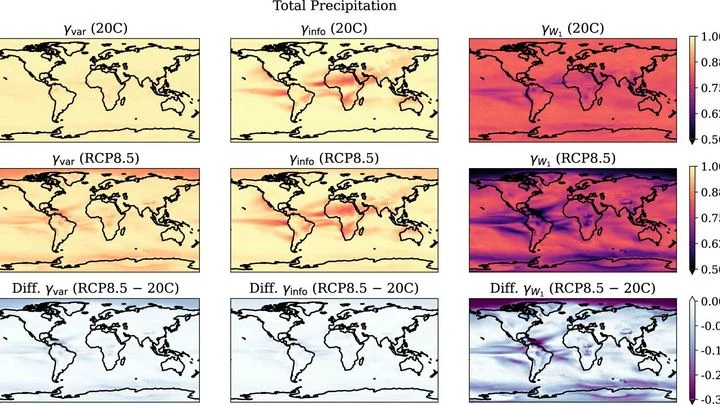
In winter, one part of town gets three times as much snow as the neighborhood next door. One year is a scorcher, the next is a cold snap. That's the whims of weather. But over decades, a different, slow shift emerges: winters, on average, get milder. Telling the two apart is the central challenge for climate scientists.
A Dictyostelium amoeba crawls across glass. Its path is recorded — a chain of points on a plane. But what forces are pushing it? Inside the cell, a molecular motor works: proteins pull, the membrane springs, water presses.
Two hundred million stars. In the heart of the Galaxy, where the future survey by the Nancy Grace Roman telescope will aim, about 250 times during its mission the light of one of them will flicker at an invisible touch.
4 610 universes — that's exactly how many cosmological models astrophysicists needed to show that the familiar Gaussian mask no longer works for next-generation data. Future sky surveys, such as the Euclid mission and the Vera C.
Gravity isn't just the force that keeps us on the floor. On cosmic scales, it conducts galaxies, bends light rays, and decides the fate of everything. A century ago, Einstein described it as the curvature of space and time.
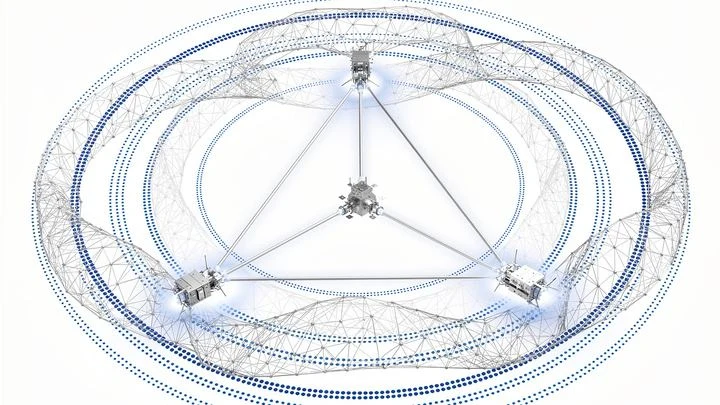
The Universe is not silent: it is filled with a continuous gravitational-wave hum. In a decade, the LISA space observatory will tune its "ears" to the millihertz range, and the richest source will be our Galaxy — tens of thousands of white dwarf pairs whirling in a frantic dance.
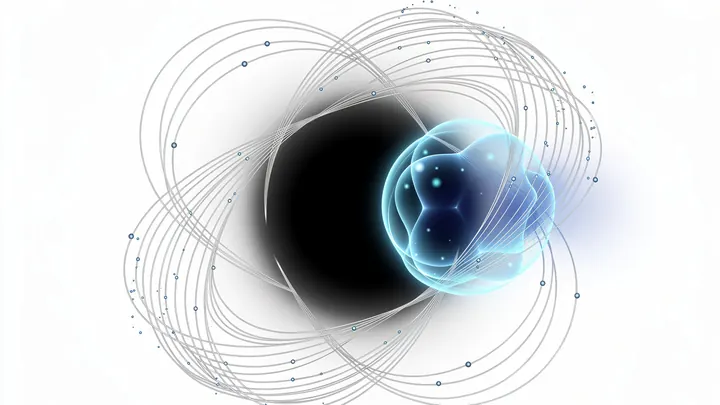
A black hole is not a frozen void, but a living magnetic engine. Its 'heart'—the accretion disk, pulsates: inhale, matter spirals into the funnel, exhale — magnetic reconnection tears the field lines, and plasma shoots away from the horizon.
Population growth from a distance looks like a train picking up speed: it crawls at first, then gains momentum. But look closely at the data, and the picture blurs. One measurement shows a dozen individuals, another a hundred. Classical models wipe away this scatter like annoying smudges on a lens. They assume the noise is uniform and simply ignore it.
Two heavy balls orbit on the surface of a pond. Ripples spread from them: these are gravitational waves. As the balls spiral closer, the waves carry away energy, and the ripples become more frequent.
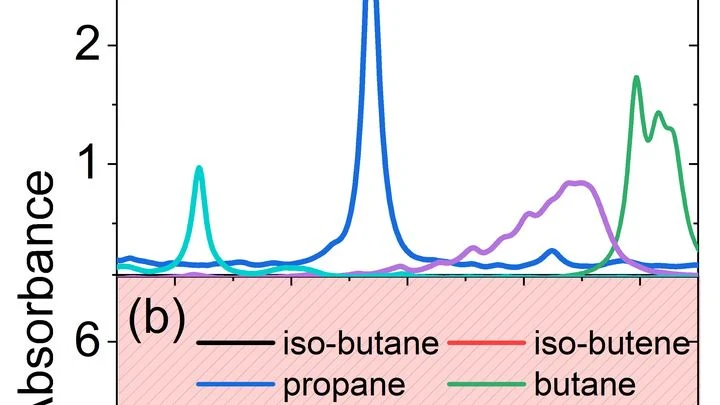
A hundred people are talking at once in a large hall. You try to hear one, but voices blend, some whisper, and you don't even suspect the existence of others. That's roughly how a conventional laser gas analyzer feels when dozens of substances mix in a combustion chamber or a factory pipe.
A library of 27,000 books, and every one of them is about concrete. Each contains a mix recipe, temperature, and strength. But the information is scattered across paragraphs, tables, and footnotes. For a human, gathering it all together would take years. The program did it in an hour.
In a regular battery, the electrolyte is liquid, and charged particles (ions) move freely. In the solid-state version, they squeeze through atomic 'corridors', like pedestrians in narrow passages. For a battery to work quickly, you need a material with high ionic conductivity.
A particle detector at the Large Hadron Collider runs for years without stopping. Its sensors produce mountains of data every second, and among it all, you need to spot a fault quickly, like overheating or a broken channel. In the past, simple rules did this, but they often made mistakes.
In a collider detector, each proton collision leaves a trail of dozens of particles, like the splash from a stone thrown into water. Making sense of that splash and understanding what exactly happened at the moment of impact is a task that humans can no longer handle alone.
When a top quark is born in a particle detector, it immediately decays into a shower of other particles. Catching a hint of new physics in that shower is like hearing a whisper at a rock concert. You need not just a good microphone, but the ability to subtract the roar of the amplifiers and the hum of the crowd.
The ocean doesn't always stick to the same schedule. Sometimes the warm El Niño current strengthens, sometimes it weakens, and each regime dictates its own reaction speed to the past. These hidden regimes are like shifts in currents that remember their path with different depths.
An interpreter at an important negotiation keeps a draft of their speech at hand but checks against the live conversation as they go: if what is said diverges from the prepared text, they adjust the translation on the fly.