How to Deliver a Pulse Right on Target express
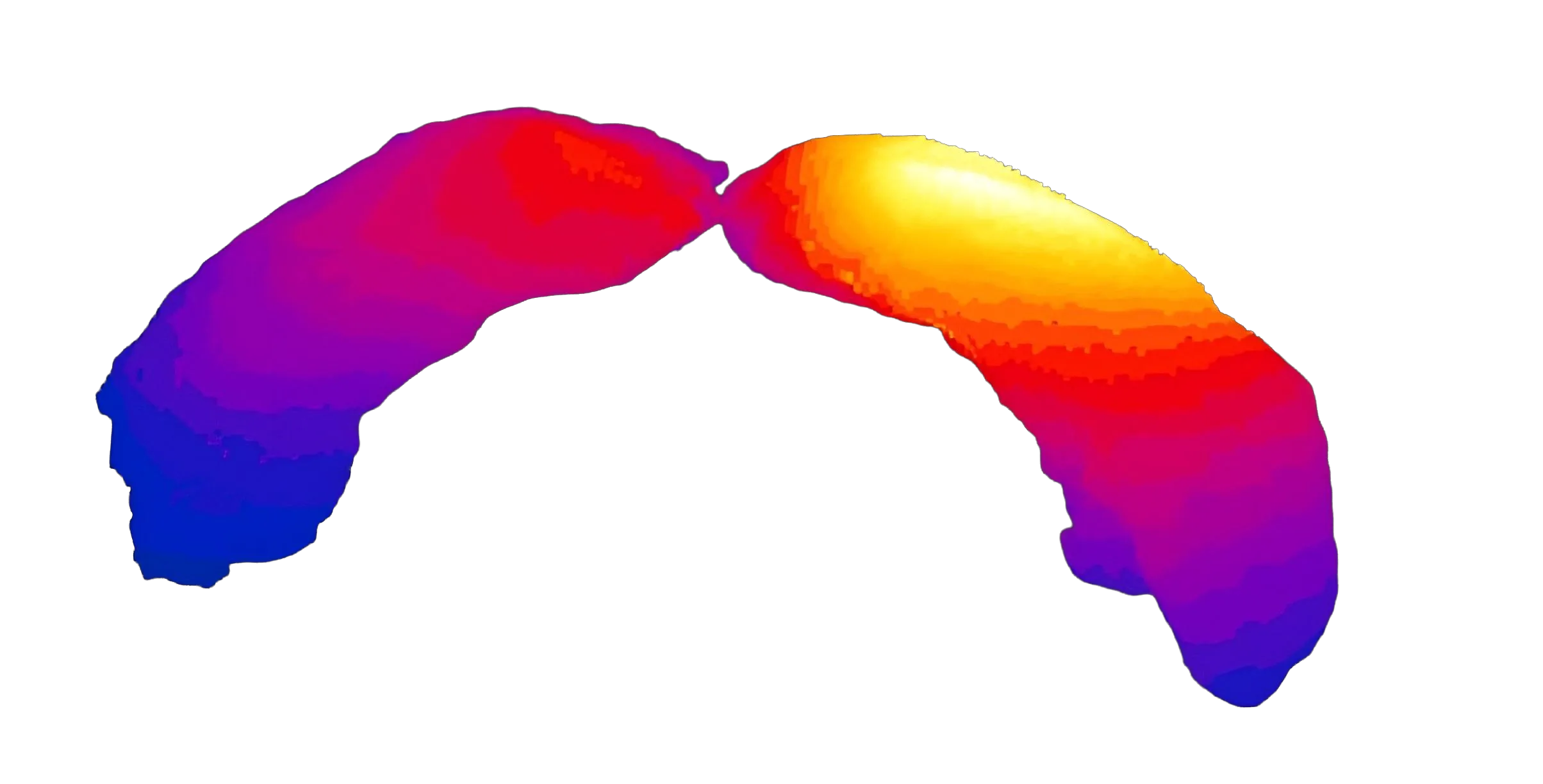
The brain is like a noisy city where each district has its own business. Neurons communicate via electrical signals, and sometimes you need to reach a specific block without disturbing the neighbors. Temporal interference stimulation (where two high-frequency fields, superimposed, create a low-frequency effect only at their intersection) promises such targeted stimulation of deep structures. But until now, tuning it felt like trying to find a particular alley without a map or a flashlight.
The researchers built a digital model of a mouse head and equipped it with an optimization algorithm. This is not just a virtual cast of the skull — the program accounts for how tissues conduct current and iterates over electrode placements, frequencies, and signal strengths. The goal is to achieve maximum brightness at the target point and minimal spillover around it. This approach turns crude tuning into precise calculation.
In another scenario, for the dentate gyrus (involved in distinguishing similar memories), the radius of the stimulation spot shrank from 3.99 to 3.54 millimeters. Almost half a millimeter — a noticeable difference for a mouse hippocampus. The algorithm doesn't just amplify the signal; it seeks a balance: sometimes power matters more, sometimes sharp boundaries. Validation on a standard Sim4Life phantom confirmed that the found settings work reliably, not just tuned to one specific model.
Now the researchers have a navigator that plots a route to any district of the neural city. This promises cleaner experiments: when you know you've only touched the target block and the neighbors are silent, conclusions about brain function become more reliable.
Original abstract
as written by the authors arXiv:2606.15192
Temporal Interference (TI) stimulation enables deep brain targeting, yet precise optimization tools for mouse models remain limited. We developed a computational optimization tool integrating mouse head modeling with the optimization algorithm to optimize stimulation strategies for predefined target regions. By balancing target intensity and spatial focality, the optimized strategy significantly outperformed empirical baselines. For the CA3-CA1 target, it achieved a 7-fold intensity increase (10.29 vs. 2.89 V/m) under iso-focality conditions. Conversely, for the Dentate Gyrus, it improved spatial confinement ($$r_{0.5}$$ reduced from 3.99 to 3.54 mm) while maintaining comparable intensity. Cross-model validation on a standardized Sim4Life phantom further confirmed the framework's robustness. This approach offers a powerful tool for enhancing the precision and reproducibility of preclinical TI stimulation studies.
Temporal interference stimulation was first proposed for stimulating deep structures of the human brain without implanting electrodes: it is now being actively tested in rodents.
A similar principle of targeted stimulation is described in Larry Niven's story 'The Hole Man': there, a criminal was punished by directing a pain signal straight into the brain without affecting surrounding tissues.