Graviton Without Extra Surprises express
The quantum world and gravity have long struggled to get along. Einstein's general relativity beautifully describes the gravity of planets and stars, but at atomic scales its equations break down — infinities appear. One approach to solving this problem is called Asymptotic Safety. Its idea is that the strength of gravity does not grow uncontrollably at short distances but reaches a constant, 'safe' value.
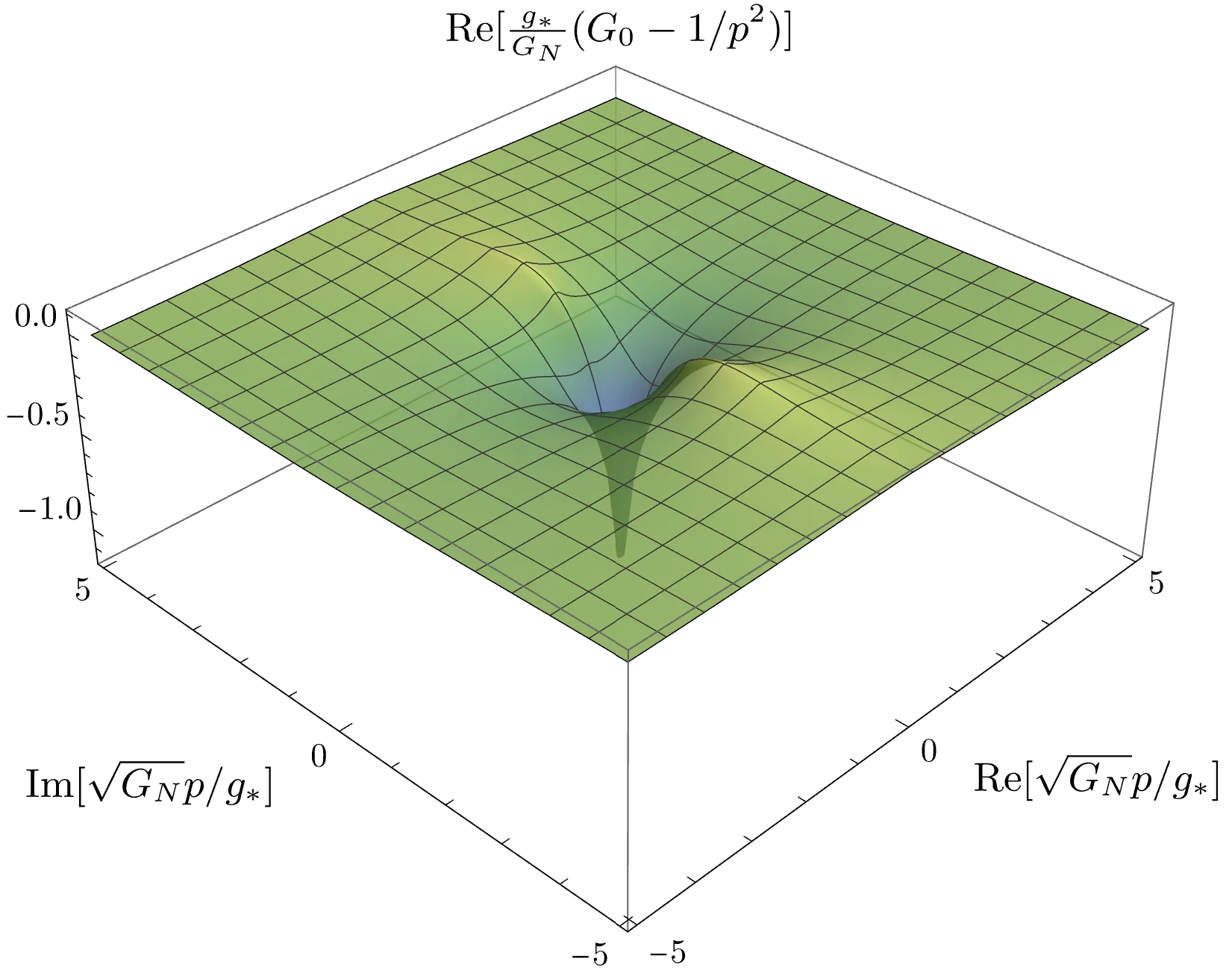
In the new work, physicists took this approach and calculated exactly how the graviton (the hypothetical particle that carries the gravitational interaction, just as the photon carries light) propagates. They obtained a simple formula (an approximation) for the so-called propagator, a quantity that describes the motion of the graviton. The main question was: would the calculations produce extra poles, which would mean new, never-before-seen particles, or worse, causality violations where a signal arrives before it was sent?
The results are encouraging: in the sector of particles with spin 2 (gravity), not a single extra pole was found. The theory does not spawn new entities and preserves all cause-and-effect relationships. It's like renovating an old building: not only did they strengthen the foundation, but they also made sure they didn't break the load-bearing walls.
This approach strengthens the position of Asymptotic Safety as a realistic candidate for unifying quantum mechanics and gravity. The universe at the smallest scales might be simpler than we thought: no exotic particles, no causality violations, just good old spacetime geometry, but with new rules of the game.
Original abstract
as written by the authors arXiv:2606.18343
We derive an analytical approximation for the graviton propagator from Asymptotic Safety. We find neither extra poles nor indications of unitarity or causality violations in the spin-two sector. Our results strengthen the case that Asymptotic Safety does not introduce new degrees of freedom, and thus propagates the same field content as General Relativity. We also identify the underlying mechanism: the residues of spurious poles in finite-order derivative expansions approach zero as the order is increased.
The graviton has not yet been detected experimentally: it interacts too weakly with matter. To catch a single graviton, a detector the size of Jupiter placed near a neutron star would register only a few events per billion years.
In Robert Wilson's novel 'Spin', alien technology changes the rate of time flow on Earth without violating local laws of physics — much like Asymptotic Safety modifies gravity at quantum scales without introducing new particles.