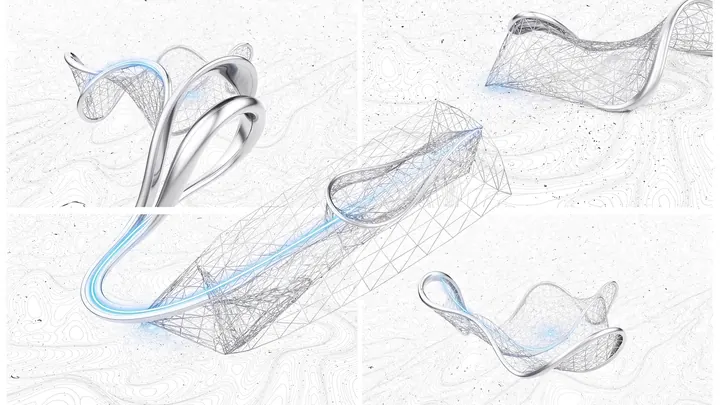
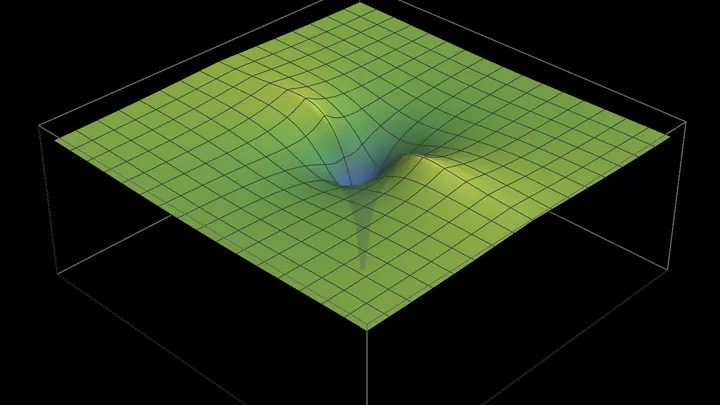
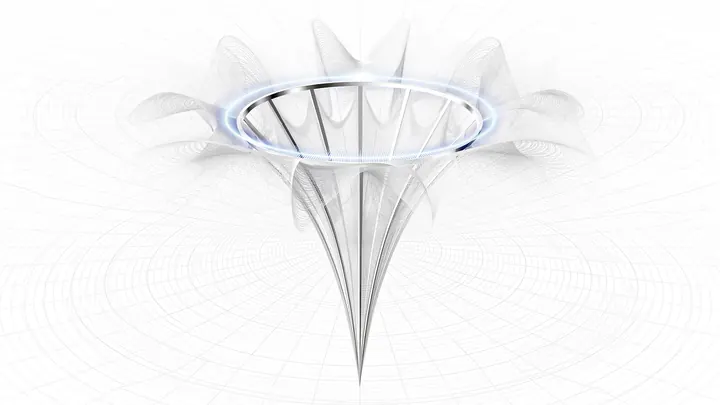
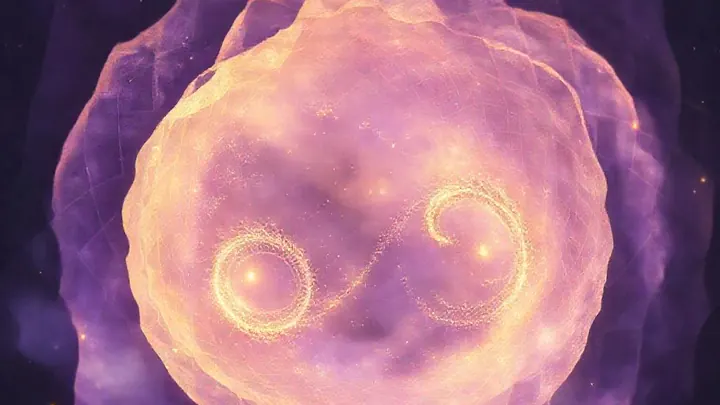
The graviton is the hypothetical quantum particle that would mediate the force of gravity in a quantum theory of gravity. In the framework of quantum field theory, forces are transmitted by exchange particles, such as photons for electromagnetism. The graviton is proposed as the spin-2 boson that would carry gravitational interactions, but it has never been detected, and its existence remains a central question in theoretical physics.
History
The concept of the graviton emerged in the 1930s from attempts to quantize gravity, with early work by Pauli and Fierz on spin-2 fields, and it became a standard part of quantum field theory discussions in the 1960s.
How it works
In quantum gravity theories, gravitons are envisioned as massless particles traveling at the speed of light, with two polarization states (like gravitational waves). They would interact with all forms of energy and matter, causing the attraction we perceive as gravity. The challenge is that gravity is incredibly weak compared to other forces, so detecting individual gravitons is far beyond current technology, and the theory requires a framework that unifies general relativity with quantum mechanics.
In practice
While gravitons have no direct practical application yet, the search for them drives research in quantum gravity, cosmology, and high-energy physics, potentially leading to a unified theory of fundamental forces.
Fun fact
If gravitons exist, they would be the only known elementary particles with spin 2, and their detection would require a detector the size of a planet to have any chance of catching one.
A translator gets distracted by every rustle in the hall, and a one-hour meeting stretches into two. A single wrong intonation changes the meaning beyond recognition. That's roughly how a particle with spin 3/2—the gravitino — behaves. It cannot exist in isolation: its "speech" must be perfectly coordinated with its surroundings, or the whole structure falls apart.
Two stars circle each other, gradually drawing closer. Their dance loses energy, and that energy escapes into space — in the form of gravitational waves, and sometimes other fields.
The early Universe was like a tightly coiled spring. In the first moments, it expanded at an unimaginable rate — a phase called inflation. Usually, this is attributed to a special field, but there's another idea: spacetime itself twists like a spring, and this twisting (in physics, torsion) becomes the engine of expansion.
A thrown stone sends ripples across water. A gravitational wave is the same kind of ripple, but in spacetime. It is produced, for example, by the merger of two black holes. In classical physics, this ripple is eternal: once created, it travels through the Universe without fading.
Usually, a black hole is described as a frozen frame: there's mass, there's charge, and it's all static. But real objects live in time. They radiate, lose energy, and change.
A quantum particle can be a wave, and pass through two paths at once. But if something 'peeks' at which path it took, the wave disappears. This effect is called loss of interference. Usually, photons or air molecules do the peeking.
A massive aluminum cylinder weighing a ton hangs in a vacuum. A gravitational wave, a ripple in spacetime, passes through it, and the bar begins to tremble almost imperceptibly. That trembling can be heard as sound: gravitational waves turn into a phonon — a quantum of sound vibrations.
In the first moments after the Big Bang, the Universe hummed like a bell. Inflation, the epoch of rapid expansion confirmed by measurements of the cosmic microwave background, ended, and the inflaton field began oscillating around the minimum of its potential.
The world around us is three-dimensional, but perhaps that's just an illusion. Some theories allow for extra dimensions of space, curled up or stretched in special ways. One such model depicts a five-dimensional universe with a "diluted" dimension (called a linear dilaton).
In accelerators like the Large Hadron Collider, heavy nuclei collide at enormous speeds. For an instant, quark-gluon plasma (QGP) is born — a state of matter where quarks and gluons float freely, just like in the first microseconds after the birth of the universe.
This plasma is not just hot.
The cosmic microwave background is not just a faint glow with a temperature of 2.7 K. It's a snapshot of the Universe 380,000 years after the Big Bang, when the primordial plasma finally became transparent to light. But for theoretical physicists, what came before is far more interesting.
The early universe resembled an overcrowded hall where heavy particles collided and decayed at a deafening pace. Among them could have been scalar leptoquarks — particles that simultaneously latch onto a quark (a building block of matter) and a lepton (such as an electron).
In the classical picture of the world, gravity is the smooth bending of space and time. But at the microscopic level, where quantum mechanics rules, these bends should turn into a grainy ripple. The particles of such a ripple are called gravitons. The trouble is that straightforward calculations with gravitons always run into infinities — the theory loses its meaning.
The quantum world and gravity have long struggled to get along. Einstein's general relativity beautifully describes the gravity of planets and stars, but at atomic scales its equations break down — infinities appear. One approach to solving this problem is called Asymptotic Safety.
Right after the Big Bang, space was a hot plasma — a mix of charged particles and light. In such a medium, electric currents couldn't flow on their own: a 'potential difference' was needed to push electrons relative to photons.
If a black hole spins quickly, it can hold a cloud of ultralight particles around it, so light that their mass almost vanishes. They arrange themselves in layers, like electrons in an atom, only here gravity does the job instead of electric forces. This structure stores energy, like a coiled spring.
Spacetime can be imagined as a tightly stretched fabric. A massive body dents it, guiding light. Rotation twists the fabric into a spiral. Such a gravitational funnel can entangle a passing photon with the very source of rotation — say, a tiny mirror. Quantum entanglement springs up: an invisible thread binding their fates.
The light cone is a blueprint of causality, laser-cut onto the fabric of the universe. In classical physics, it is as sharp as a scalpel: events inside are linked by invisible threads of influence, while outside lies eternal isolation, sealed by the ultimate speed limit.
Two massive spheres slowly drift apart in empty space. From the standpoint of ordinary mechanics, nothing special is happening. But Einstein's equations say otherwise: accelerating masses stir spacetime itself, and from them spread gravitational waves — ripples that stretch and squeeze everything in their path.
A magnet the size of a grain of rice floats in a vacuum without touching the walls. It is held by the magnetic field of a superconducting trap — a ring cooled to a state where current flows without resistance.
Gravity is the curvature of spacetime, not just an attraction, as Einstein showed. On such a curved "dance floor", even the hypothetical carriers of gravity — gravitons — move oddly.
Imagine a giant orchestra where every musician is a particle born in the fire of the Big Bang. When time's baton gives the downbeat, these particles begin to decay into lighter ones. Each decay is accompanied by a quiet chord — the emission of gravitons, tiny quanta of gravity.
A single graviton, a quantum of spacetime, is incredibly weak. For detectors like LIGO, built by Rainer Weiss and colleagues, quantum effects are suppressed by a factor of 10⁻³⁸: it's like trying to hear a grain of sand changing the wind's direction in a hurricane.
The Universe speaks two fundamental languages — gravity and light. Under normal conditions, they do not mix: gravitational waves glide through matter without a trace, while photons dance in mirror labyrinths.
Hydrogen is the most common element. Its atoms are like antennas: they emit and absorb light at very specific frequencies. Einstein predicted that spacetime can ripple: these are gravitational waves.
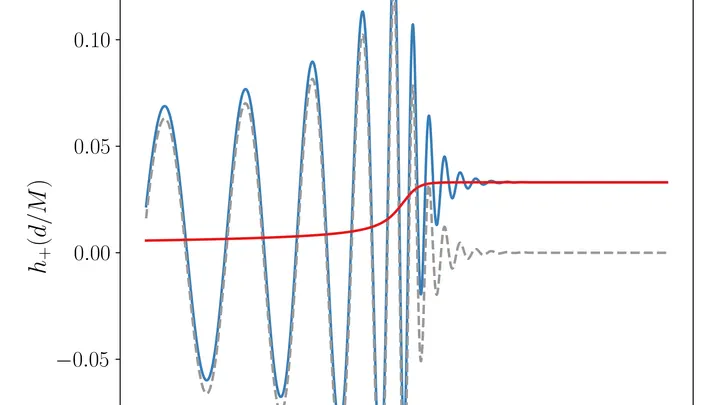
A black hole collision isn't just a burst of gravitational waves; it also leaves a lasting trace: an eternal curvature of spacetime — gravitational memory. Like a boat on water leaves a lingering wake, the cosmos 'remembers' the catastrophe.
A light carousel spins not people but electrons. Instead of wooden horses, there are invisible blades of light. This is exactly the kind of 'carousel' physicists built to give electrons a spin.
Usually, to twist an electron beam into a vortex, you need a tiny mask — a stencil with slits carved on the atomic scale. Fabricating it is extremely challenging.
Light bends around massive bodies: this has been known since Einstein's time. But what if gravity itself is not a smooth fabric of space but a stream of tiny carrier particles? Then a beam passing near a particle should not just bend but enter into a special quantum relationship with it.
This relationship is called entanglement.
In 2015, the LIGO detectors caught the first burst of gravitational waves — astronomers heard two black holes colliding far out in space. That ripple in spacetime reached us with its signal shape intact: like the sound of a bell traveling billions of years without distortion.
Picture two choirs in soundproof rooms on a wobbly stage. They sing, but can't hear each other — the air doesn't carry the tune. Yet if the stage trembles, its vibrations link their songs. That's the idea behind a new test for quantum gravity.
In 2015, two giant facilities in the United States caught the shiver of space — a gravitational wave from the collision of black holes. Since then, such signals have been caught regularly, but the detectors themselves are enormous: their arms stretch for kilometers.
A tiny superconductor, levitating above a magnet, is like a cork on the surface of an invisible ocean. The slightest breath of dark matter makes it shudder. Scientists examined two kinds of such 'wind'. The first – gravitational waves, which stretch and squeeze space itself, like ripples on the fabric of the cosmos.
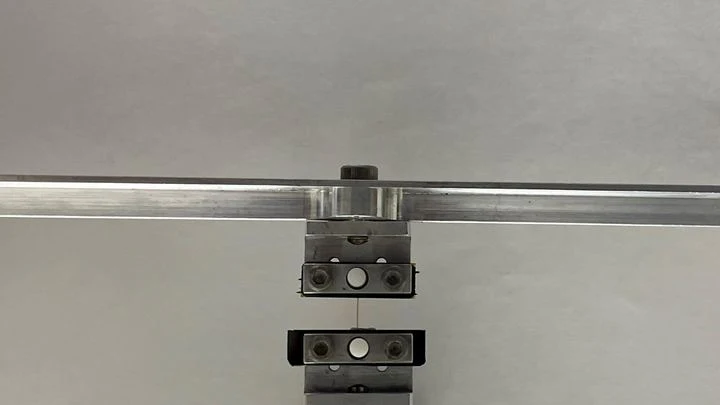
A weight about the size of a small apple hangs from a thread hundreds of times thinner than a human hair. The thread doesn't snap and barely interferes with the weight's swinging. This setup is the heart of a new lab scale for measuring gravitational attraction.
A sugar solution can twist light — many have seen this in polarization experiments. Surprisingly, a similar trick appears in the fabric of the cosmos itself.
All bodies in vacuum fall with the same acceleration: this principle, formulated by Einstein in general relativity, underpins our understanding of gravity. Yet so far it has been experimentally confirmed only for particles of ordinary matter.
Two particles can become linked so that a nudge on one instantly reverberates in the other, even if they are separated by galaxies. Einstein called it "spooky action at a distance." Physicists wondered: can gravity itself, a simple mutual attraction, create such a connection?
Cosmic rays are elementary particles carrying colossal energy that pierce the intergalactic void. When two such particles smash head-on, the energy density at the point of impact could be enough to collapse into a black hole the size of an atomic nucleus.