Causality is the principle that an effect cannot precede its cause in time. In physics, this is encoded in the structure of spacetime: information and influence can only propagate within the light cone of an event. Causality ensures that the universe has a well-defined order of events and underpins the consistency of all physical theories, from classical mechanics to quantum field theory. It also imposes constraints on what theories are physically acceptable — any theory that allows signals to travel faster than light or backward in time is considered pathological.
History
The modern concept of causality in physics was formalized by Albert Einstein in his 1905 specialrelativity paper, where he showed that simultaneity is relative but causality remains absolute. The light-cone structure was later made explicit by Hermann Minkowski in 1908.
How it works
In specialrelativity, causality is enforced by the invariantspacetime interval: events separated by a timelike or lightlike interval can be causally connected, while spacelike-separated events cannot. In quantum mechanics, causality is more subtle — quantum correlations can be nonlocal, but they cannot be used to send information faster than light. In quantum field theory, causality is implemented through the commutator of field operators vanishing outside the light cone, ensuring that measurements at spacelike separation do not interfere.
In practice
Causality is a design constraint in signal processing (e.g., causal filters), in the development of quantum communication protocols, and in the search for new physics — any proposed theory must preserve causal structure to be viable.
Fun fact
In quantum mechanics, the 'quantum switch' — a process where two operations are applied in a superposition of orders — can create situations where the causal order itself is indefinite, yet no information travels backward in time.
A mail carrier delivers letters along one-way streets. As long as he only drives forward, the route is simple and predictable. But if U-turns are suddenly allowed, he'll start doubling back, crossing his own tracks, and the delivery pattern gets tangled. That's roughly how an infection behaves when people can get sick more than once.
In the quantum world, a fact becomes objective when its value is imprinted on many independent fragments of the environment, like a notice posted on hundreds of bulletin boards across the city. Each copy alone adds no new information, but it changes the rules of the game for anyone trying to erase that information.
A jazz ensemble: at first, a cacophony of random notes. Then — a catchy riff that plays over and over. Such is the riddle of the origin of life — only in the language of chemistry.
General relativity, which describes the structure of the universe, does not forbid closed timelike curves. But Stephen Hawking put forward the 'chronology protection' conjecture: quantum effects should destroy such curves, making time travel to the past impossible.
Quantum chromodynamics is the theory that describes how quarks and gluons assemble into protons and neutrons. In its equations, there is a strange angle, the parameter θ (theta).
Neutron stars are the final chord in the evolution of massive suns. Born in the cataclysm of a supernova, they pack a mass comparable to the Sun's into a sphere the size of an earthly metropolis.
Erasing even a single bit means releasing heat. This discovery by Rolf Landauer hinted that information is neither material nor illusory. Imagine that every event casts a shadow: that is information, the collection of all unrealized possibilities.
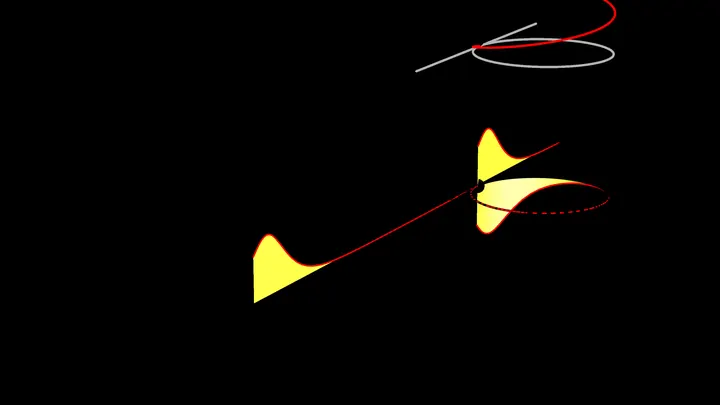
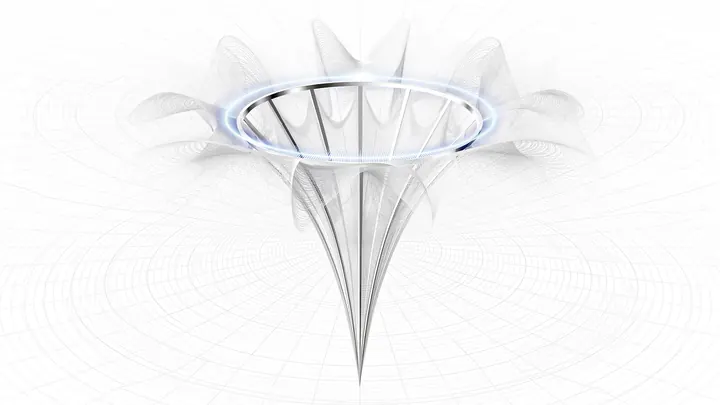
Light cones are not about light; they are boundaries in spacetime that separate causes from effects. These cones are not rigid: a massive object curves them, like a heavy ball pressing into a stretched sheet.
For almost a century, cosmologists have been grappling with the mystery: what makes the Universe expand ever faster? The standard answer — dark energy — creates a monstrous discrepancy between the theoretical vacuum density and observations. But there's another path, one that turns causality on its head.
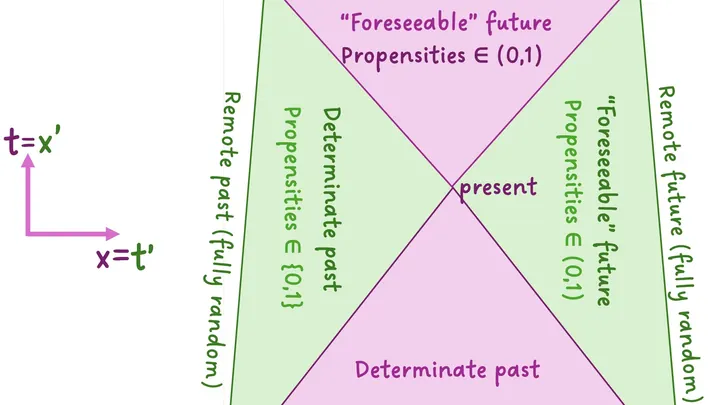
The light cone is a blueprint of causality, laser-cut onto the fabric of the universe. In classical physics, it is as sharp as a scalpel: events inside are linked by invisible threads of influence, while outside lies eternal isolation, sealed by the ultimate speed limit.
Entropy is a measure of disorder. Two shuffled decks of cards, dumped into one pile, won’t become more chaotic than the sum of their individual disorders. This is the rule of subadditivity: the whole is no more chaotic than its parts.
Spacetime is often pictured as a smooth fabric. But at the very microscopic level, this fabric might not be continuous; instead, it could consist of individual 'atoms'—events linked by causality. This picture of the world is called causal set theory.
Every morning you pick up the same mug, but the coffee tastes either bitter or just right. It's not about the coffee, and not about your character. Inside us, an invisible panel with dozens of sliders is constantly shifting: fatigue, hunger, anxiety, hormone levels.
An old mechanical alarm clock ticks on the shelf. You hear the steady sound, see the hands moving, and you're certain time is passing. But if you take the clock apart, you won't find a single part labeled "time." Only springs and gears.
The quantum world plays a strange game with causality. If in everyday life salt is always added to soup before serving, here the ingredients end up in the bowl at the same time, and the chef doesn't remember the order. Physicists asked: can we measure this 'recipe'? The answer is no.
The deepest equations of physics, like the Wheeler–DeWitt equation, contain no time. Past and future are scrambled within them, like frames on a film reel with no arrow indicating which way to play it. This symmetry is not a flaw but a feature.
In the kitchen, the sequence of actions is strictly dictated by the recipe: first chop, then fry, and nothing else. In quantum physics, the role of the recipe is played by causality — one event causes another, and they cannot be swapped. But in recent years, theorists have devised clever scenarios where the order of events seems to 'hang' in uncertainty.
In causal set theory, spacetime is not a smooth sheet but a web of tiny points connected by arrows of cause and effect. A point is linked to another only if the first can influence the latter. In such a web, a black hole is described differently: its horizon, the boundary from which signals cannot return, must be redefined.
According to Einstein, spacetime is a flexible fabric, curved by matter. But in the quantum world, everything is different: particles are smeared over a probability cloud, governed by a rigid rule discovered by Max Born.
Gravity is like a stretched trampoline: massive bodies press into it, making other bodies roll toward them. This shared curvature of space, gravity, affects everyone, but it doesn't convey secret messages.
If two people look at a city from different hills, their maps don't match. One sees the tower to the left of the river, the other sees it to the right. But both know: it's the same city. That's roughly how our Universe works in this new approach to quantum gravity.
The authors suggest distinguishing between two "flavors" of spacetime.
A drop of ink falls into a glass of water, and ripples spread out from it. Water seems simple, but if you look inside, each molecule isn't just moving forward: it's also spinning like a tiny top. Physicists call this intrinsic rotation spin. Usually, it goes unnoticed: in calm water, the tops spin every which way, and their rotation doesn't affect the fluid's overall motion.
Two people read the same book, but one turns the page first and then looks at the text, while the other does the opposite. It would seem the result is the same. But in the quantum world, the order of operations changes everything.
This work examines models that output sequences of symbols, like a ticket machine.
According to the laws of physics, nothing can outrun light, otherwise for some observers the effect would occur before the cause. Artur Ekert and Andrzej Dragan showed that this situation creates an uncertainty resembling quantum indeterminacy.
A stone on a table won't budge without a kick. Where does this stubbornness come from? The idea that the rest of the Universe is to blame was put forward over a century ago. Now it has been formalized into a rigorous theory.
In the new work, gravity is described not as an attraction between bodies but as a field that sets the scale of distances and time.
Two massive spheres in the cosmic void. Push one, and the second will feel the push only after a moment: gravitational influence travels, like an echo of a shout in the mountains, with inevitable delay. This is how curved space transmits signals locally, step by step — predicted by Einstein long ago.
The Social Laser theory describes society by borrowing the inner workings of a laser. People, like atoms in a crystal, absorb streams of information and become charged by it. When the number of those charged with a single idea outweighs the indifferent, even a weak signal (a post, a call to action) makes everyone act as one.
When entropy reaches its maximum, the play is over. The curtain falls, the actors leave, the scenery freezes. But the stage remains. So it is with time: the heat death of the universe erases the direction 'past—future', but not time itself.
In an empty concert hall, two musicians play a single part. First the violin, then the cello, or the other way around. It has always been this way: every note has its place in time, its own "earlier" and "later." But what if an orchestra could play both versions at once, in a quantum superposition of two orders?
The clock on the kitchen wall ticks, and each tick relentlessly carries us from breakfast to lunch. This is so familiar that it seems like a law of nature, but physics says otherwise. In Einstein's equations, time is reversible: you can rewind the film, and no frame will give the trick away.
Quantum mechanics is a linear theory. This property is so fundamental that violating it would mean losing the superposition principle and, consequently, the possibility of superluminal information transfer. But physicists have long suspected that at a deep level, where gravity meets quanta, linearity might not survive.
Picture a translator at a meeting where everyone speaks an unfamiliar language. They don't know the words, but they notice: when one person raises their voice, another starts nodding a minute later. At first it seems like coincidence, but over time the translator learns to understand who influences whom.
Ocean currents intertwine like sticky spider silk: every disturbance leaves a trace that does not vanish instantly. Climatologists have been used to treating random jolts in this web as invisible and memoryless, but new research shows that noise has memory, and that memory strengthens connections between distant nodes.
A translator in a meeting room hears not only individual voices but also how they bounce off each other: one speaker trails off, another picks up the thought, a third clarifies. Remove that interplay, and you are left with a set of monologues, and the meaning of the conversation slips away.
An orchestra without a conductor plays in harmony, and you want to understand who influences whom. The violinist hears the cello, the cellist catches the rhythm of the percussion, and the flute adapts to everyone at once.
Winning the lottery changes the winner's life, but for the statistics of all players it means almost nothing: the probability of winning is negligible, and the average winnings per ticket remain tiny.