The Score of Reproduction: How Entropy Predicts Reproductive Age
An orchestra plays a score in which every note is a birth at a particular age. In some species the notes cluster into a short, loud phrase; in others they stretch across an entire lifetime. The rhythm of that distribution, it turns out, obeys a mathematical law that can be computed straight from life tables.
Researchers in Lisbon and San Antonio started from Leslie matrices: tables that give, for each age, the odds of surviving and the number of offspring produced. From these tables they derived a quantity they called evolutionary entropy. It measures how evenly reproduction is spread across ages. If a species gives birth at one and the same age, entropy is low; if its contributions are smeared across decades, entropy is high. Strikingly, entropy does not depend on how fecund a species is or how long it lives, only on the shape of the distribution.
Testing against 130 animal species from the COMADRE database showed strong agreement. For 61% of species the predicted and observed reproductive medians matched exactly, and for 85.8% they matched to within two age classes. Even after accounting for species relatedness, the correlation between the predicted median and the mean reproductive age came to 0.884. That means the score of reproduction in most species is tuned to maximum entropy.
It used to be thought that reproductive schedules were set by survival curves, whether type I, II or III. But the model showed that species with different curves can have identical reproductive distributions. Entropy optimization yields biologically meaningful lower bounds on reproductive lifespan, and the geometric distributions that arise naturally in open populations play a central role.
The practical payoff is obvious: from demographic tables alone, you can assess a species' reproductive strategy without spending years on field observations. That gives a tool for comparative demography and conservation. The orchestra of life plays from a score that can now be read.
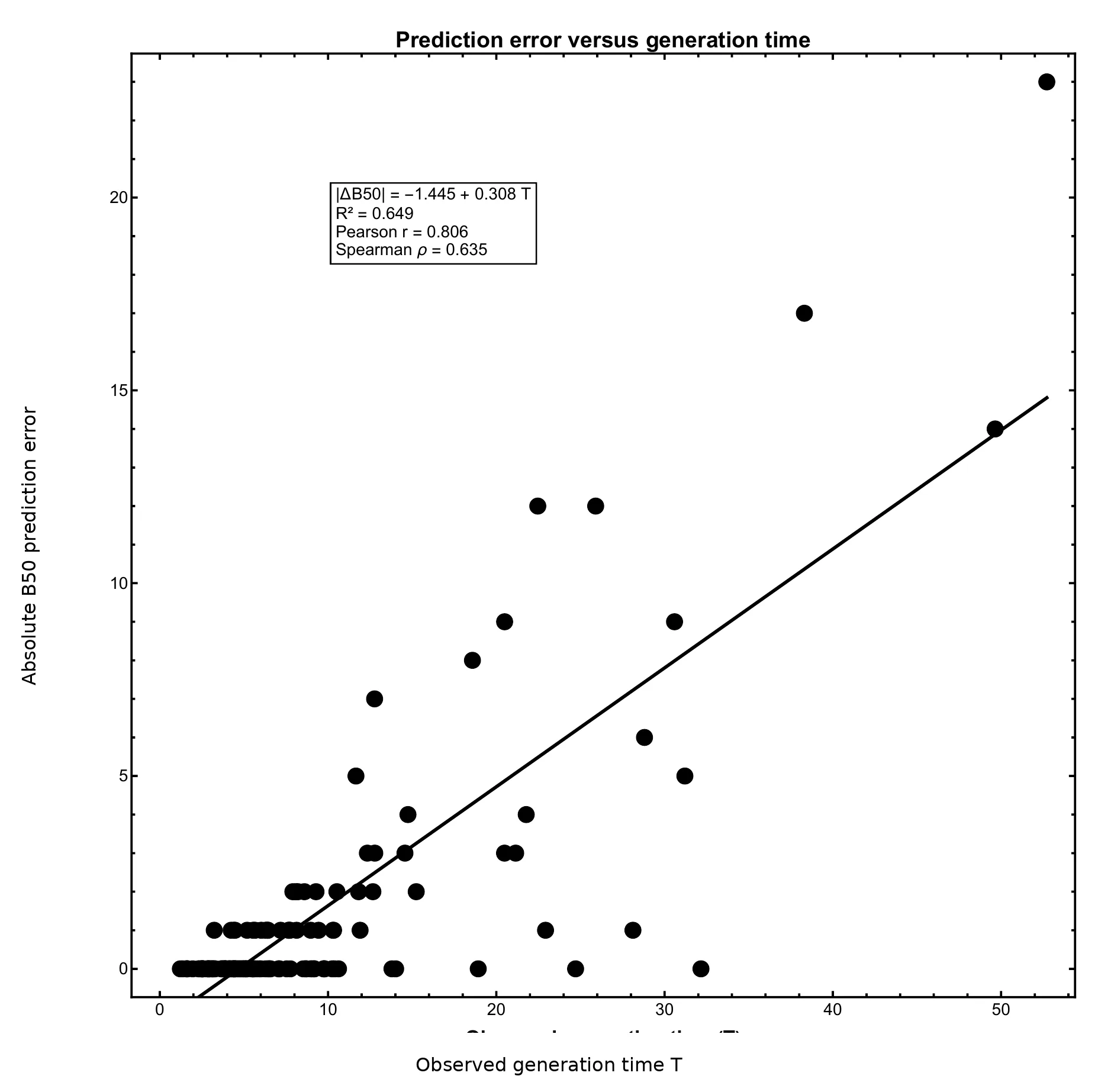
Among the species analyzed was the beluga sturgeon (Huso huso), one of the longest-lived fish, whose predicted reproductive median was off by 23 age classes, the largest discrepancy in the sample.
The idea that the distribution of reproductive contributions can be described by entropy echoes the concept of 'demographic pressure' in Ursula K. Le Guin's novel The Dispossessed, where a society deliberately regulates reproduction to maintain equilibrium.