The entropy of life: how the distribution of reproduction predicts reproductive age
Context
The work sits off to the side of evolutionary demography research, where neighboring papers study cell aging, noise in biological systems, phylogenetic networks and horizontal gene transfer. Unlike them, this one focuses on the age structure of populations and the mathematical optimization of the reproductive schedule. Classical demography describes a population through its net reproductive rate and growth rate, but it does not explain how exactly reproductive contribution is distributed over time. This paper fills the gap by showing that evolutionary entropy, introduced by Demetrius, is a measure of the temporal organization of reproduction and can predict reproductive windows.
Methods
The authors developed a mathematical framework for age-structured populations described by Leslie matrices. They derived a functional of evolutionary entropy that depends only on the normalized distribution of reproductive contributions and proved a theorem about its homogeneity: entropy does not change when survival or fertility is multiplied by a constant. For finite and open populations with a geometric tail, explicit formulas for entropy were obtained. The key result is a threshold theorem: there exists a critical value of the parameter q (the ratio of survival to growth rate) that separates regimes with a finite entropy maximum from those with monotonic growth. The theory was tested on 130 animal species from the COMADRE database by comparing entropy-optimal age classes with independent data on age at first reproduction, mean reproductive lifespan and other life-history traits.
Results
The empirical agreement turned out to be strong. In 61% of species the predicted and observed reproductive medians matched exactly, in 85.8% they matched to within two age classes, and more than 90% of species were predicted within three classes. Overlap and Bhattacharyya coefficients showed that the entropy-derived distributions capture the shape of reproductive contribution, not just a single summary age point. After phylogenetic correction based on the Open Tree of Life, the correlations remained strong: for instance, between the predicted median and the observed mean reproductive age, r = 0.884 (p < 10⁻³⁰). The threshold theorem correctly classified the entropy regimes for all open populations except three species whose survival crossed the threshold.
Implications
The work differs from neighboring studies in that it moves the question of reproductive organization away from descriptive survival curves and into the language of probability distributions. It shows that the classical types of survival curves (I, II, III) have limited explanatory power for the reproductive schedule: species with different curves can have similar reproductive distributions. Entropy optimization yields biologically meaningful lower bounds on reproductive lifespan, and the geometric distributions that naturally arise in open populations play a central role. This is the first large-scale test of the entropy maximization theory on real data with phylogenetic correction.
Future development
The topic could develop in three directions: propagating the uncertainty of demographic matrices into entropy calculations, directly analyzing stage-structured and seasonal models instead of forcing them into annual Leslie matrices, and incorporating environmental stochasticity through random matrix products. Each of these extensions will make it possible to test whether the regularity found is a stable property of reproductive organization or an artifact of deterministic annual matrices.
Impact
The results will influence comparative demography, the evolutionary biology of life cycles and, possibly, population management models in conservation.
Next steps
The next step is to carry out the analysis at the population level, using several matrices for a single species, in order to test how robust the entropy-optimal windows are to ecological variability.
Key open problems
The paper speaks directly to an unsolved problem in evolutionary demography: which mechanisms set the length of reproductive life. It does not claim that natural selection directly maximizes entropy, but it identifies a quantitative regularity that needs to be explained. This ties the work to the fundamental question of the role played by physiological constraints, ecological filtering and historical contingency in shaping life cycles.
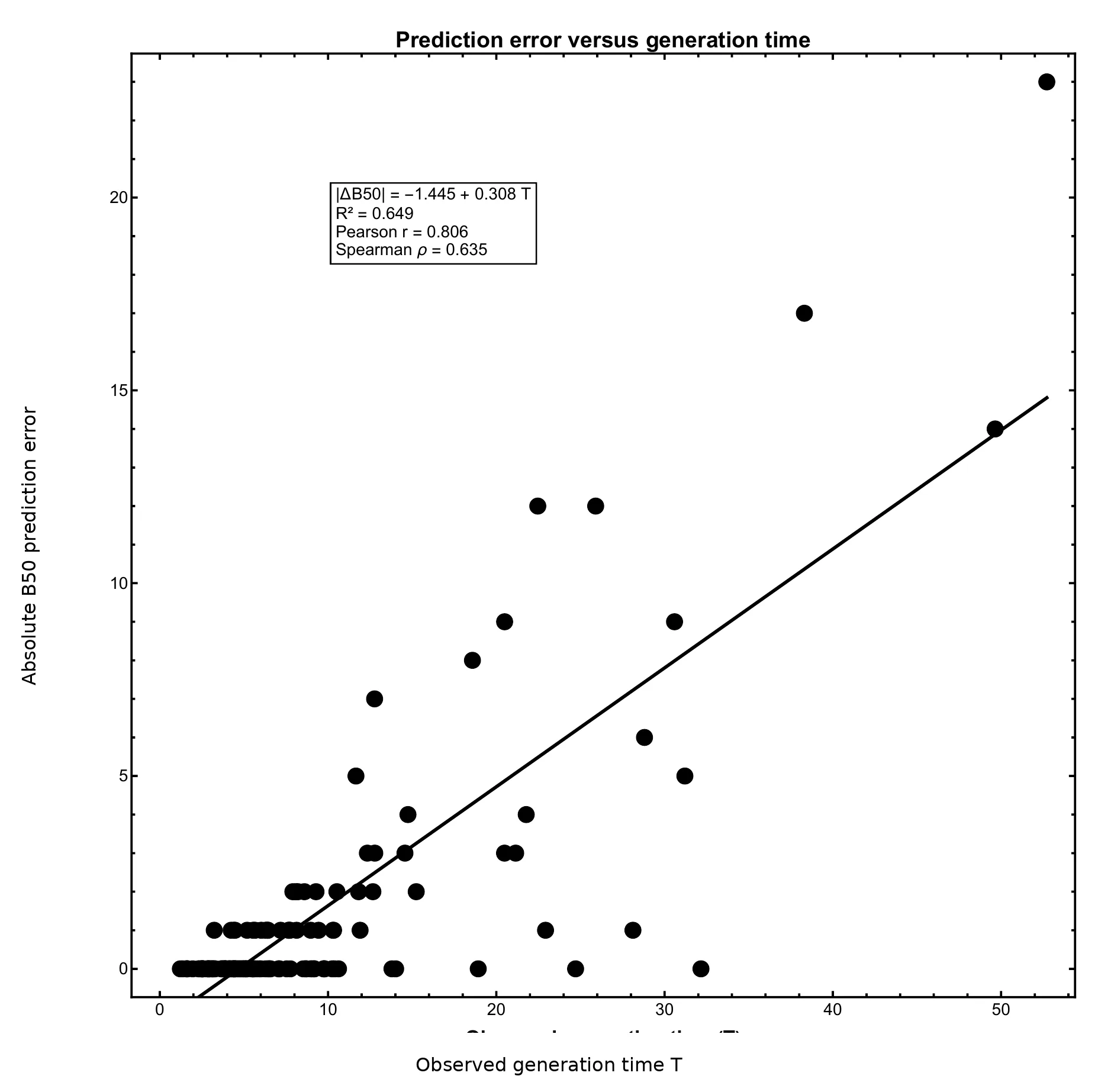
Among the species analyzed was the beluga sturgeon (Huso huso), one of the longest-lived fish, whose predicted reproductive median deviated by 23 age classes, the largest spread in the sample.
The idea that the distribution of reproductive contributions can be described by entropy echoes the concept of "demographic pressure" in Ursula K. Le Guin's novel The Dispossessed, where a society deliberately regulates reproduction to maintain equilibrium.
Key numbers
- Exact match of reproductive medians: 61% of species
- Prediction within two age classes: 85.8% of species
- Share of open Leslie matrices in the data: 74%
- Phylogenetic correlation (Pearson) between predicted median and mean reproductive age: 0.884
- Number of species in the analysis: 130