The Price equation was derived by George Price, who worked in London in the late 1960s. Originally a chemist, he became interested in altruism and evolution. In 1970, he published a paper presenting a universal formula describing evolutionary change. Its beauty lies in its generality—it applies not only to genes but to any reproducing entities: ideas, firms, cultural practices. The formula proved so fundamental that the renowned biologist Steven Frank wrote, 'If you have Price's theorem, you need nothing else.'
History
George Price, an American scientist who moved to England in 1967, became fascinated with the problem of the evolution of altruism. Working with William Hamilton, he sought to provide a rigorous mathematical formulation of natural selection. In 1970, his paper 'Selection and Covariance' was published in Nature, presenting the equation for the first time. Price showed that trait change could be decomposed into a component related to the correlation between trait and fitness, and a component due to changes during inheritance. His work remained little known for a long time but later became a cornerstone in quantitative genetics and game theory.
How it works
The Price equation is widely used in theoretical biology to model quantitative traits, in ecology to analyze species interactions, and in social sciences to study the spread of innovations. Limits of applicability: it describes only one-step change in the mean, not dynamics over time. Moreover, applying it requires precise data on individual traits and fitness, which is rarely feasible in natural populations.
In practice
Scientists use it to predict how quickly bacteria will become resistant to a new antibiotic, or how viruses mutate to evade immunity.
Fun fact
The Price equation is a mathematical identity, meaning it is always true, like 2+2=4. But that is precisely what makes it such a powerful tool for uncovering the mechanisms of evolution.
Picture every blood test as a dot on a large map. Plot thousands of those dots and they won't scatter at random: they line up along two main roads. One road separates men from women, the other stretches from youth to old age. Follow these roads and you can see how a person grows up, lives and grows old.
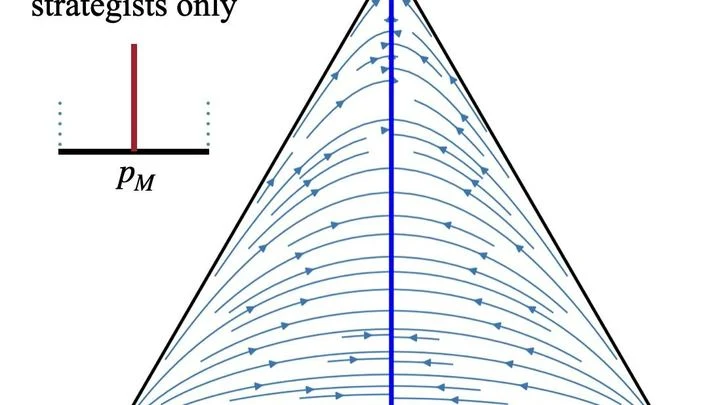
Picture a wind map over a mountain range. The wind mostly blows downhill, following elevation changes. But if you look closely, in some valleys the air swirls into little eddies that keep the wind from simply flowing down. That is exactly what the mutation field in human DNA looks like.
Two runners start a race on a course with changing incline. One starts earlier, the other later, and the judge measures their speeds without knowing about the staggered starts. So it is with virus variants: data arrive with delays, and if those delays are unequal, estimates of competitive advantage can be badly wrong.
A Greenland shark swims through cold water in its fourth century, and with every passing year its odds of dying do not rise but fall. This is not a miracle, but the result of an evolutionary trade-off that has so far eluded theory. An organism is like a family budget that cannot be spent twice: every unit of energy can go into reproduction, growth, or body repair.
A lone fish sees a shadow overhead. Should it flee? If it's just a leaf, it wastes energy and gives away its position to a predator. If it's a heron, hesitation is fatal. That's the eternal trade-off of the solitary individual: quick reactions mean many false alarms, while caution means risking being eaten.
In a school, it's different.
Two daughter cells receiving equal shares from the mother: that's the familiar picture of division. But what if one gets almost everything and the other just crumbs? Stochastic modeling shows that sometimes unequal division is more advantageous.
Each cell stores a protective reserve that helps it weather hardships. During division, this reserve is distributed between daughters.
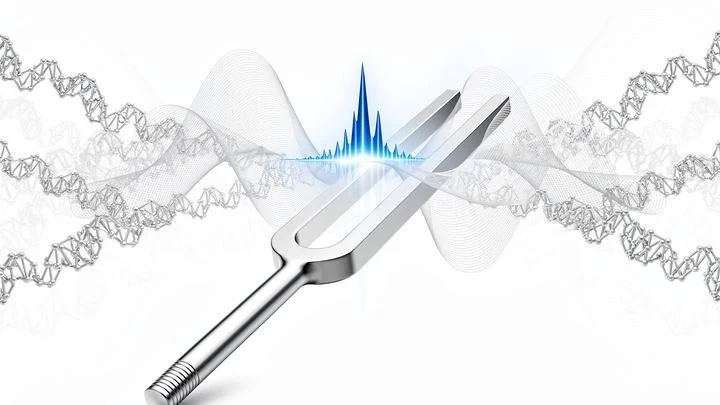
As you slowly turn the tuning knob of an old radio, the sound doesn't fade in gradually from the static: it bursts forth in a sudden jump, the moment the antenna hits resonance with the wave. Genes in a living cell behave much the same way.
Clocks in the Universe are tricky things. Usually, in calculations of the birth of the world, a special scalar field plays the role of a clock — something like an invisible fluid filling all of space. It ticks, and physicists watch how the world changes relative to that ticking. But these clocks are man-made, introduced for convenience.
The authors of the new work took a different path.
A perfume bottle is not just glass with liquid. It is a snapshot of its time, a frozen melody of fragrant notes. From 1900 to 2024, tens of thousands of such 'melodies' have accumulated, and now they can be studied as a single organism.
For a long time, biologists argued: if a herd of animals stably maintains a mix of aggressive and peaceful individuals, does each one alternately change behavior, or do some always fight while others always yield? In classical equations, these options are indistinguishable.
In the web of life, predators and prey exchange carbon and water, and each act of eating slightly increases the universe's disorder. But the intrusion of disease turns this system into a giant seesaw. When a mid-level predator gets sick, its hunting abilities decline, and it becomes easy prey.
Traditionally, machine learning algorithms operate in a static environment, like water flowing along a pre-cut channel without changing its shape. The new method flips this paradigm: it lets an agent simultaneously master actions and deliberately modify the very environment it inhabits.
Ecosystems are not chaos but a complex dance where every species plays its part. Scientists modeled such a dance: two prey compete for carbon and water (the building blocks of cells), while a predator eats both. Sixteen scenarios emerged — from predator extinction to a steady rhythm for all three species.
A family tree becomes a tangle if you account for adopted children and remarriages. Evolution often resembles such a tangle: although the Standard Model, the traditional view of divergent evolution where species branch like a tree, paints a neat tree of species, in reality genes travel not only by inheritance but also directly between unrelated organisms — a process…
Molecules float in a pot of broth. Some copy themselves, others help their neighbors, and still others just get in the way. This isn't soup: it's a model of early life: a replicator system. Usually, we assume the rules of the game are fixed once and for all: whoever reproduces fastest wins. But the authors of this study proposed something different — the rules can change too, just very slowly.
A hundred agents, two thousand tasks, less than a hundred iterations, and the market for unloved chores settled into equilibrium all on its own. No one was directing things from the center; each participant only responded to the nearest signal. That’s how multiplicative tatonnement works — a mechanism like the synchronized dance of a flock without a leader.
Biological complexity has long eluded us: you can count genes, cells too, but how do you grasp the organization of the proteome itself — a multi-thousand ensemble of proteins woven from carbon, oxygen, and hydrogen?
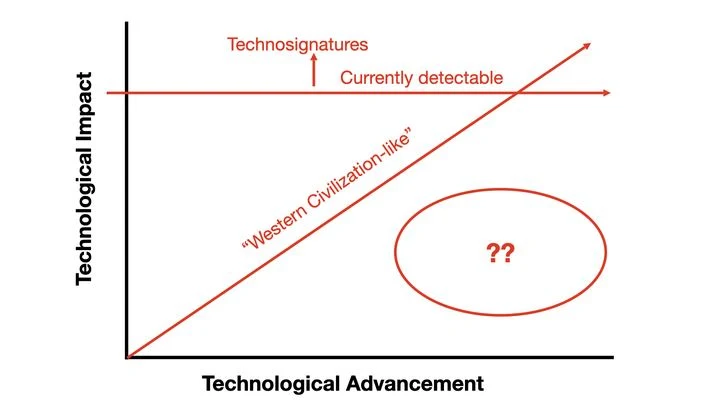
The Drake Equation is an attempt to guess the number of intelligent civilizations in our Galaxy. It’s like counting finished cakes in an unknown bakery: you know the ovens (stars), the baking sheets (planets), and the baking time. But were eggs added to the batter? Western science, relying on a single earthly recipe, considers them a rare ingredient.
A crowd at a metro station during rush hour. Some hurry toward the escalator, others slow down at the departure board, still others weave around a column. Each step is not merely a reaction to what's right in front of your nose. A person estimates in advance where a neighbor will be a second from now and adjusts their route accordingly. Physicists call this forward-looking behavior anticipatory.
An eight-kilogram rhesus macaque can live up to forty years. A cat of the same weight rarely sees its twentieth birthday. This difference is no accident: across all primates, from tiny marmosets to gorillas, lifespan is markedly longer than in other mammals of similar body mass. Standard models linking lifespan to metabolic rate fall short here.
A pot of water sits on the stove. The temperature drops: plus one degree, zero, minus one — the water stays liquid. But at some point, a light breath is enough to make the whole mass instantly freeze into ice. Physicists call such jumps first-order phase transitions.
Engineers improving neural networks act like breeders: they try a variant, check the result, and keep the best. They collected 935 such trials from 161 papers and measured how often a code tweak turns out beneficial, harmful, or neutral. The picture is familiar to any biologist: 68% of changes degrade performance, 19% do nothing, and only 13% yield a gain.
Before measurement, a quantum object lives in a world of possibilities, where wave amplitudes add up like sound waves in a studio before pressing the “record” button. Crests amplify each other, troughs cancel out.
An epidemic is like a fire in a dry forest: a spark flares up, the flames leap from tree to tree, and within a week the whole area is burning. A hundred years ago, scientists devised a simple mathematical model for such a fire: they divided people into those who had not yet fallen ill, those who were ill, and those who had already recovered.
In two neighboring ponds, the same microorganisms swim. Food appears now in one, now in the other — randomly, with no rule. After a month, there are a hundred times more of them in the first pond than in the second. No one chose where to live. Just luck.
This is how disequilibrium works. While the environment keeps changing, abundances don't have time to even out.
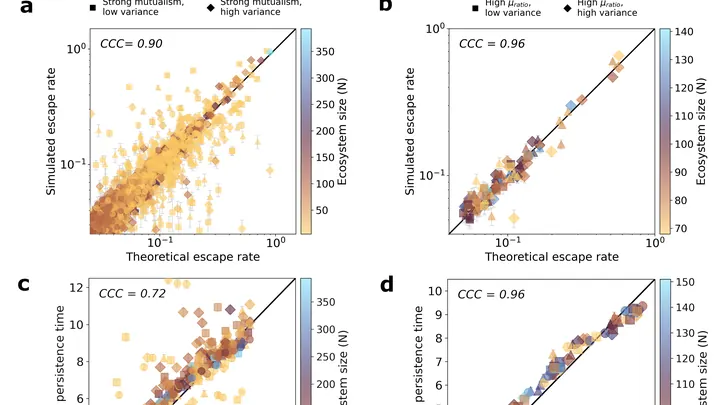
An ecosystem is like a swing that someone is subtly pushing. Previously, it was thought that the main concern was that the swing wouldn't swing too wildly. But the authors of this work showed that the greater danger is when the equilibrium point itself slides toward a place where the swing can no longer return.
The Galaxy is a forest where birds don't start singing right away. First, trees must grow — stars, around which planets eventually appear. The Drake equation counts how many birds might be singing in this forest right now, but it implicitly assumes that their number doesn't change: as many as there are, that's how many there have always been.