Neutron Gravita-Waltz and Dance with a Defect ✦
Original: "Detection of relativistic orbital deformation from improved timing of PSR J1757$$-$$1854"
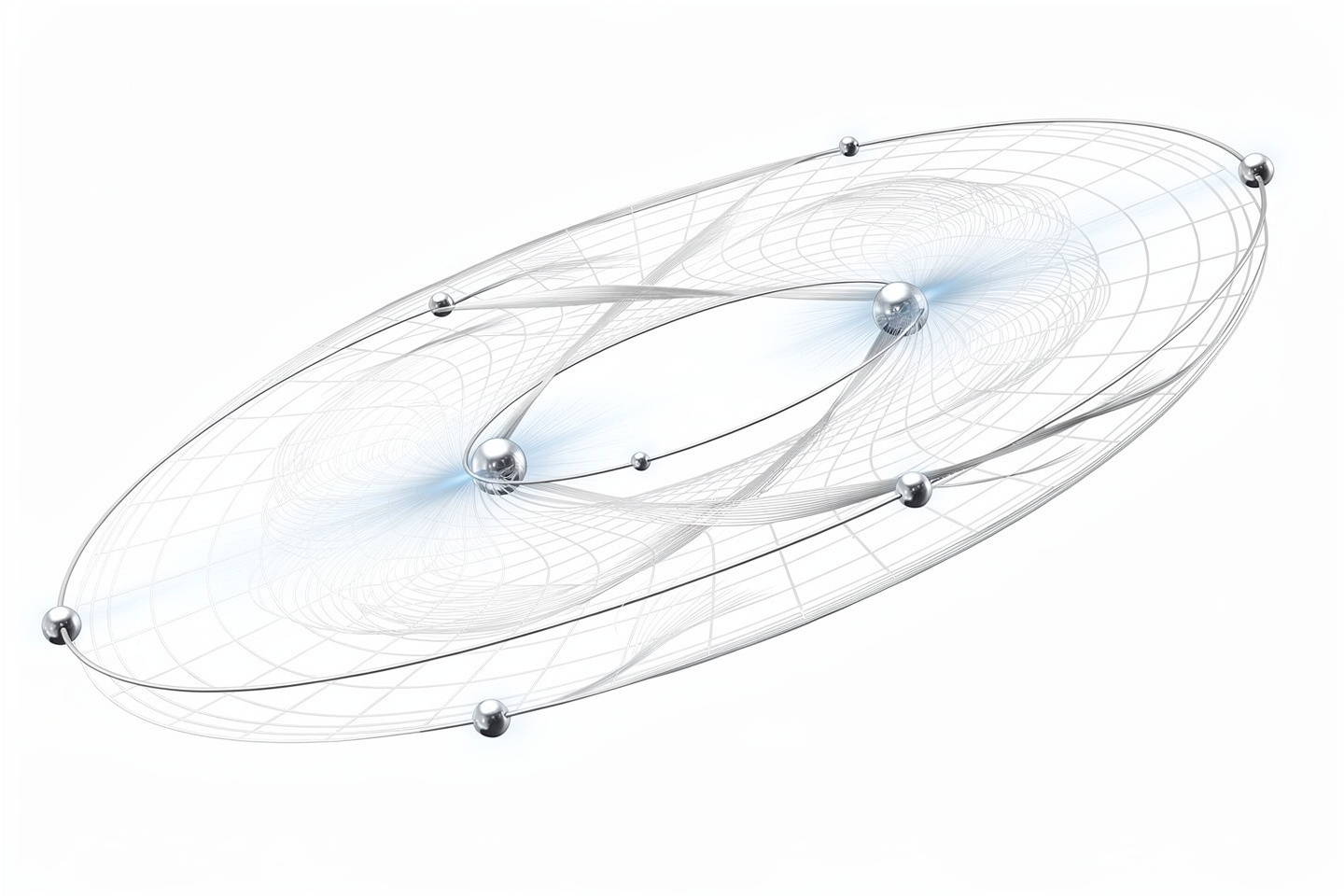
Ultra-precise timing of the double pulsar PSR J1757−1854 for the first time revealed relativistic orbital distortion — and allowed a glimpse into the heart of twisted spacetime.
Links in the knowledge graph 1
Two neutron stars perform a deadly dance, shrinking their orbit by 5 femtoseconds per second. Over 9 years, astronomers detected how spacetime itself warps the dance, making the orbit subtly wobble. This discovery is like eavesdropping on gravity's whisper. By 2031, we may learn just how stiff the matter inside these ultra-dense spheres is. A true choreography of gravitational waves, leading to a kilonova 76 million years from now.
🎯 The orbit of PSR J1757−1854 shrinks by 5.282 femtoseconds per second due to gravitational wave emission — accumulating about 0.17 milliseconds per year. In 76 million years, these two neutron stars will merge in a kilonova explosion similar to GW170817.
\delta_{\theta}^{GR} = \frac{2 m_c^2 + 6 m_p m_c + \frac{7}{2} m_p^2}{(m_p+m_c)^{4/3}} (T_{\odot} n_b)^{2/3}
The value of δθ depends only on the component masses and orbital period; the GR prediction against which the measured value is compared.
\dot{\omega}_{1PN} = \frac{3 n^{5/3} (T_{\odot} M_{tot})^{2/3}}{1-e^2}
The main relativistic effect used to determine the total mass of the system.
Scientists
Bernhard RiemannJoseph WeberKarl SchwarzschildKip ThorneRainer WeissHendrik Lorentzpulsar
neutron star
gravitational waves
Time dilation
gravity
radio astronomy
interstellar medium
spacetime curvature
supernovaLaws
Einstein field equationsLorentz transformationsFermi–Dirac statisticsequivalence principleChandrasekhar limitno-hair theorem