Pulsar Waltz: Orbit Curves to Einstein’s Tune ✛ ✦
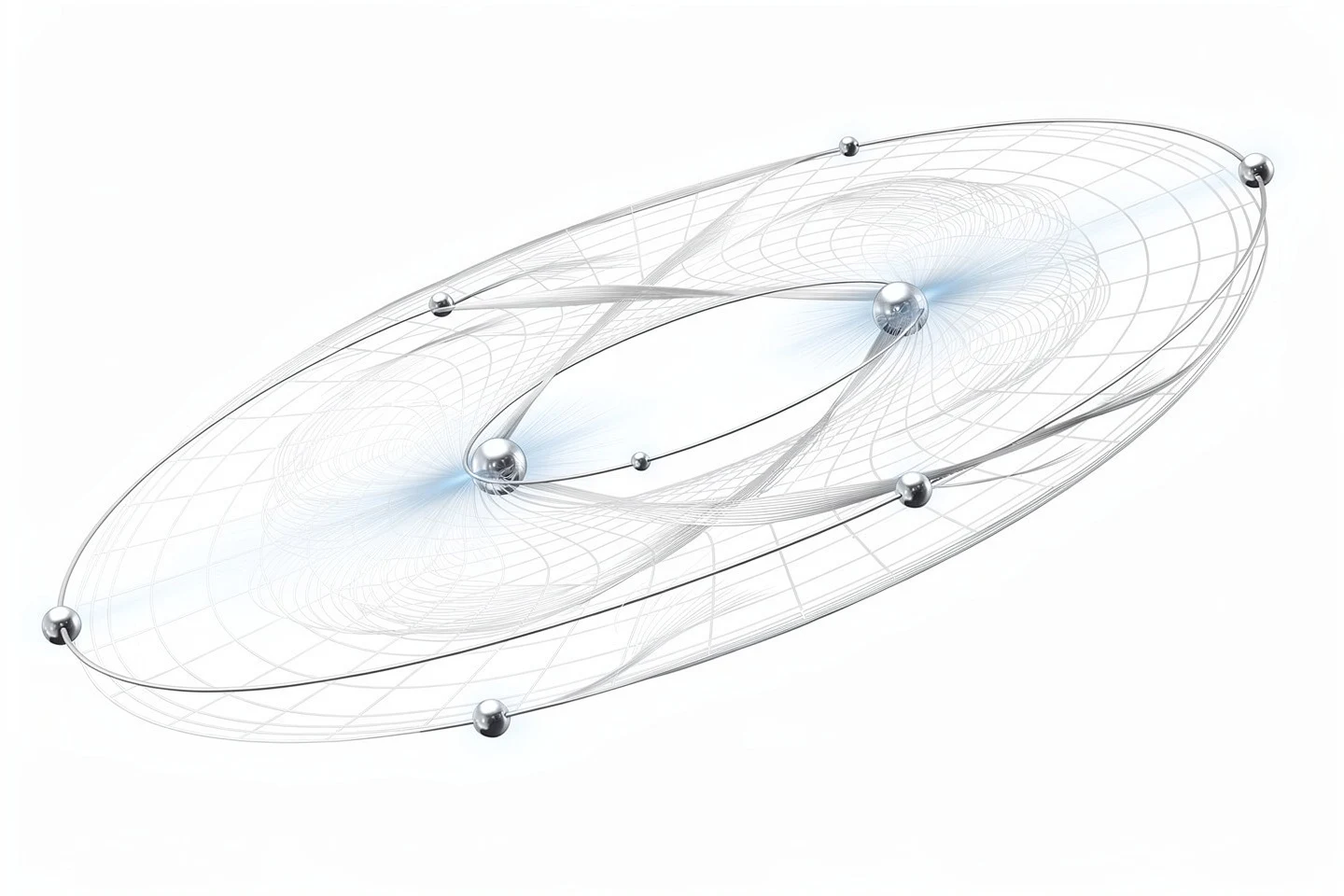
Pulsar in the PSR J1757−1854 system is the ultra-dense core of a star that perished in a supernova blast. Its partner is another neutron star. Their mutual gravitational tug curves spacetime like a heavy ball sinking into a stretchy sheet. That makes time tick slower for the pulsar and nudges the orbit’s shape at its tightest point, shrinking it and sending out ripples of gravitational waves.
To catch this subtle kink, astronomers spent nine years logging pulses with radio dishes, scrubbing away interstellar static. The numbers lined up perfectly with Einstein’s forecast and helped toss out wonky guesses about the system’s tilt. This picks up the baton from Hulse and Bell Burnell, locking down relativistic effects in double pulsars.
Every second, the orbit shrinks by five femtometers — a thousand times thinner than a human hair. In 76 million years, that’ll spark a spectacular merger like the one LIGO caught in 2017.