Neutron Gravita-Waltz and Dance with a Defect ✛ ✦
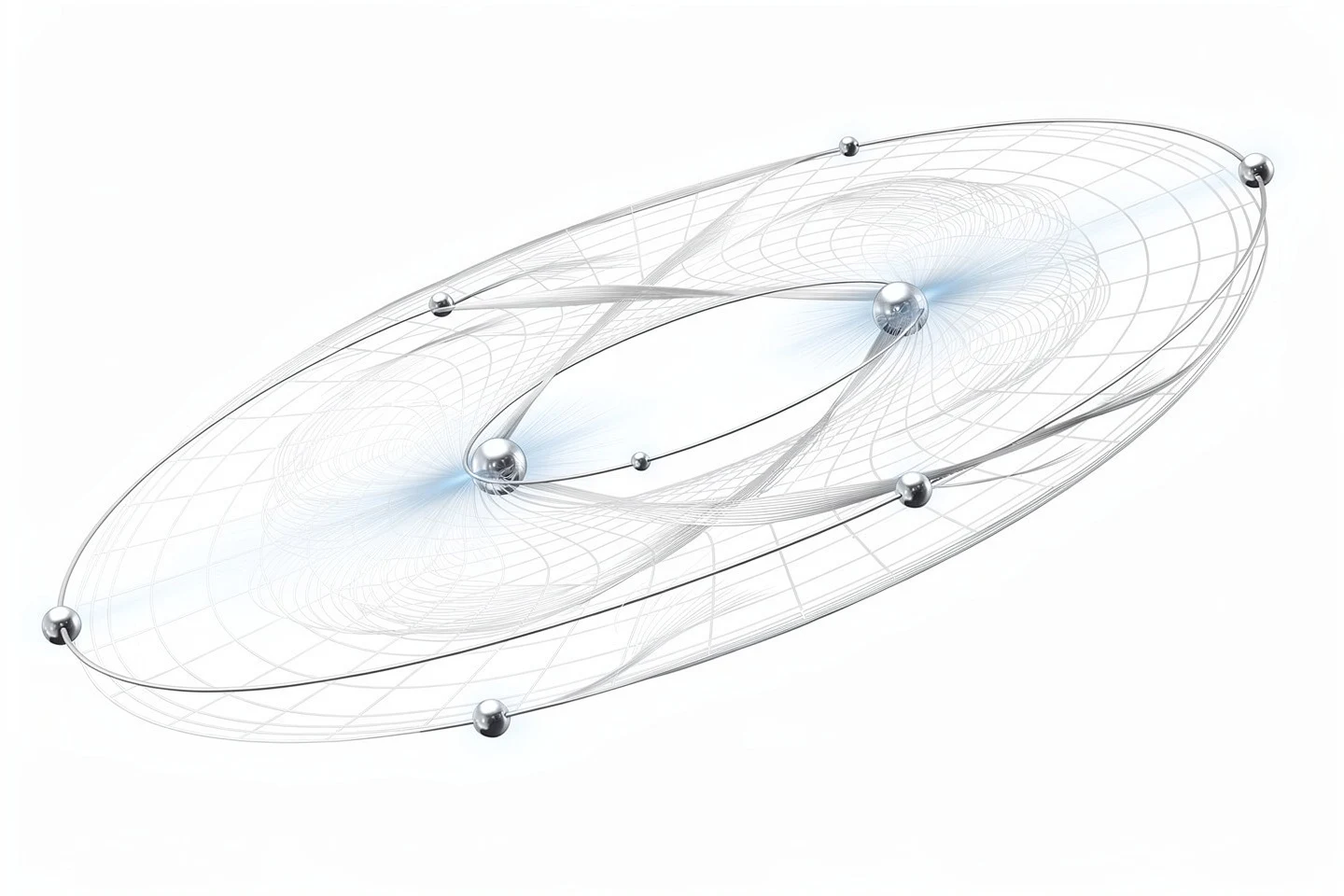
Imagine two neutron stars, compressed to the size of a metropolis yet weighing one and a half Suns each. They whirl in an unrestrained gravitational dance, drawing together and flying apart every 4.4 hours. At periastron — the point of closest approach — only a couple of light-seconds separate them, and their speed reaches three and a half million kilometers per hour. This isn't fantasy, but the real system PSR J1757−1854, discovered in 2015 and since turned into one of the most mesmerizing relativistic laboratories. When one of the stars is a pulsar, its radio emission becomes a metronome of cosmic precision. The tiniest glitches of this metronome, caused by the curvature of spacetime around its companion, let us hear the silent music of strong gravity — the rhythm of post-Keplerian parameters.
But even under these extreme conditions, there is a correction that is almost impossible to catch. This is the parameter δθ — the angular relativistic deformation of the orbit. The orbit itself ceases to be a perfect ellipse: spacetime curvature makes it subtly 'wobble', shifting the points of ascending and descending by fractions of an arcsecond. As a first approximation, it resembles the uneven spinning of a top — precession, but here the very direction of periastron gets twisted. For PSR J1757−1854, the effect is estimated at five millionths of an arcsecond. To notice it, astronomers combined ultra-sensitive observations from the MeerKAT, Parkes, and GBT telescopes and applied Bayesian analysis to nine years of data. For the first time, δθ was reliably detected in just nine years, whereas it took the legendary Hulse–Taylor system B1913+16 forty years to do so.
Measuring δθ is not just another confirmation of Einstein's general theory of relativity. It has unveiled the geometry of the system. Previously, there were four equally probable orientations of the pulsar's spin axis. Subtracting the aberration contribution from δθ, astrophysicists obtained a purely relativistic deformation, compatible with theory for only two scenarios. Two exotic scenarios, requiring a sharp flip of the axis at the system's birth, were ruled out. This is true cosmic tomography: from a tiny flaw in the orbital dance, we reconstruct the supernova explosion that gave birth to the second neutron star, and possibly its collapse mechanism. Each such flaw is a fossil of the catastrophe, frozen in the stars' motion.
Even more intriguing was the contribution to the periastron advance. The main rate of 10.365 degrees per year is explained by the post-Newtonian approximation, but after subtracting all classical effects, an excess remained — about 0.0003°/year. This was identified as a manifestation of the Lense–Thirring effect — the dragging of the orbit by the neutron star's rotation, predicted back in 1918. If further observations confirm the signal, it will open the way to directly measuring the moment of inertia. And a neutron star's moment of inertia is a direct indicator of the stiffness of nuclear matter, the very stuff that even the most powerful colliders cannot reproduce. We are, as it were, probing the star's interior through its gravitational field.
By 2031, as geodetic precession turns the pulsar's axis and periastron aligns with the line of sight, we will gain a new window into the system. Increased timing precision from the upcoming SKA and independent distance measurements by radio interferometers will eliminate the remaining uncertainties. Then PSR J1757−1854 will become a true knowledge factory about ultra-dense matter, capable of rivaling even gravitational wave detectors. Born as a double neutron star, discovered as a radio pulsar, and deciphered as a relativistic choreographer, this system has not yet finished writing its score. Its dance continues, and each new measure promises to bring notes of the most fundamental physics.
The orbit of PSR J1757−1854 shrinks by 5.282 femtoseconds per second due to gravitational wave emission — accumulating about 0.17 milliseconds per year. In 76 million years, these two neutron stars will merge in a kilonova explosion similar to GW170817.