Light Quenches Light: Suppressing Instabilities in Gravitational Wave Detectors ✦
Original: "First Demonstration of Optical Feedback Control to Parametric Instability at Advanced LIGO"
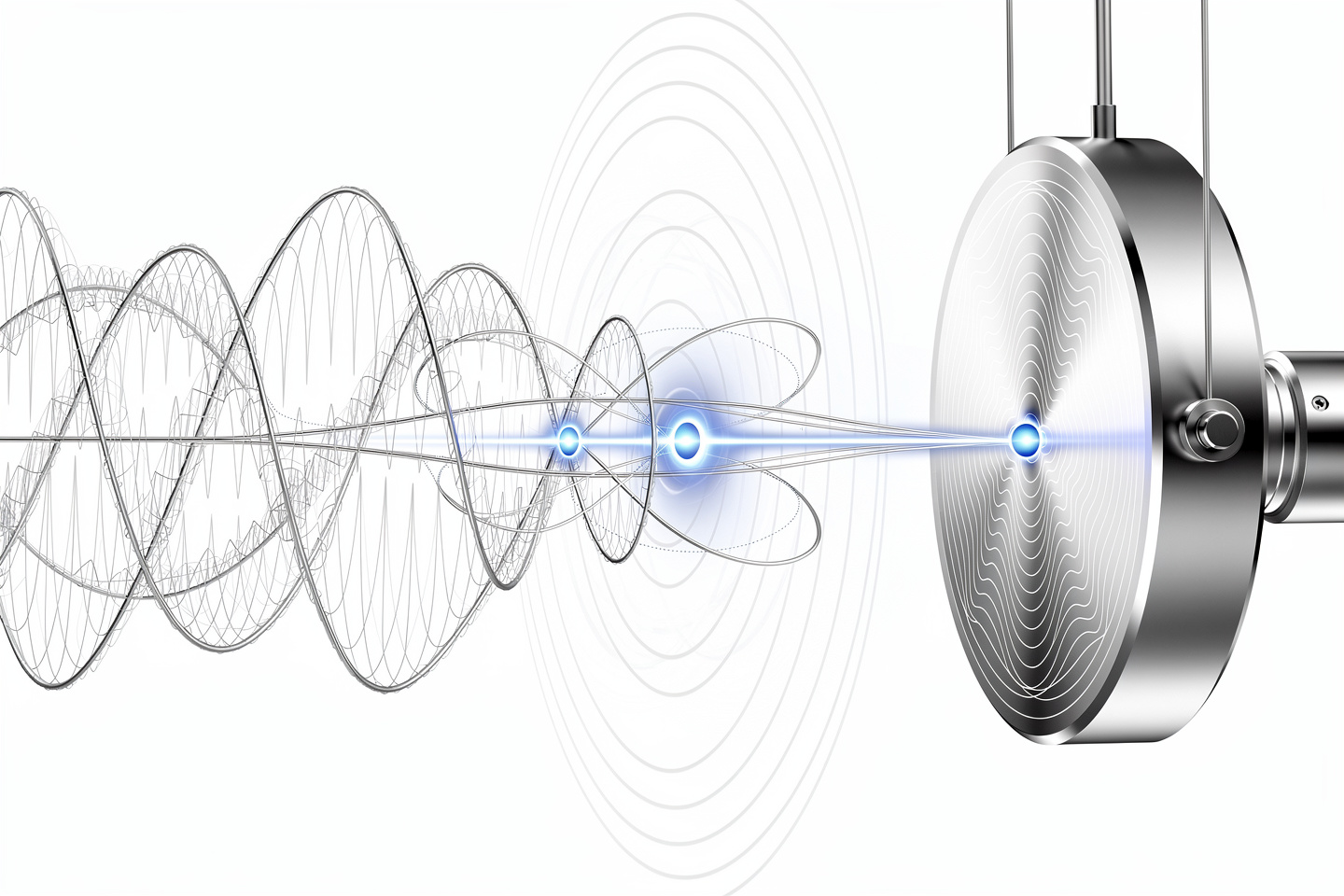
For the first time, a full-scale LIGO detector tamed parametric instability using 'anti-light' — optical feedback that crushed the gain from 2 to 0.02.
Links in the knowledge graph 1
In the giant ear listening to the cosmos, 40-kilogram mirrors start singing under the onslaught of photons—this resonance threatened to drown out the gravitational echoes of distant cataclysms. Physicists responded with optical 'noise-cancellation': an optical feedback loop, like anti-light, crushed the parasitic oscillations a hundredfold. The whisper of distant galaxies became clearer. Now megawatt detectors are no longer a dangerous dream—a step toward hearing the echo of the Big Bang itself.
🎯 LIGO's 40 kg mirrors shake a thousand times more from photon pressure than from a passing gravitational wave—it's like trying to hear a whisper in a hurricane.
R = \frac{8\pi Q_m P}{M c \omega_m^2 \lambda_0} \Re[G_n] B^2
The gain is directly proportional to the mechanical mode quality factor, circulating power, and optical response; inversely proportional to the mirror mass and the square of the mode frequency.
Scientists
Christian DopplerD. B. McLaughlinDidier QuelozMichel MayorR. A. RossiterStephen HawkingLIGO
gravitational waves
interferometry
numerical simulation
black hole
neutron star
speed of light
spacetime curvatureLaws
Doppler effectHawking radiationgravitational lensingprinciple of constancy of the speed of lightBekenstein-Hawking entropymass–energy equivalence