Optical Feedback vs Parametric Instability in LIGO ✛ ✎ ✦
Context
Increasing the circulating power in LIGO to a megawatt is critical for enhancing sensitivity and discovering new astrophysical sources of gravitational waves, such as post-merger remnants of neutron stars. This became possible thanks to the efforts of Rainer Weiss, Kip Thorne, and Barry Barish. However, parametric instability (PI) stands in the way – a resonant buildup of mechanical oscillations in 40-kilogram mirrors by light that travels in vacuum at the unchanging speed of light. Without its suppression, further power increases are impossible. Traditional methods, such as electrostatic damping and acoustic dampers, are reaching their limits.
Methods
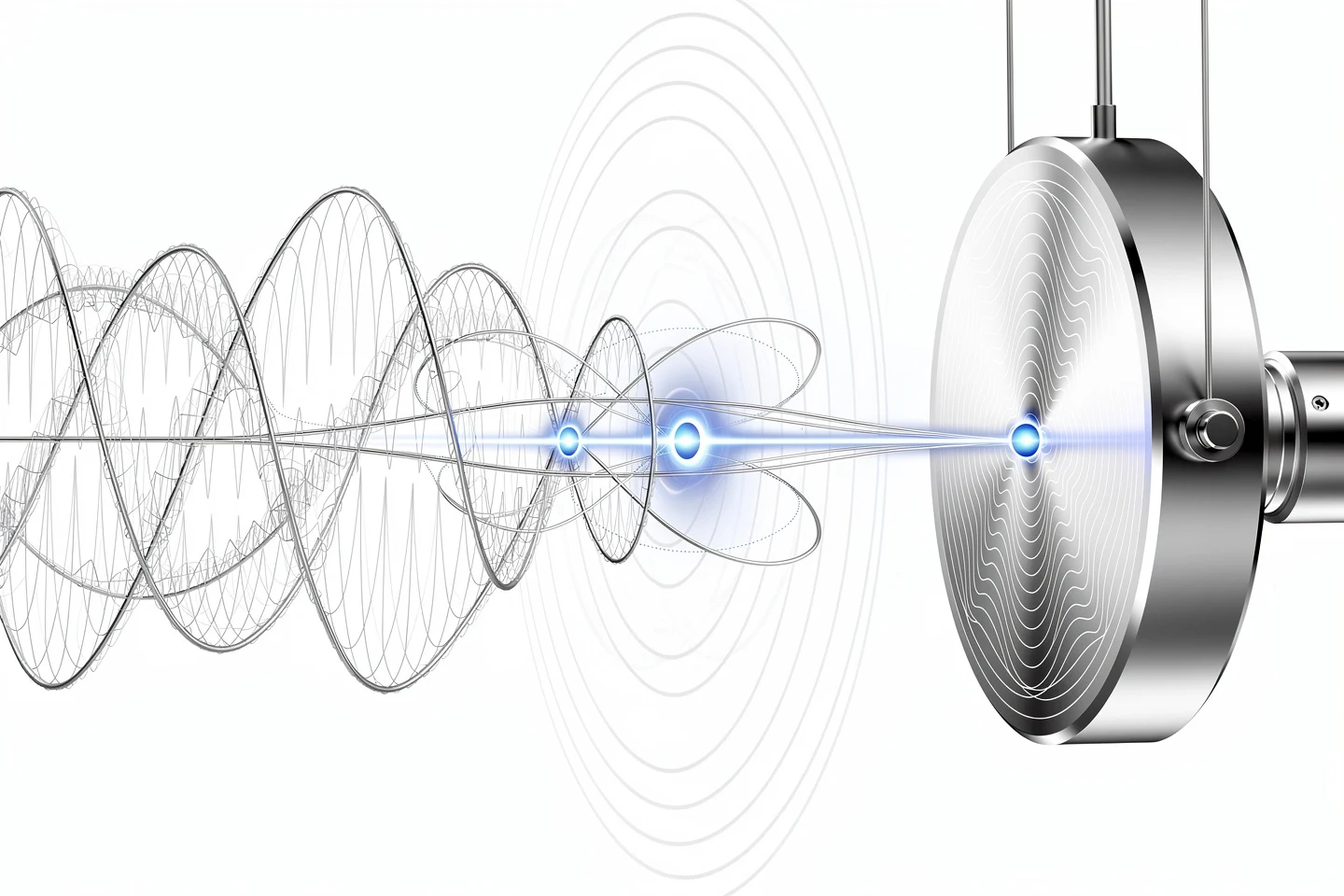
In the experiment at the Advanced LIGO facility in Livingston, instability at 10.428 kHz was deliberately induced by heating the mirrors. Optical feedback was used for suppression: light scattered by the mechanical mode interfered with a control field generated by an acousto-optic modulator. The phase mismatch error was extracted from the beat note at the output port of the interferometer and, after digital processing, fed back. This signal, phase-shifted by 180 degrees, provided destructive interference in accordance with the superposition principle.
Results
Without PI control, the parametric gain R was about 2, and the oscillation amplitude grew exponentially with a time constant of about 400 s. After feedback was turned on, the growth turned into damping, and the resulting gain dropped to R < 0.02 – a two-order-of-magnitude reduction. Models built with the Finesse simulation package and analytic calculations confirmed that at the moment the system was activated, the gain was 1.9–1.95. The experimentally measured suppression corresponds to transitioning from megawatt-level power to a modest 10 kW in terms of the instability threshold.
Implications
The achieved two-order-of-magnitude suppression is equivalent to turning a megawatt-class detector into a ~10 kW detector from the standpoint of parametric instability. This means that optical feedback alone can handle instabilities that will arise in next-generation telescopes like Cosmic Explorer and the Einstein Telescope, aimed at studying black holes and other objects. The method also removes the thermal noise limitations inherent in acoustic dampers.
Future development
In the future, a single feedback loop could suppress multiple mechanical modes coupled to one optical mode, drastically reducing the number of required control channels. To overcome current limitations associated with injecting the control signal through the main input of the interferometer, plans are underway to introduce it through the back surface of the end masses, which will improve sensitivity and dynamic range. Work is already in progress on specialized Mach–Zehnder interferometers for extracting the weak error signal.
Impact
This development will directly impact gravitational-wave astronomy, enabling the detection of more distant and fainter sources, including post-merger neutron stars, and will expand the capabilities of multi-messenger astronomy.
Next steps
The immediate next step is implementing multi-mode control using fast digital electronics and testing the method on instabilities around 80 kHz, which remain a challenge for Advanced LIGO.
Key open problems
This work advances the solution to a key instrumental challenge – overcoming parametric instability, which hinders increasing detector sensitivity to the level needed for testing general relativity in the strong-field regime and detecting relic gravitational waves.
The knowledge machine's view
This section is addressed to the author of the paper and their colleagues. Neighbouring works were found by meaning-based search across our archive, not by word overlap. We do not review: we show the field around the work.
What the work does
In a study at the Advanced LIGO facility in Livingston, parametric instability at a frequency of 10.428 kHz was deliberately induced by heating the mirrors. To suppress it, optical feedback was used: light scattered by the mechanical mode interfered with a control field from an acousto-optic modulator, and the phase error was extracted from the beat signal at the interferometer's output port. The experiment demonstrated a reduction in parametric gain from R≈2 to R<0.02, i.e., suppression by two orders of magnitude, confirmed by Finesse models.
Where its strength is
This is the first successful demonstration of suppressing parametric instability via optical feedback in a full-scale detector, paving the way for megawatt-scale powers without the thermal noise limitations inherent to acoustic dampers.
Where it could go next
- The optical feedback method could be extended to other types of noise and instabilities in interferometers. Our archive contains a paper on glitch-invisible events in LIGO—perhaps there are ideas there for adapting feedback to more complex noise structures.based on: Kaleidoscope of Noise: The Hunt for Invisible Glitches Inside LIGO arXiv:2607.18136v3
- Applying similar feedback might be useful for future detectors with extreme parameters. Nearby is a paper on a laser that doesn't need a perfect resonator—its approaches to controlling optical fields could help expand the system's operating range.based on: A Laser That Doesn't Need a Perfect Cavity arXiv:2605.17491
Worth trying
- Test whether the same feedback principle can suppress multiple modes simultaneously by modulating the control field at several frequencies.
- Investigate the method's stability during long-term operation and possible phase drifts under real detector conditions.
- Assess the applicability of optical feedback for suppressing parametric instabilities in next-generation cryogenic detectors such as Cosmic Explorer.
Why this may matter
The successful two-order-of-magnitude suppression of parametric instability opens the door to significantly increasing the sensitivity of gravitational-wave detectors, potentially enabling the detection of new sources such as neutron star merger afterglows and deepening our understanding of the Universe.
Nearby works in our archive
- Tuning Into the Hum of Spinning Starssimilarity 0.65
- The Unheard Hum of Neutron Starssimilarity 0.64
- Laser Detector to Catch the Whisper of Dark Mattersimilarity 0.64
- Gravitational Waves: When the Front Isn't Flatsimilarity 0.63
- New Sensors Open Low Frequencies for Gravitational Wavessimilarity 0.63
- A Laser That Doesn't Need a Perfect Cavitysimilarity 0.62
- Kaleidoscope of Noise: The Hunt for Invisible Glitches Inside LIGOsimilarity 0.62
The closest work in the archive sits at 0.65 by meaning — the usual level for our corpus.
LIGO's mirrors weigh 40 kg each, but the surface vibrations caused by parametric instability can be a thousand times larger than the influence of a gravitational wave, literally 'drowning out' the signal from space.
Key numbers
- R before suppression: ≈2
- R after suppression: <0.02
- Instability frequency: 10.428 kHz
- Mirror damping time τ0: 406.3 s