Light Quenches Light: Suppressing Instabilities in Gravitational Wave Detectors ✛ ✎ ✦
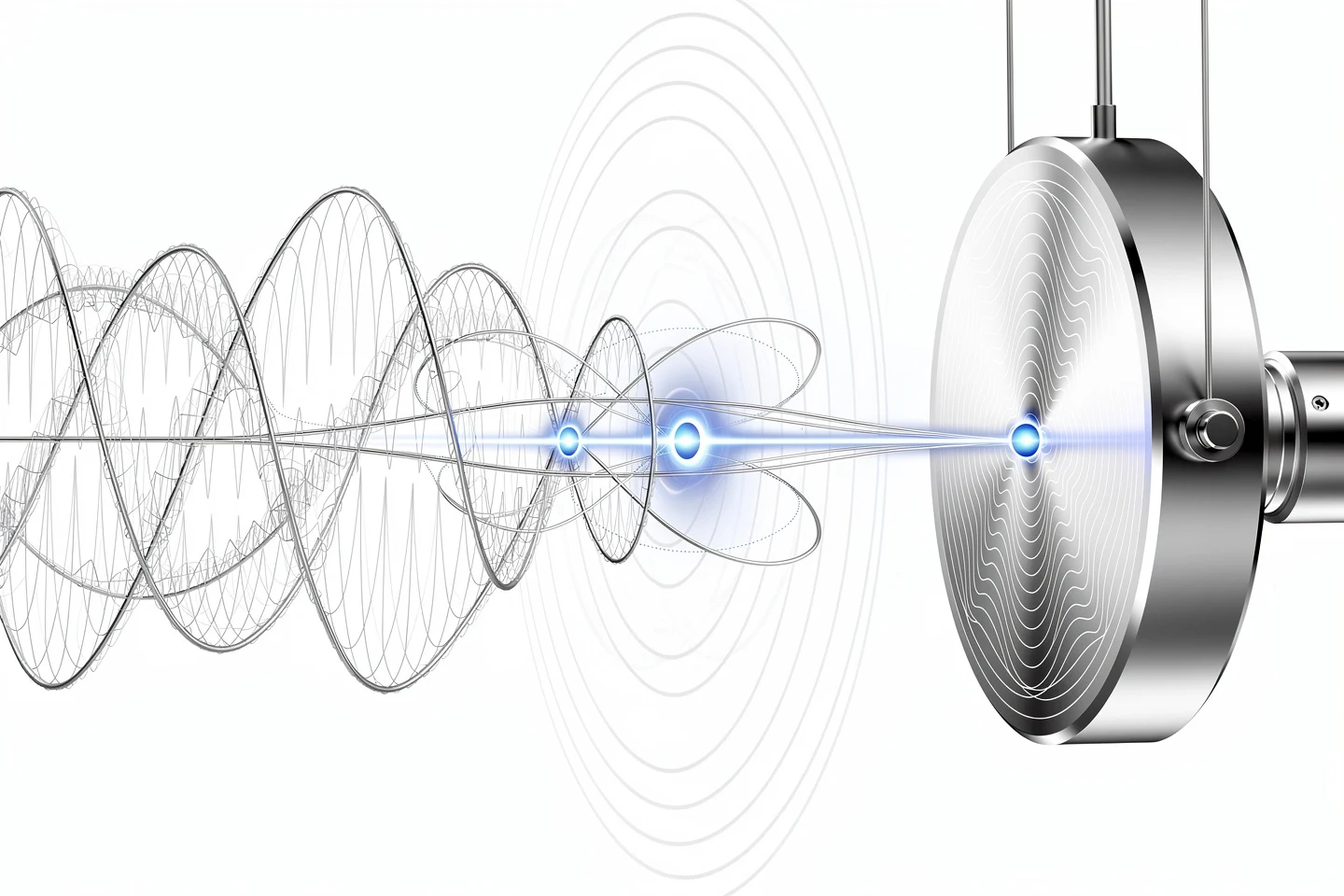
In pursuit of gravitational waves, ripples in spacetime left by black holes and neutron stars, detectors like LIGO pump their arms with light of dazzling intensity. But the brighter the beam, the more it shakes the massive mirrors, turning the ultra-sensitive interferometer into a cacophony where the cosmic whisper is drowned in mechanical roar. This is parametric instability — an optical vampire threatening the dream of megawatt-scale instruments. The brainchild of Rainer Weiss, Kip Thorne, and Barry Barish, LIGO fell victim to its own perfection.
Imagine a huge bell struck relentlessly by invisible photon hammers. Each blow hits right at resonance, and the vibrations build into an avalanche, drowning out the faint echoes of distant cataclysms. Electrostatic dampers and acoustic traps are powerless here, like plugging your ears in the eye of a storm. So physicists from the LIGO collaboration resorted to a trick: they pitted light against itself, creating an optical feedback — a kind of light-based noise-canceller that quenches vibrations with destructive interference.
The experiment was conducted at Advanced LIGO in Livingston. By deliberately heating the mirrors, researchers woke a parasitic mode at 10.428 kHz with a gain of R ≈ 2. Then the control loop entered the fray: light scattered from the trembling mirror was mixed with a reference beam from an acousto-optic modulator, and the beats revealed the phase error. After numerical processing, the signal was fed back into the interferometer with a phase shift of exactly 180 degrees, just like noise-cancelling headphones. The phase adjustment accuracy reached mere nanometers: the slightest miss, and the system would amplify rather than suppress vibrations. The result was stunning: the gain collapsed to R < 0.02, as if a megawatt beast turned into a 10-kilowatt kitten.
The key was precise phase opposition. The superposition principle, expressed by the formula: R = \frac{8\pi $Q_m$ P}{M c \omega_m^2 \lambda_0} \Re[$G_n$] $B^2$ shows how gain depends on mode quality factor, power, and geometry. Optical feedback essentially manipulates the \Re[$G_n$] term, driving its contribution to zero. A simple idea hidden in that term delivered a dramatic effect — a hundredfold suppression.
This work is not just an elegant trick. Taming instability opens the door to detectors with megawatt beams, where mirror noise no longer masks the signal. Projects like Cosmic Explorer and the Einstein Telescope may finally hear the afterglows of neutron star mergers and even relic gravitational waves from the Big Bang itself. Moreover, a single control loop can pacify multiple modes at once — an elegance that simplifies the architecture of future observatories.
Currently, the correction beam is injected through the main port of the interferometer, but engineers are designing signal injection through the back of the mirrors: this could expand the dynamic range without disturbing the main measurement. Additional Mach–Zehnder interferometers are being built to extract the faint error signal: that's the price of perfect silence.
LIGO's 40 kg mirrors shake a thousand times more from photon pressure than from a passing gravitational wave: it's like trying to hear a whisper in a hurricane.