Light Against the Shudder: How a Laser Calmed Giant Mirrors ✛ ✎ ✦
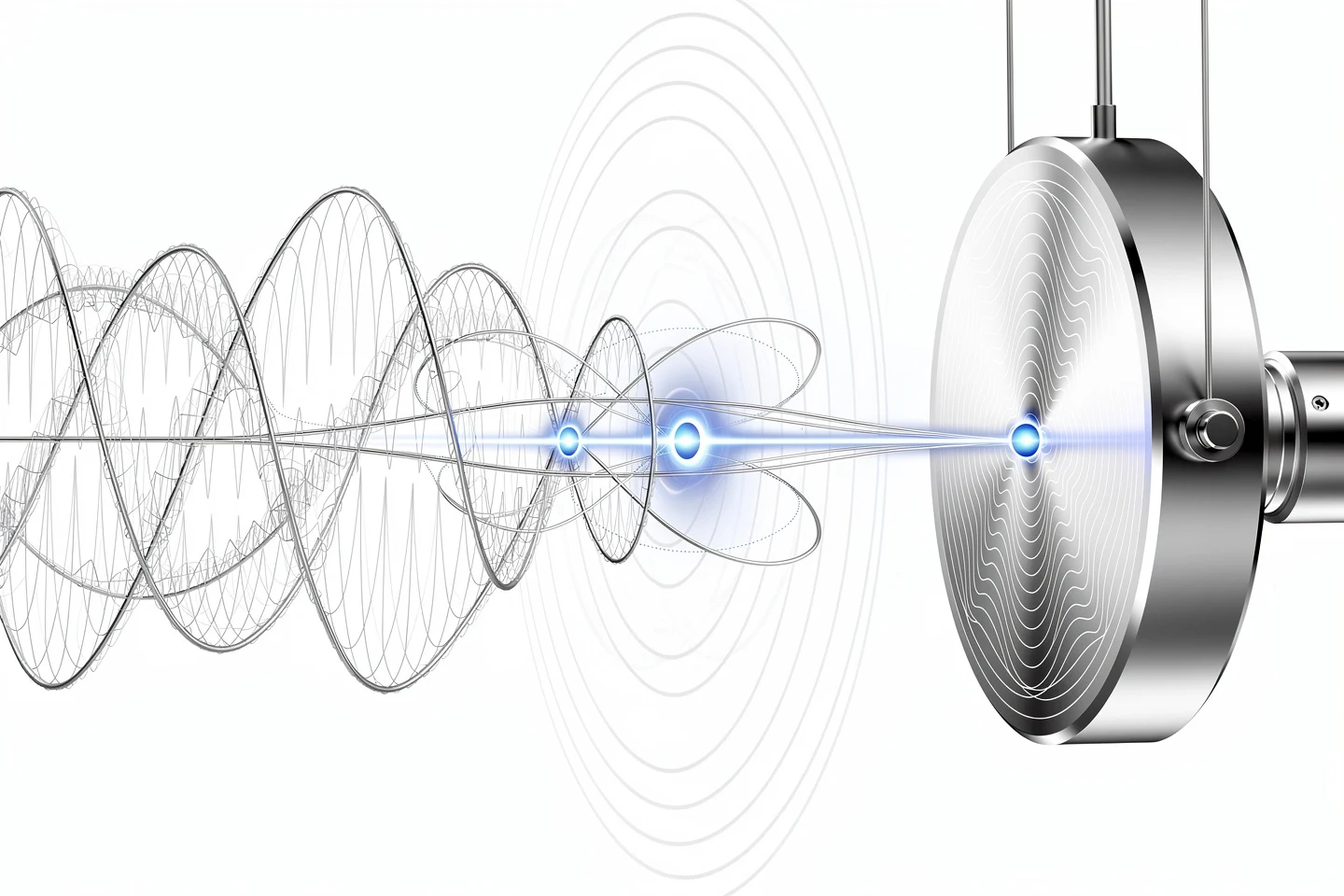
In gravitational-wave detectors like LIGO, an interferometer does the work: a laser beam races between mirrors in arms kilometers long, catching shifts as tiny as a thousandth of a proton. But when the power climbs to megawatts, the mirrors start to 'howl'—the reflected light shakes them even more, exactly like a microphone pointed at a speaker. This roar drowns out the faint whisper of gravitational waves from merging black holes or neutron stars.
Engineers tamed the shudder with an additional beam: they tuned it so its crest meets the main beam's trough, and the waves cancel each other, just like noise-canceling headphones, only for light. Computer simulations and an experiment on the working LIGO in Livingston showed: the vibration buildup crashed nearly a hundredfold. This method, developed by Rainer Weiss, Kip Thorne, and Barry Barish, paves the way for next-generation telescopes like Cosmic Explorer and the Einstein Telescope. They'll catch waves from events at the edge of the universe and test how spacetime curves in extreme collisions.
Thanks to the constant speed of light, detectors notice mirror movements a thousandth the size of a proton — without that stability, gravitational waves would remain elusive.