How Ultra-Clean Crystals Revealed a Hidden Symmetry express
Sometimes a crystal behaves like an interpreter who gets distracted by every rustle in the room, and a one-hour meeting stretches into two. In the metal ScV₆Sn₆, atoms are arranged in a kagome pattern (a weave of hexagons and triangles), and upon cooling, a charge density wave emerges — a periodic deformation of the electron cloud. But until now, crystals were not clean enough to hear all the details of this process.
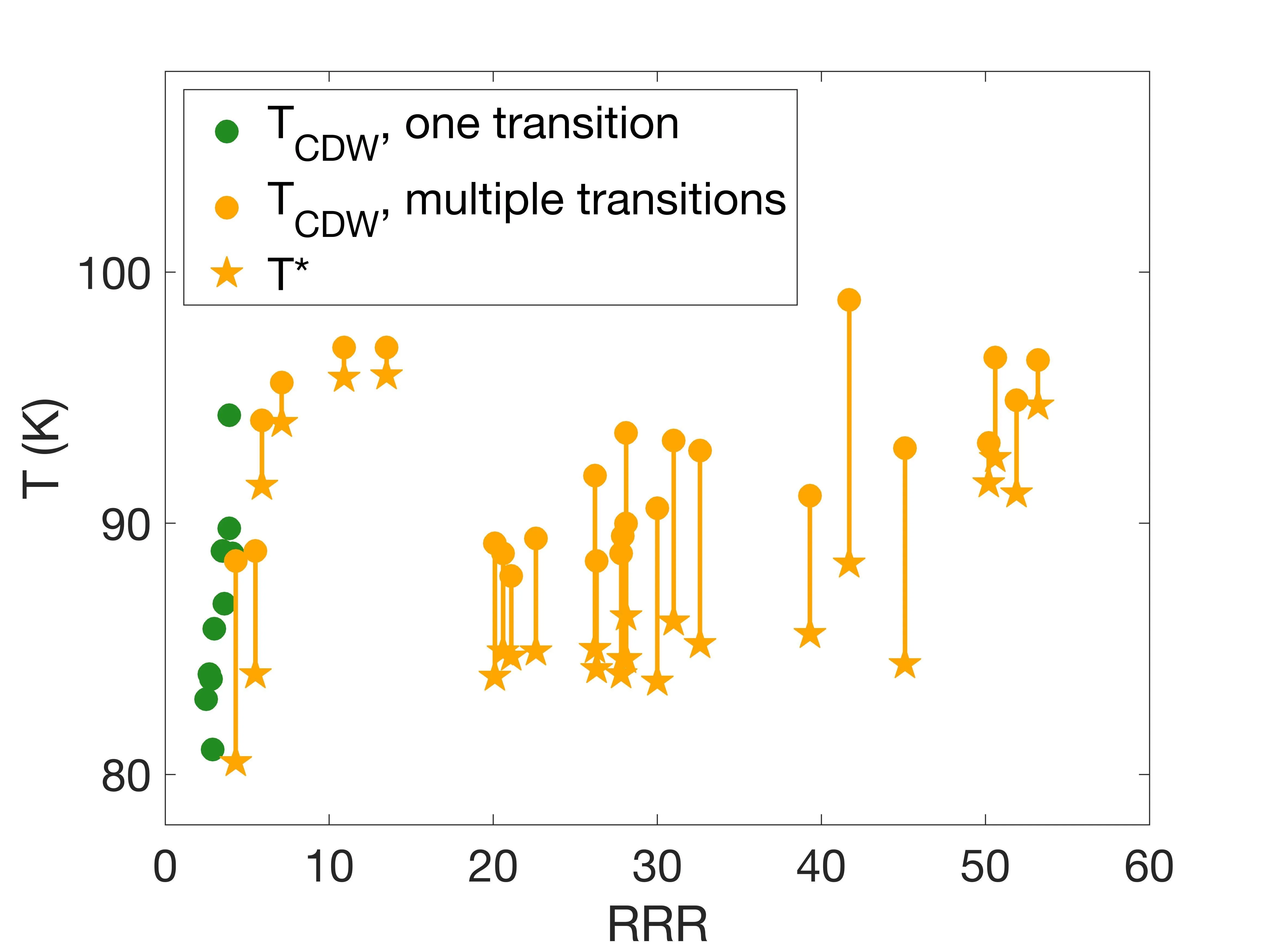
A team of scientists changed the growth recipe: they added more tin to the growth solution and lowered the temperature. The result was single crystals with a resistance ratio (RRR) above 50—five times better than before. This is like recording sound on tape without hiss: new notes became audible. Near the transition temperature into the charge density wave, a series of closely spaced jumps appeared, and an intermediate phase, as revealed by elasticity measurements, breaks the threefold symmetry of the original lattice.
With clean sound came understanding of an old puzzle. Earlier, in a weak magnetic field, an anomalous Hall effect was noticed — a deflection of carriers attributed to the material's intrinsic magnetism. But new measurements on crystals of varying purity and with chromium doping showed that the effect is perfectly described by ordinary electron motion across multiple bands, where there are small but highly mobile pockets. Quantum oscillations confirmed their existence.
Now the interpreter is not distracted. The clean crystal has told us that its 'anomalous' behavior is just the coordinated work of many voices, not a solo performance of exotic physics. The method of systematically tuning mobility becomes a tuning fork for future research: it will help distinguish true anomalous Hall effect from multi-band echoes in other kagome materials.
Original abstract
as written by the authors arXiv:2606.29048
The kagome metal ScV$$_6$$Sn$$_6$$ has attracted attention as a platform for exploring the interplay between charge density wave (CDW) order and symmetry-breaking phenomena, including a recently reported intermediate phase and a low-field Hall anomaly that has been attributed to an anomalous Hall effect (AHE). The interpretation of both observations has been limited by the modest sample quality achieved by previous growth procedures, which produced crystals with in-plane residual resistivity ratios (RRR) of at most $$\approx$$9. Here, we report a simple modification of the flux growth procedure that yields ScV$$_6$$Sn$$_6$$ single crystals with RRR exceeding 50, more than five times the previous highest reported value, and use this expanded mobility range to revisit both the symmetry and the magnetotransport of the CDW phase. We resolve a sequence of closely spaced transitions in the immediate vicinity of $$T_{CDW}$$ that emerges above a sharp threshold of RRR $$\approx 4$$, and demonstrate through elastoresistivity that the intermediate phase breaks the three-fold rotational symmetry of the parent lattice. We examine the Hall response from both the parent samples across the full RRR range as well as Cr-doped samples, and conclude it is quantitatively inconsistent with an intrinsic AHE and is instead explained by ordinary multi-band transport involving small, high-mobility pockets identified through quantum oscillations. These results refine the symmetry-breaking landscape of ScV$$_6$$Sn$$_6$$ and establish systematic mobility tuning as a diagnostic for disentangling an intrinsic AHE from multi-band Hall contributions in kagome CDW systems.
The kagome lattice is named after a Japanese woven basket, and its pattern appears in crystals where electrons can behave like a liquid with very unusual properties.