A single crystal is a solid material in which the atomic lattice is continuous and unbroken throughout the entire sample, with no grain boundaries. Most everyday solids are polycrystalline — they are made of many tiny crystals (grains) with different orientations, and the boundaries between them scatter electrons and phonons. A single crystal, by contrast, has a perfectly periodic arrangement of atoms over macroscopic distances, which gives it unique properties: anisotropic behavior (properties depend on direction), high mechanical strength, and exceptional electronic and optical characteristics.
History
The deliberate growth of single crystals began in the late 19th century with the work of Auguste Verneuil, who developed the flame-fusion method for growing synthetic rubies. The Czochralski method, invented in 1916 by Jan Czochralski, became the standard for producing silicon wafers for electronics.
How it works
Single crystals are grown by carefully controlling the solidification of a melt or solution so that only one nucleation site forms and grows. Common methods include the Czochralski process, where a seed crystal is dipped into a melt and slowly pulled upward, and the Bridgman method, where a crucible is moved through a temperature gradient. The resulting crystal inherits the orientation of the seed, and if conditions are kept stable, the entire boule becomes one continuous lattice.
In practice
Single crystals are essential in modern technology: silicon wafers for microchips, sapphire crystals for LED substrates and watch faces, and nickel-based superalloy single-crystal turbine blades for jet engines, which resist creep at high temperatures better than polycrystalline alloys.
Fun fact
The largest single crystal ever grown is a silicon boule weighing over 300 kilograms, produced for the semiconductor industry — it can be over 2 meters long and 30 centimeters in diameter.
A drop detaches from a faucet nozzle, and a thin filament trails behind it. At the last instant, the filament breaks not in one place but in two—and between them, a tiny sphere, a satellite droplet, hangs suspended. This "debris" of secondary droplets clogs printheads, ruins microchips, and throws off the accuracy of drug dosing.
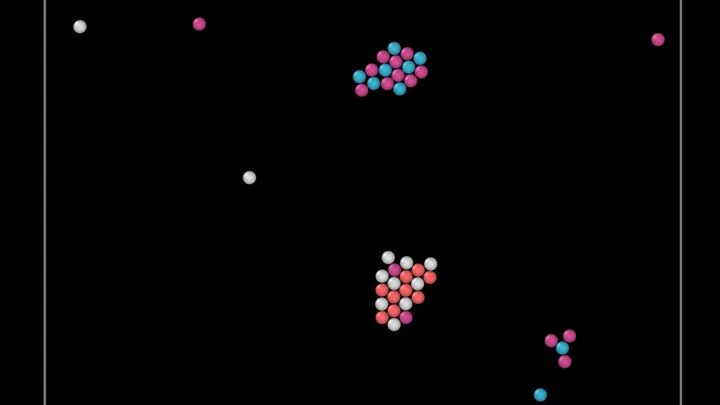
A drop of water on glass trembles and shimmers: it seems to have a life of its own. Similar behavior can now be observed in the world of colloids: tiny particles suspended in a liquid. Researchers simulated particles that emit chemical signals. These signals, like scents in the air, spread around and cause neighbors to either draw closer or move apart.
A mosaic of squares and triangles covers the floor without gaps, yet it never settles into a simple repeating pattern. Such a pattern is a quasicrystal — a solid where atoms are arranged not periodically but according to a pattern of several waves of different lengths. These waves are incommensurate with each other, and together they create long-range order.
A neutron star is a city squeezed to the size of a metropolis, where matter is packed to the limit. At the very center of such a city, a redevelopment may begin: familiar neutrons and protons give way to quark plasma — free quarks, the building blocks of almost everything around us.
The story began with a missing mass. In the 1930s, Fritz Zwicky, measuring velocities in galaxy clusters, first suspected the presence of invisible matter. Later, Vera Rubin showed that the outskirts of spiral galaxies rotate too fast for the visible matter.
A pendulum that swings on its own, without any winding — in the quantum world, such 'pendulums' are called time crystals. In them, rhythmic motion arises spontaneously and does not decay. But until now, controlling this rhythm was nearly impossible: any intervention threatened to destroy the fragile order.
A crystal is like a row of soldiers on a parade ground: every atom is in its place, and electrons march through it in neat waves. An amorphous material is like a crowd at a train station, where there is no order, just a jostling throng. In such a crowd, an electron usually gets stuck quickly, like a person trying to push through a dense mass of people.
Tile a floor with identical triangles, and you get a boring repeating pattern. But what if you want the pattern to never repeat, yet use just one tile? For a long time, mathematicians were sure it couldn't be done: you'd need at least two different shapes. The famous Penrose mosaic is a case in point: rhombi with acute and obtuse angles arrange into an infinitely varied but strictly ordered pattern.
A hot spoon in a cup of tea — heat runs along the metal from the hot end to the cold one. Textbooks describe this process as atoms jiggling and passing on their jolts to each other. But atoms don't just jiggle: they also spin, like tiny tops. Until now, physicists had no common language to describe both motions at once.
The authors of the work built such a language.
Silicon is like a universal building block: it goes into the chips in your phone, solar panels, and lasers. But if you squeeze it with immense force, the atoms rearrange into new patterns: these forms are called allotropes. One of them, Si-XIII, was first spotted more than twenty years ago, but its exact pattern remained a mystery.
A handful of lead sulfide nanocrystals coated with charged molecules spontaneously assembles into a perfect crystalline lattice. Each nanocrystal is like a brick just a few nanometers across, while the charged molecules on its surface act as the mortar.
Time crystals are an exotic phase of matter that exhibits periodic motion not in space but in time, even while in its ground, unexcited state. This idea, reminiscent of a perpetual clock that never needs winding, was first proposed by Frank Wilczek.
Perovskite crystals are building blocks where metal atoms and halogens arrange into a neat lattice. Swap one halogen for another, and the crystal glows in a different color. But there's a catch: chlorine and iodine don't like to be neighbors in the same lattice, and in large crystals the mixture separates into distinct zones, like oil and water in a glass.
Two pieces of graphite rub against each other, and the resistance vanishes as if an invisible film of oil separated them. Previously, this was only seen under a microscope, on tiny contact patches.