Quantumoscillations are periodic variations in a physical property, such as electrical resistance or magnetization, that occur when a material is placed in a strong magnetic field at low temperatures. These oscillations arise because the energy levels of electrons in a magnetic field become quantized into discrete Landau levels. As the magnetic field strength changes, these levels pass through the Fermi energy, causing the property to oscillate.
History
The effect was first predicted by Lev Landau in 1930, and the de Haas-van Alphen effect was observed experimentally by Wander de Haas and Pieter van Alphen in 1930. The Shubnikov-de Haas effect was discovered by Lev Shubnikov and Wander de Haas the same year.
How it works
In a magnetic field, electrons move in circular orbits, and their energy is quantized into Landau levels. When the field increases, the spacing between these levels grows, and they move upward in energy. As a level crosses the Fermi energy, electrons are redistributed, causing oscillations in the density of states at the Fermi level. This leads to periodic variations in resistance (Shubnikov-de Haas effect) or magnetization (de Haas-van Alphen effect). The period of oscillation is directly related to the cross-sectional area of the Fermi surface.
In practice
Quantumoscillations are a powerful tool for mapping the Fermi surface of metals and superconductors, providing crucial information about their electronic structure.
Fun fact
Quantumoscillations are so sensitive that they can be used to detect the presence of a single impurity atom in a crystal, as it would slightly alter the Fermi surface and thus the oscillation pattern.
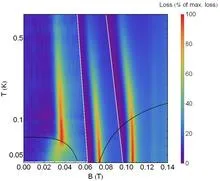
Tuning a radio receiver to a station that changes frequency as you cross a phase boundary: that is how you might picture the challenge facing the researchers. In the metal YbRh2Si2, electrons behave as "heavy" particles: their effective mass is hundreds of times that of a free electron.
Ion current through a membrane is like a queue at a turnstile. Sometimes the turnstile is free — ions pass through quickly. Sometimes it gets stuck — the flow drops. A weak magnetic field, it turns out, doesn't push ions from behind; it simply changes the number of open turnstiles.
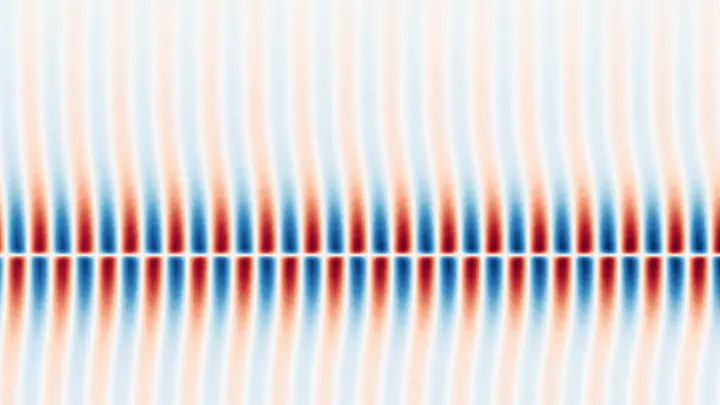
A lone fold runs across a taut sheet — a sharp drop in height that doesn't spread out but moves as a whole. Physicists call such a fold a 'kink'. If you give the sheet a sharp tug in one spot, ripples will travel across it. But in some media, these ripples don't disperse; instead, they gather into a clump and tremble in place for dozens or hundreds of cycles. Such a clump is an oscillon.
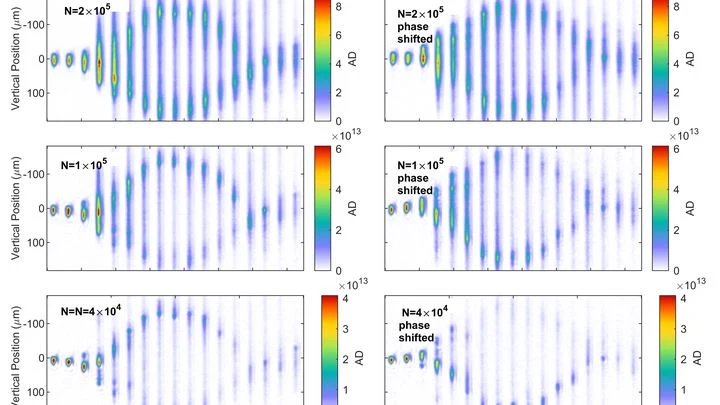
A child on a swing: too strong a push and they fly off. Roughly this is how powerful light tears electrons out of an atom. It would seem that the stronger the push, the more certain the destruction. But in the quantum world it is different: when the field strength crosses a certain threshold, the atom suddenly freezes.
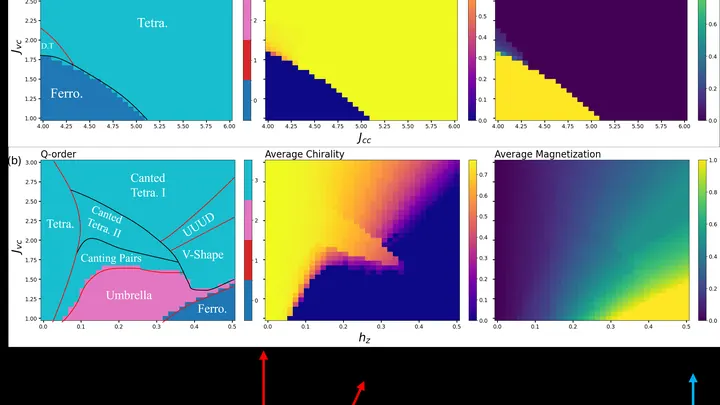
Imagine a triangular grid with tiny magnetic arrows at each node. Electrons, the charge carriers, run across this grid. Usually, the arrows align simply: all pointing the same way (ferromagnet) or alternating in the plane.
In a strong magnetic field, electrons in a thin metal film move along circular orbits. When the film thickness is comparable to the size of such an orbit, the resistance starts to oscillate: these are Sondheimer oscillations, known since the mid-20th century as a purely geometric effect.
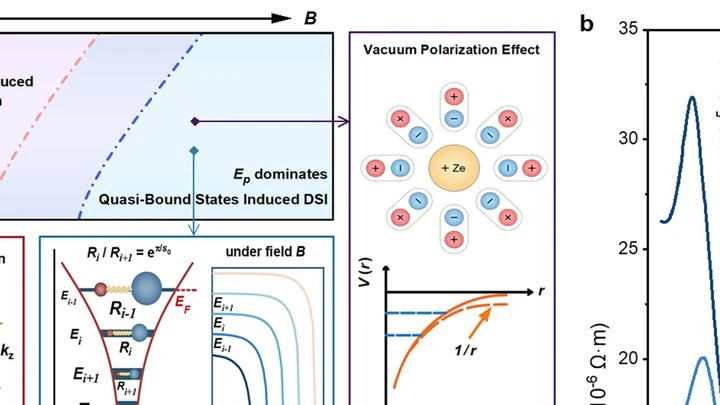
In the crystal HfTe5, electrons behave almost like light: their mass is so small that they obey the laws of relativity. If you place such a crystal in a strong magnetic field, the electrons start to circle in tiny orbits. Their energy then changes not smoothly but in steps, like floors in a building.
A sheet of paper hundreds of times thinner than a human hair: that's roughly the thickness of the vanadium oxide film scientists grew. Inside this film, electrons, the tiny carriers of electric current, move almost without collisions. Like cars on an empty night highway, they accelerate and don't lose speed.
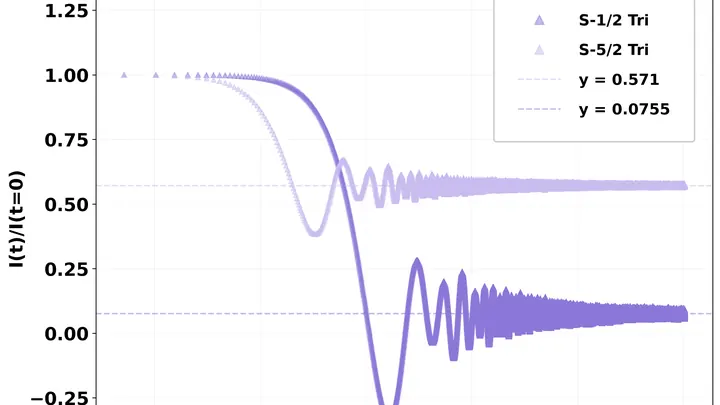
A fridge magnet sticks because the tiny atomic arrows inside it are aligned in one direction. But quantum mechanics makes these arrows jitter, so the overall magnetization falls short of the ideal.
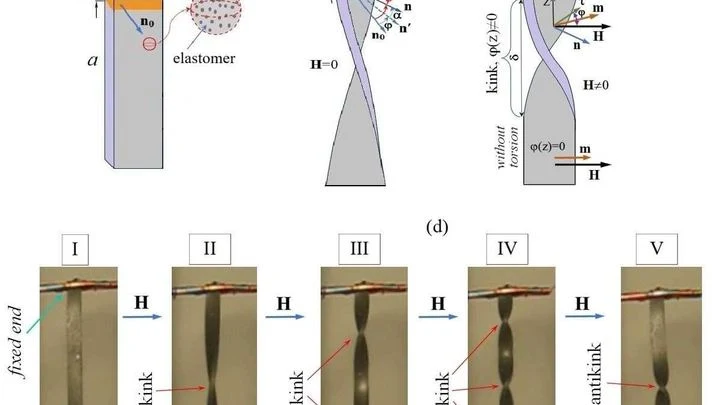
An ordinary rubber strip filled with fine iron filings doesn't just bend in a magnetic field: it ties itself into a stable knot. This effect was predicted and reproduced in experiments by physicists working with magnetoactive elastomers: a silicone base with carbonyl iron particles.
An ordinary superconductor loses resistance when cooled, and current flows through it without loss. But in ultrathin films, things are different: the material fluctuates between normal and superconducting states, and in this transition zone, strange resistance waves emerge. Resistance rises and falls as if someone were turning a volume knob.