In 1879, Edwin Hall, a student at Johns Hopkins University, experimented with thin gold foil. He noticed that the magnetic field not only bends the current but also creates a transverse potential difference. It turned out that the sign of the voltage depends on the sign of the charge carriers: in metals it is one way, and in semiconductors the opposite. Thus was born the method for determining the type of conductivity.
History
Edwin Hall discovered the effect in 1879, inspired by Maxwell's idea that the magnetic field should act on the conductor, not on the current directly. He used gold foil and a strong magnet, measuring the tiny voltage with a galvanometer. Subsequent research led to the discovery of the quantum Hall effect by Klaus von Klitzing in 1980.
How it works
Used for measuring magnetic fields, contactless current sensing, and in magnetoresistive sensors. In semiconductors, it is used for material characterization: by measuring R_H and conductivity, one finds mobility and carrier concentration. Limits: the weak-field condition where trajectories are nearly straight; in strong fields quantum effects appear.
In practice
Hall sensors are used in cars (ignition), phones (flip cover with a magnet), and for contactless magnetic field measurement.
A translator gets distracted by every rustle in the hall, and a one-hour meeting stretches into two. That's roughly how disorder in a crystal slows electrons: tiny inhomogeneities make them wander, and resistance grows. In the Dirac semimetal PdTe, this effect has now been observed in its pure form for the first time.
Current in an ordinary metal flows like a crowd of people down a straight street: each electron is on its own, and if you turn on a magnetic field, the whole crowd shifts slightly sideways. This shift is called the Hall effect.
Current in an ordinary metal flows like a crowd of people down a straight street: each electron is on its own, and if you turn on a magnetic field, the whole crowd shifts slightly sideways. This shift is called the Hall effect.
A magnetic field usually acts like a strict traffic cop: for heat to turn into electricity, it must stand across the road. If the field lies along the heat flow, the effect disappears, or so it was believed for decades.
Scientists took an ultra-thin film of a magnetic oxide — a material where electron spins are aligned in a plane, like compass needles on a table.
A vortex in a magnetic material is like a whirlpool, but instead of water, the directions of magnetization twist. An electron flying through such a vortex feels not just a magnetic field, but a curvature of space: its path bends as if it were rolling down a funnel with a narrow neck.
Electricians working with high voltage are like divers: they need to see what's happening deep underwater without going down themselves. What's needed is a sensor that stays away from the dangerous current and relays information to the surface. Usually, light is used: a beam passes through a transparent crystal, and the electric field slightly rotates it.
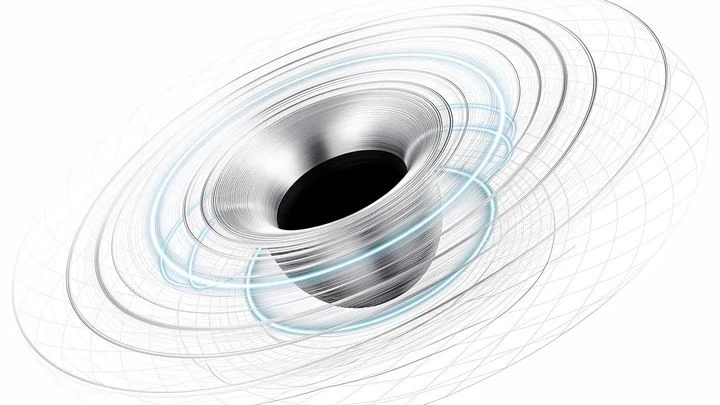
A superconductor pushes out a magnetic field like a sponge squeezing out water. This Meissner effect has been known for nearly a century, but it's usually calculated in a flat world — without gravity. In the strong field of a black hole or at enormous speeds, the picture changes.
Take two thin sheets of a semiconductor. One is saturated with free electrons, like a packed café where every table is taken. The other, by contrast, is full of empty spots—'holes' eager to be filled. When these sheets are brought close together, a spark of attraction jumps between them: electrons and holes begin to feel each other across the thin gap.
A neuron transmitting a signal is like a tiny battery that quickly discharges and recharges. For nearly 70 years, it was believed that a special "potassium valve," opening with a delay, was responsible for the recharge phase. New work claims this current is a ghost.
Ordinary electric current heats up wires — anyone who has touched a phone charger knows that. But there's another kind of current: instead of electrons rushing in a crowd in one direction, they spin in sync, like figure skaters in a pairs routine. This coordinated rotation is called a spin current, and it produces almost no heat.
Ion current through a membrane is like a queue at a turnstile. Sometimes the turnstile is free — ions pass through quickly. Sometimes it gets stuck — the flow drops. A weak magnetic field, it turns out, doesn't push ions from behind; it simply changes the number of open turnstiles.
Two galaxies (our Milky Way and its satellite, the Large Magellanic Cloud) slowly circle each other. Their gravitational pull stirs the distant outskirts of the Milky Way, like a pebble thrown into a pond makes the water ripple.
A thin sandwich made of two different materials. You run an electric current through it, and the top slice magnetizes in one direction, the bottom in the opposite. This isn't a magic trick; it's the layer Edelstein effect, just described by physicists.
A thin film of a special crystal (for instance, molybdenum disulfide) sits on a microscope stage. The temperature is just above the point where the material becomes a superconductor.
A guitar string keeps vibrating even after the musician lets it go, and that vibration changes the sound the listener hears. Magnetic moments in a crystal behave much the same way: they align into a strict antiferromagnetic order (neighbors point in opposite directions), but they never completely freeze.
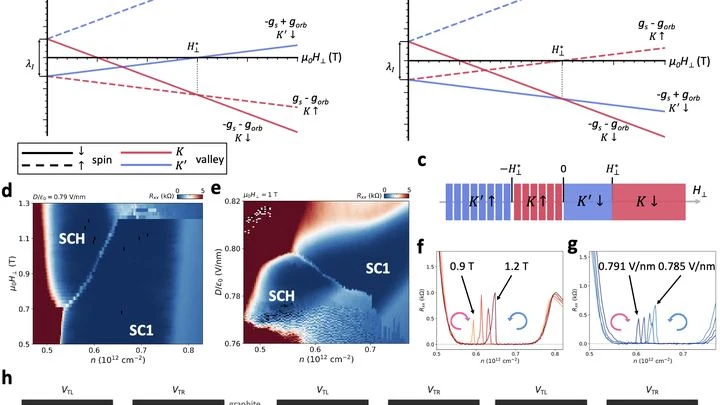
Superconductors usually don't get along with magnets: a strong field destroys the state in which current flows without resistance. But in thin layers of carbon, things are different.
In a superconducting ring shaped like a washer, current sometimes flows more easily in one direction than the other. This property is called the diode effect. Usually, its direction is rigidly set by the material's structure. But in new work, physicists showed that it can be switched, and the switch is the number of magnetic vortices trapped in the ring.
The solar wind rushes from the Sun to Earth, but the magnetosphere bends the flow and sculpts it into plasma tails. The same motif plays out at the heart of galaxies: jets from accretion disks around black holes are twisted by the invisible hand of a magnetic field.
A wormhole is a tunnel connecting two distant regions of the universe. If such a wormhole existed and were traversable, a particle inside it would feel not only gravity but also a force from its own electric field. This force depends on how spacetime is curved around it.
Imagine a river at a rapid: the current accelerates until no wave can go against the flow. So it is with gas near a black hole: reaching the speed of sound, it locks itself in — an acoustic black hole is born, a twin of the gravitational abyss. Here the event horizon is woven from a flow faster than its own sound.
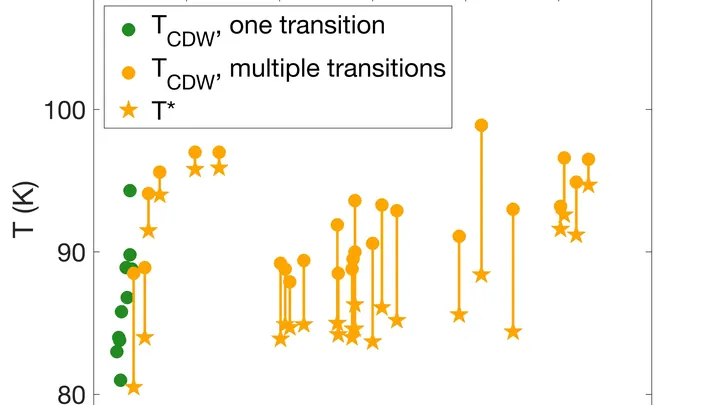
Sometimes a crystal behaves like an interpreter who gets distracted by every rustle in the room, and a one-hour meeting stretches into two. In the metal ScV₆Sn₆, atoms are arranged in a kagome pattern (a weave of hexagons and triangles), and upon cooling, a charge density wave emerges — a periodic deformation of the electron cloud.
Light from a distant blazar, an active galactic nucleus whose jet points our way, travels for billions of years. Along the way, it triggers cascades of charged particles that the intergalactic magnetic field deflects sideways. This creates a blurred gamma-ray glow around the blazar: a secondary halo.
A superconductor is like an ideal highway with no traffic lights: electrons race along without hindrance. But apply a voltage, and the picture changes. In a new experiment, physicists found that an electric field penetrates the superconductor and creates a mixed regime inside.
Two thin layers of a semiconductor were twisted relative to each other by 2.29 degrees, like two sheets of transparent paper with printed grids. Where the lines nearly align, a large pattern of dark and bright spots emerges. Electrons in this pattern behave very differently from those in a regular crystal.
A superconductor is like a perfect electron dance: electrons move in pairs without losing energy, like dancers who never miss a beat. But add a few magnetic impurities, and strangers crash into the dance, disrupting the synchronized motion. The temperature at which this dance begins drops.
Electric current in a wire is like a crowd of people hurrying down a corridor. Usually, each person bumps into walls and loses speed almost instantly: that's electrical resistance.
Two ultrathin sheets, resembling mica, lie on top of each other. One shifts by a fraction of a nanometer, and a modest semiconductor turns into a magnet. That's roughly how the materials studied by the authors work: layered compounds of niobium and tantalum with sulfur or selenium.
If you toss a handful of coins onto a table, they land in a jumble. But in some crystals, atoms arrange themselves into a pattern reminiscent of a woven basket — the kagome lattice. In the metal MgMn₆Sn₆, manganese atoms form such a lattice, and at room temperature they act like tiny magnetic needles.
A palm hovering over a hot stove feels the heat even when the surrounding air seems cool. Something similar happens to electrons in the Aharonov–Bohm effect: the particle senses an electric voltage even though it enters a region where the field has already been switched off.
In a pot of boiling soup, churning currents carry heat to the walls, and the soup cools. In a tokamak, a huge magnetic bottle for plasma, the same thing happens: turbulent eddies carry energy outward, hindering the ignition of a fusion reaction. But sometimes the plasma seems to find a way to calm itself.
River water often swirls into funnels. But in semiconductors, the foundation of microchips, electrons at low temperatures and high purity also turn into a fluid. If you create a circular cavity, vortices appear, just like in a river backwater.
In a tiny magnet, information is encoded not in which way the arrow points, but in how the directions of its atoms alternate. In antiferromagnets, these arrows cancel each other out, so the material appears non-magnetic from the outside. The data is there, but you can't read it the usual way: the state is like a note written in invisible ink.
A crystal that looks like a stack of pancakes was placed on a smooth substrate of magnesium oxide. The result was a film only a few hundred atoms thick. When they ran a current through it and switched on a magnet, the resistance jumped by nearly a quarter—22.5% in a 9-tesla field.
Inside the film, electricity is carried by two streams of particles.
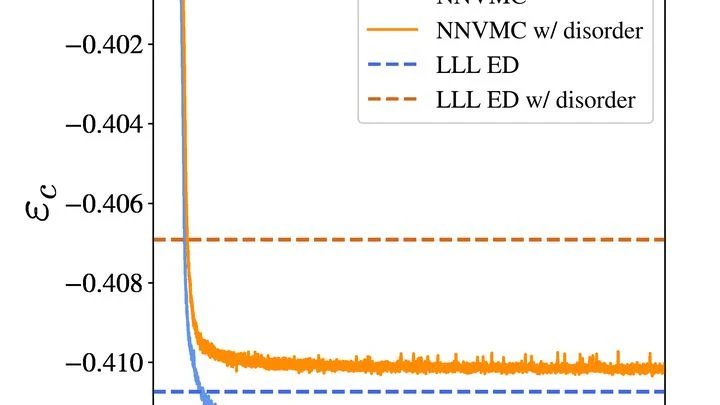
A mosaic floor made of many small tiles, each turned in a different direction. It seems that any pattern trying to cross such a floor would get scrambled and vanish. That's how people usually think about disorder in crystals: if atoms aren't arranged in a perfect lattice, delicate quantum effects should fall apart.
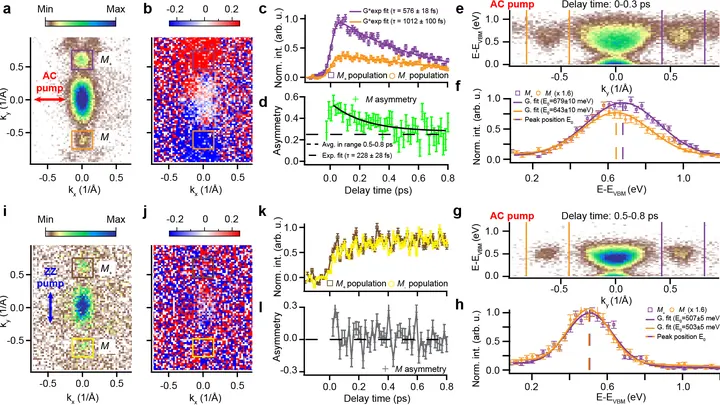
An ordinary sheet of black phosphorus looks like a layered cake of atoms. If you shine a regular lamp on it, nothing special happens: the electrons sit still, like spectators in a dark theater. But a short laser flash lasting millionths of a billionth of a second shakes up that theater.
In a strong magnetic field, electrons trapped in a thin layer sometimes arrange into a regular pattern, like guests at a crowded party who find a spot where no one jostles them. This order is called a crystal, although it is not ice or salt, but the electrons themselves, frozen in place.
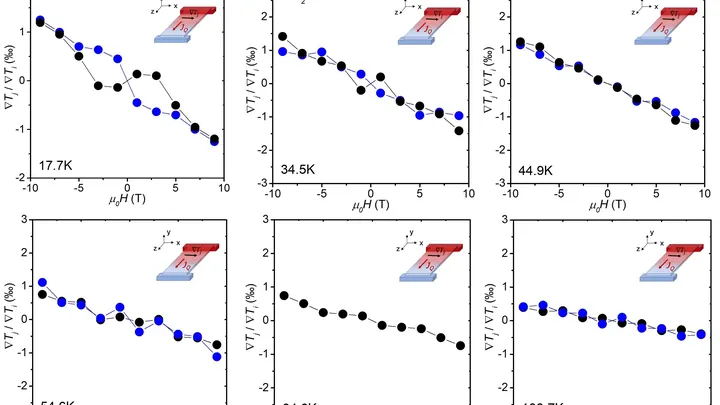
In an insulating crystal, heat usually flows from the hot end to the cold end. But when you switch on a magnetic field, part of the heat flow veers sideways, like water running down a slope that drifts to the side when the wind pushes it. This behavior is called the thermal Hall effect.
Two sets of swings, rocking in opposite directions, don’t tilt the platform. Yet their motion creates invisible vortices that push a ball sideways. Alternagnets behave just like that: the atomic magnetic arrows are perfectly balanced, but a hidden symmetry bends the heat flow.
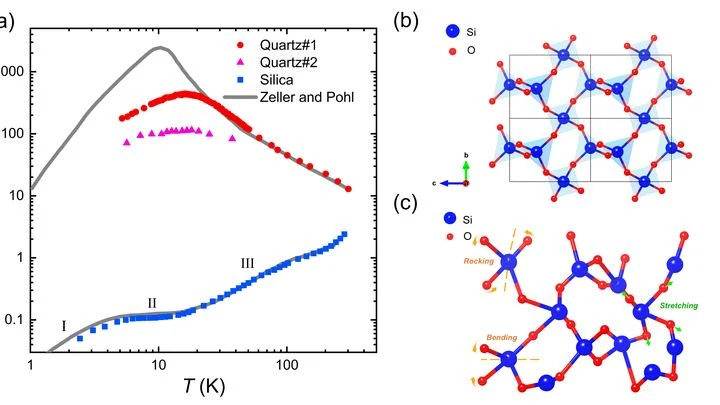
If you push heat through a piece of quartz, it usually goes straight, like water through a pipe. But switch on a magnetic field, and the flow veers slightly sideways, as if the pipe suddenly grew a side branch.