Xiaodong Xu

5 articles · 30 co-authors · latest: 2026-08-09
514 citations · h-index 11 · 36 papersData: Semantic Scholar

We have retold 5 papers by this author. most often about: superconductivity, thermal conductivity, topological insulator. 30 co-authors across our retellings.

Links in the knowledge graph
Superconductivity2026-04-252 minarXiv:2604.23378express
The Crystal That Won't Be Thrown Off Course
A crystal is like a city: if the streets are crooked, traffic jams. In a crystal, the streets are atomic rows, and the traffic is the flow of electrons. Any tiny imperfection, impurity, or atomic displacement makes electrons scatter. Scientists from several labs have learned to grow crystals so that the "streets" are almost perfectly straight. The method is called horizontal vapor transport.
Mesoscale2026-04-261 minarXiv:2604.23587express
Magnetic Patterns in Twisted Material
Layers of a thin material rotated relative to each other resemble stacked grids. Where the lines intersect, a new pattern emerges — a moiré. In this pattern, electrons move differently than in a regular crystal and can form unexpected states. In the new study, researchers took two layers of molybdenum telluride and twisted them by 4.8 degrees.
Mesoscale2026-06-192 minarXiv:2606.21004express
An electrical switch for the quantum world
A sheet of paper with square grid, one with diamond grid, and one with honeycomb — three different universes for an ant. Change the sheet, and the rules of movement change. That's roughly how electrons experience the crystal lattice: geometry dictates whether they become little magnets, superconductors, or something else. In ordinary materials, the lattice is as rigid as if engraved.
Strongly Correlated2026-06-272 minarXiv:2606.29048express
How Ultra-Clean Crystals Revealed a Hidden Symmetry
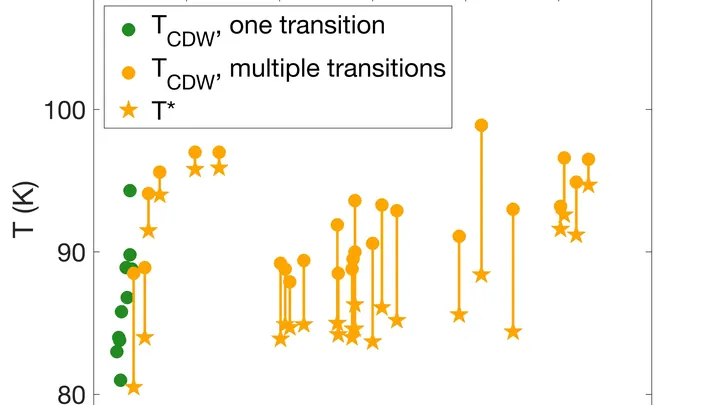
Sometimes a crystal behaves like an interpreter who gets distracted by every rustle in the room, and a one-hour meeting stretches into two. In the metal ScV₆Sn₆, atoms are arranged in a kagome pattern (a weave of hexagons and triangles), and upon cooling, a charge density wave emerges — a periodic deformation of the electron cloud.
Strongly Correlated2026-08-093 minarXiv:2608.08937express
How a vacuum bubble fights a magnetic field
In a pot of water carefully heated above its boiling point, the liquid remains calm. But the slightest disturbance, and it violently turns to steam. Physicists call this a metastable state: it seems stable, but in reality it's ready to break apart at the slightest nudge.