Cosmic Fountain: How Shock Waves Control the Growth of Black Holes ✦
Original: "General Relativistic Shock Wave Solutions with Black Hole Formation: The Singular Isothermal Sphere Case"
Shock waves during gravitational collapse of isothermal gas turn the birth of a black hole into a cosmic fountain: ejecting up to 10% of rest energy, they regulate accretion and explain the rapid growth of supermassive black holes in the early Universe.
Links in the knowledge graph 1
Already 500 million years after the Big Bang, black holes of a billion suns exist — many times faster than old models allowed. The key is a shock wave acting like a cosmic fountain: it ejects gas, slowing accretion by 5–7 times, and converts up to 10% of mass into radiation (compare with 0.7% for thermonuclear fusion). Such explosions could have ignited the first quasars and explain JWST's red dots.
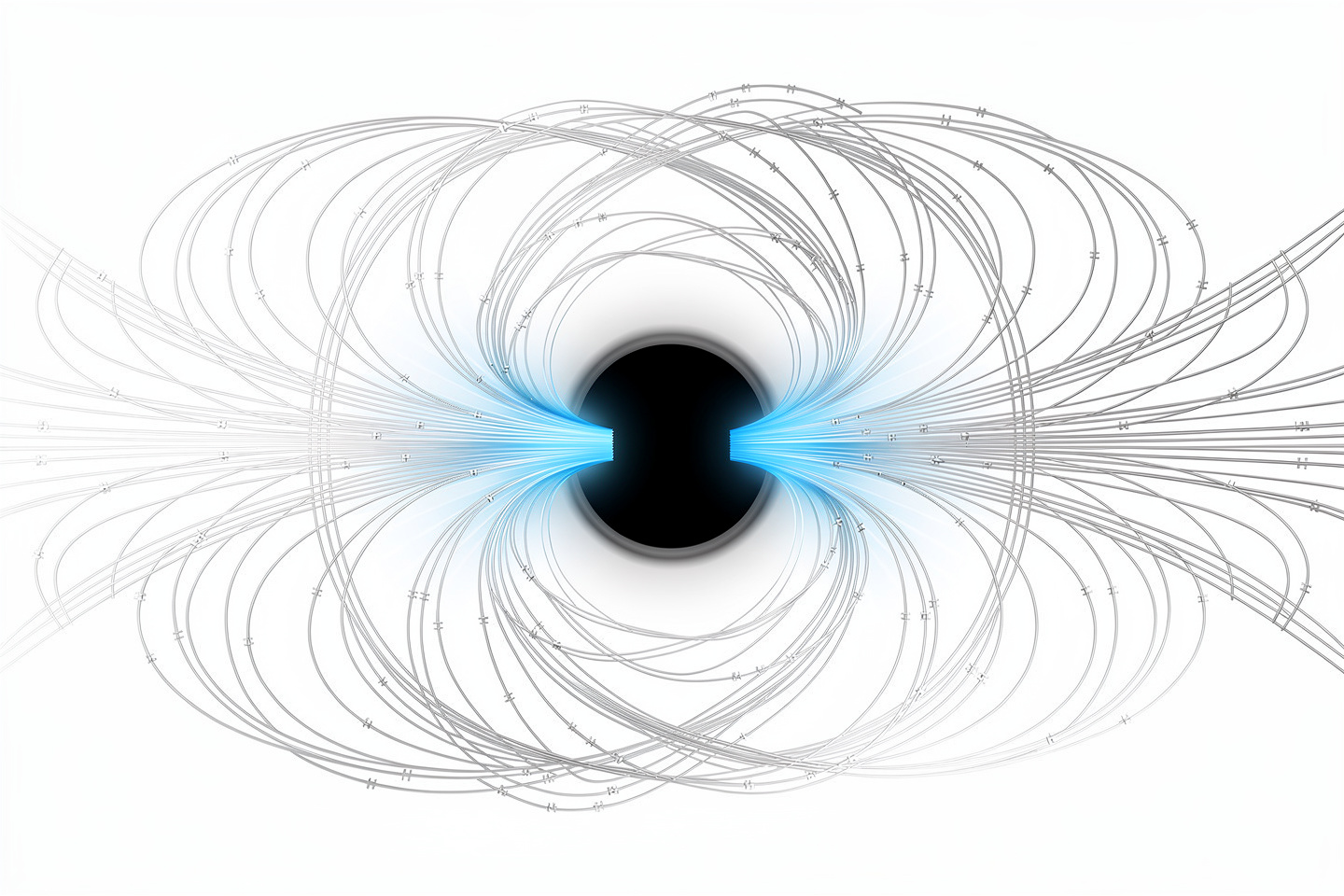
🎯 In shock-wave solutions, gas doesn't just fall into the black hole, but performs a 'fountain' loop: first the shock wave flings it outward, and only when the expanding zero-velocity surface catches up with the gas, it turns around and rushes unimpeded toward the singularity.
p_{\rm pre} p_{\rm post} = \frac{\gamma}{1+\gamma}
The product of the proper momenta of the gas before and after the shock front is constant and depends only on the square of the sound speed.
Scientists
Christian DopplerD. B. McLaughlinDidier QuelozMichel MayorR. A. RossiterStephen Hawkingblack hole
JWST
redshift
Accretion disk
active galactic nucleus
spacetime curvature
speed of light
entropy
metallicity
singularity
numerical simulationLaws
second law of thermodynamicsDoppler effectHawking radiationgravitational lensingprinciple of constancy of the speed of lightBekenstein-Hawking entropy