Fabio Pacucci

4 articles · 30 co-authors · latest: 2026-07-06
4,392 citations · h-index 36 · 167 papersData: Semantic Scholar

We have retold 4 papers by this author. 3 of them with a full read. most often about: primordial black hole, star formation, Reionization. 30 co-authors across our retellings.

Links in the knowledge graph
Galaxies2026-01-201 minarXiv:2601.14368express
Red Dots in Space Turned Out to Be Growing Black Holes
The James Webb telescope peered into the early universe and saw a multitude of mysterious red dots. Their glow didn't resemble familiar galaxies or stars. The answer was unexpected: these are growing black holes, born without a stellar stage.
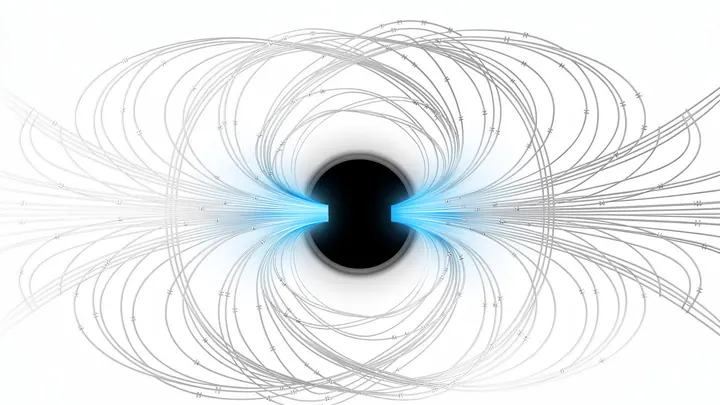
Cosmic Fountain: How Shock Waves Control the Growth of Black Holes
Observations by James Webb showed: already 500 million years after the Big Bang (at redshifts z~10), the Universe was aglow with black holes with masses of billions of solar masses. This baffles theories of gradual growth: matter would not have time to 'feed' the seeds at the required rate.
Galaxies2026-07-023 minarXiv:2607.02666
Cosmic Cocoons: MEOW's Infrared Hunt Reveals the Secret Growth of Black Holes
The Universe is less than a billion years old, yet at its centers already sit black holes with masses of a billion suns. According to the conventional picture, they grew by voraciously devouring matter, but calculations show that 'feeding' must have been almost continuous, while visible quasar flares last only a few million years. So where does all the accreting fuel go?
The Pulse of a Black Hole: Birth of a Jet in X-ray Echo
For years, silence reigned in the heart of galaxy 1ES 1927+654: the accreting gas merely whispered in X-rays, leaking slow winds. But in 2022–2025, the picture changed dramatically. Spectra taken by XMM-Newton and Swift lit up with emission lines — a narrow peak at 0.56 keV, likely from OVII oxygen, a broader feature near 1 keV, and a powerful iron band in the 6–7 keV region.